Buying signals are observable actions or events that show a prospect is entering a buying window, and the fastest reps win by responding to the right ones immediately. Not all signals carry equal weight. A pricing page visit at 10 a.m. deserves a different response than a job posting for a “VP of Sales” that popped up three weeks ago.
The first move: score every incoming signal by fit, intent, and recency, then treat anything that clears the bar as a Tier 1 alert. Reps who contact a prospect within one hour of a signal are roughly seven times more likely to have a meaningful conversation with a decision-maker. That’s the number that should set your team’s clock.
What to do right now if you’re staring at a fresh signal:
- Check fit (does this account match your ideal customer profile?)
- Check recency (did this happen in the last hour, or three days ago?)
- If both check out, send a short, personalized note referencing the exact signal within 60 minutes.
Key Takeaways
Buying signals only translate into revenue when reps score them by fit, intent, and recency, then act inside the response window each tier demands.
| Point | Details |
|---|---|
| Speed wins meaningful conversations | Contacting a prospect within one hour of a signal makes a real conversation roughly seven times more likely. |
| Not all signals are equal | Verbal and product-usage signals are usually stronger on their own than firmographic or technographic ones. |
| Stack weak signals for strength | Pairing signals, like funding plus a new VP hire, converts far better than acting on either alone. |
| Score before you act | Use Fit × Intent × Recency to separate same-hour outreach from nurture-track leads. |
| Coaching closes the loop | Tools like CoachMode help reps convert a fast response into a strong live conversation with real-time prompts and post-call grading. |
Table of Contents
- What Are Buying Signals in Sales?
- What Types of Buying Signals Should Reps Track?
- When Do Buying Signals Demand a Same-Hour Response?
- What Are Real Examples of Buying Signals in Sales?
- How Do You Detect Buying Signals Before Competitors Do?
- How Should Reps Prioritize and Triage Buying Signals Daily?
- How Do You Measure the Impact of Signal-Driven Outreach?
- How Does Live Call Coaching Help Reps Act on Buying Signals?
- What Mistakes Do Reps Make When Reading Buying Signals?
- How Should Managers Train Reps to Spot and Act on Signals?
- Do Buying Signals Look Different Across Industries?
- A Note on Balancing Scorecards With Judgment
- How CoachMode Turns Detected Signals Into Closed Deals
- Frequently Asked Questions
- Sources
What Are Buying Signals in Sales?
A buying signal is any action, statement, or event that suggests a prospect is closer to making a purchase decision than they were yesterday. Some are explicit: a prospect asks for pricing, requests a demo, or tells you directly they’re comparing vendors. Others are implicit: a visitor from a target account reads your pricing page four times in a week, or a company you’ve been watching just hired a new VP of Operations.
The distinction matters because explicit signals need almost no interpretation. Implicit signals require judgment, and that’s where most reps either overreact or miss the moment entirely.
Ignoring signals costs more than most managers realize. Reps who wait a day or two to follow up on a hot signal are working against math that doesn’t favor them; contacting a lead within the first hour dramatically changes qualification odds compared to waiting even a few hours longer. Speed doesn’t just win the deal. It often decides who controls the conversation.
Why this matters beyond one deal closing faster:
- Wasted outreach drops when you stop cold-calling accounts with zero signal activity.
- Conversion improves because you’re talking to people at the exact moment they’re evaluating options, not three months before or after.
- Pipeline velocity increases because signal-driven conversations start further along than cold ones.
What Types of Buying Signals Should Reps Track?
Buying signals fall into a handful of categories, and knowing which bucket a signal lives in tells you how much to trust it.
- Behavioral/digital signals: pricing page visits, repeat site sessions, webinar attendance. Implicit, and stronger when repeated.
- Verbal signals: a prospect says “what would onboarding look like for a team our size?” Explicit, and among the most reliable indicators you’ll get.
- Nonverbal signals: on a video call, a prospect leans in, starts taking notes, or brings in a colleague unprompted. Implicit and easy to miss if you’re not watching.
- Firmographic triggers: new funding round, leadership change, office expansion. Implicit, but firmographic events like leadership hires and funding rounds often predict genuine buying windows more reliably than isolated digital actions.
- Technographic signals: a company adopts a complementary tool or drops a competitor’s product from its stack. Implicit, moderately strong.
- Product-usage signals: an existing customer’s team suddenly triples logins, or a free-trial user invites five teammates. Implicit and often the strongest signal you’ll ever get for expansion revenue.
Verbal and product-usage signals tend to be the most reliable on their own. Firmographic and technographic signals are useful but noisier in isolation. They work best stacked with something more immediate.
When Do Buying Signals Demand a Same-Hour Response?
Real-time signals are the ones that surface as they happen, not the ones a weekly report surfaces after the fact. Behavioral, firmographic, and technographic events create outreach windows the moment they occur, and the right response speed depends entirely on the signal’s urgency. A pricing page visit and a funding announcement are both signals. They do not deserve the same clock.
Here’s how urgency should break down in practice:
| Urgency tier | Example signals | Recommended response window |
|---|---|---|
| Sub-hour | Pricing page visit, demo request, live chat inquiry | Within 60 minutes |
| Same-day | Intent spike on a competitor comparison, recent job change into a buying role | Same business day |
| Next-day | Funding announcement, new tech stack addition, org chart change | Within 24 hours |
Sub-hour signals are the ones tied directly to active evaluation. Someone requesting a demo or lingering on your pricing page is telling you, in the moment, that they’re deciding something. Wait a day and you’ve likely lost the window to a competitor who didn’t.
Same-day signals still carry urgency but tolerate a bit more prep time, enough to check the account, glance at firmographic data, and write a note that doesn’t read like a form letter.
Next-day signals are usually organizational, not behavioral. They tell you a door is opening, not that someone is standing in front of it right now.
Build your day around this. A 15-minute check first thing in the morning catches overnight alerts. A second pass around midday catches anything that fired while you were on calls. Skip the midday check and sub-hour signals quietly age into next-day problems.
What Are Real Examples of Buying Signals in Sales?
Here are 15 buying signals reps see constantly, with the tier and the first move for each.
- Pricing page visit (Tier 1): Send a short note within the hour referencing the specific plan they viewed.
- Demo request (Tier 1): Confirm the slot immediately and ask one qualifying question before the call.
- Live chat inquiry about features (Tier 1): Respond in real time if a rep is available; escalate to a call within the hour if not.
- Repeat visits to a case study page (Tier 2): Reference the specific case study in your next outreach.
- A prospect asks about implementation timeline (Tier 1): This is a verbal buy signal. Answer directly, then ask about their target start date.
- New executive hire in a relevant role (Tier 3 alone, Tier 1 if stacked): Wait for a second signal before reaching out, unless paired with funding news.
- Funding announcement (Tier 2): Reach out same day referencing growth plans, not the funding itself.
- Job postings for roles your product supports (Tier 3): Weak alone. Job postings without a second signal are poor predictors of buying intent.
- Competitor review browsing on G2 or similar sites (Tier 2): Reading competitor reviews suggests active shortlist behavior; follow up with a comparison-focused message.
- Content download (whitepaper, guide) (Tier 3): Low intent alone. Note it and wait for a stronger signal.
- Free trial sign-up (Tier 1): Reach out within hours with onboarding help, not a pitch.
- Sudden increase in product logins (Tier 1 for existing customers): Flag for expansion conversation immediately.
- Prospect mentions a budget timeline on a call (Tier 1): Verbal signal. Ask directly what needs to happen before that date.
- Headcount growth over 10% in 90 days (Tier 2): Strong predictor when paired with another signal, especially a leadership hire.
- New tool added to their tech stack (Tier 3): Noisy alone; useful context when another signal fires.
How Do You Detect Buying Signals Before Competitors Do?
Signals come from five main places: your website, your CRM, intent-data platforms, call recordings, and product telemetry. Each source has different latency, and knowing which is which prevents you from treating a stale signal like a fresh one.

Web visitor identification tools can flag a pricing page visit within minutes. Intent-data platforms, by contrast, often update daily rather than in real time, since they’re tracking topic research across the web rather than in-session behavior. That gap matters: a same-day intent spike from yesterday is not a sub-hour signal today, no matter how the alert is labeled.
A practical signal-detection stack usually includes:
- Web visitor ID for real-time, on-site behavior.
- Intent platforms like the categories ZoomInfo and Clearbit occupy, for topic-level research signals across accounts.
- CRM activity logs for verbal signals reps log manually after calls.
- Call recordings for nonverbal and verbal cues that never make it into CRM notes.
- Product telemetry for usage spikes among existing customers or trial users.
The workflow that actually works: detection feeds an alert, the alert gets scored, and only signals that clear a threshold create a task in the rep’s queue. Skip the scoring step and reps drown in noise within a week.
Before adopting any signal-source vendor, check three things: how fast the alert reaches you, how well it resolves anonymous traffic to a named contact, and how cleanly it plugs into your existing CRM. A tool that surfaces perfect signals a day late is barely more useful than no tool at all.
How Should Reps Prioritize and Triage Buying Signals Daily?
A simple scoring formula keeps a crowded signal queue from becoming unusable: Fit × Intent × Recency. Score each on a 1 to 3 scale, multiply them, and treat anything scoring 18 or higher (a 3 on all three) as immediate outreach. Anything scoring 6 or below goes into a nurture sequence instead of a rep’s task list.
- Morning triage (15 minutes): Review overnight alerts, score each using the formula, and flag anything above threshold for same-morning outreach.
- Midday check (15 minutes): Catch anything that fired while you were on calls. This is where sub-hour signals most often get lost.
- End-of-day logging: Record which signals you acted on, what happened, and queue follow-ups for anything still open.
This structure works because it caps decision fatigue. A practical triage approach scores by recency, fit, and signal type so reps act on the highest-value signals first, rather than getting buried in volume. Without a threshold, reps either chase everything (and burn out) or chase nothing (and let hot accounts go cold).
Pro Tip: Cap yourself at 10 to 12 actionable signals a day. If your queue regularly exceeds that, your fit or intent scoring is too loose, not your signal source too generous.
How Do You Measure the Impact of Signal-Driven Outreach?
Track response time, demo conversion rate, pipeline velocity, and win rate before and after adopting a signal-driven approach. Add one more: conversion lift from stacked signals versus single signals, since pairing two or three signals on the same account, especially recent funding with a new VP hire, converts at notably higher rates than working single signals alone.
Two experiments prove this fast. Experiment A: split your team, half responding within one hour, half on standard cadence, and compare demo conversion over four weeks. Experiment B: compare outreach on stacked signals versus single signals over the same period. Keep the sample size reasonable, at least 50 signals per group, or the results won’t hold up when you present them.
How Does Live Call Coaching Help Reps Act on Buying Signals?
Detecting a signal is only half the job. The other half happens on the call itself, when a prospect who requested a demo starts asking pointed questions about implementation or price, and the rep has seconds to respond well.
This is where the signal-to-action loop either holds or breaks. A rep gets a Tier 1 alert, reaches out within the hour, books the call, and then has to actually navigate the conversation without fumbling the exact objection that almost killed the deal. Real-time coaching tools like CoachMode listen during the live call and surface objection responses and next-step prompts in the moment, which shortens the gap between “prospect raises a concern” and “rep says the right thing.”
The signal got them on the phone. What happens in the next ninety seconds decides whether the signal turned into pipeline or into a missed opportunity nobody remembers to follow up on.
Post-call scoring closes the loop. Instead of guessing what went wrong on a call that didn’t convert, reps see graded feedback tied to specific moments, which speeds up skill development far faster than quarterly coaching sessions ever could.
- Faster objection handling in the moment, not after a post-mortem.
- Phrase suggestions that keep reps from freezing on tough pricing questions.
- Post-call grading that turns one strong or weak call into a repeatable lesson.
What Mistakes Do Reps Make When Reading Buying Signals?
The most common mistake is treating every signal as equally urgent. A content download and a demo request are not the same event, but reps under quota pressure often chase both with identical energy, which burns time on low-intent leads while high-intent ones wait.
The second mistake is acting on a single weak signal as though it were strong. A job posting alone rarely means much. Paired with a funding announcement, it can mean a great deal. Reps who don’t wait for a second signal end up reaching out too early with a pitch that doesn’t match where the account actually is.
The third mistake is misreading nonverbal cues on video calls. A prospect going quiet doesn’t always mean disengagement. Sometimes it means they’re taking notes or thinking through a real objection. Reps who fill silence with more pitching often talk right past the moment they should have paused to ask a question.

The fourth, and maybe the costliest, is letting real-time signals sit in a queue overnight. A pricing page visit at 4 p.m. that gets a follow-up email the next morning has already lost most of its urgency value. The prospect has likely moved on, looked at a competitor, or lost the specific question they were trying to answer.
Signal fatigue causes a fifth problem: reps who receive too many low-quality alerts start ignoring the queue altogether, including the signals that actually matter.
How Should Managers Train Reps to Spot and Act on Signals?
Most reps aren’t naturally good at reading buying signals. It’s a trained skill, not an instinct, and treating it that way changes how managers should coach.
Start with call reviews focused specifically on signal recognition, not general performance. Pull three recent calls where a prospect gave a verbal buying signal, and ask the rep to identify the exact moment it happened. Most reps miss it the first few times; they remember the objection that followed but not the signal that preceded it.
Role-play stacked scenarios instead of single-signal ones. A rep who’s only practiced responding to “can you send pricing” hasn’t practiced the harder skill: recognizing that a funding announcement plus a new VP hire is worth a proactive outreach before any explicit signal appears at all.
Build a shared scoring rubric across the team so “high intent” means the same thing to every rep, not a personal judgment call that varies by who’s having a good week. Review the discovery question sequence reps use once a signal triggers a conversation, since the questions that follow a demo request should differ from the ones that follow a cold pricing inquiry.
Finally, review missed signals as often as won deals. A rep who let a Tier 1 signal sit for six hours and lost the deal to a faster competitor is a coaching moment just as valuable as a closed-won call.
Do Buying Signals Look Different Across Industries?
Yes, and treating every industry’s signals identically is its own kind of misread. In SaaS, product-usage signals, like a trial account suddenly adding five seats, tend to outrank almost everything else, because usage growth maps directly to willingness to pay for more.
In manufacturing or industrial sales, firmographic triggers carry more weight than digital behavior. A plant expansion or new facility announcement often matters more than any website visit, since purchase cycles run through procurement processes that don’t show up in web analytics at all.
In professional services, verbal signals dominate because the sales cycle is relationship-heavy from the start. A prospect asking about your team’s specific experience with their exact problem is a stronger tell than any page view.
In enterprise and high-ticket sales, organizational change, hiring, funding, leadership shifts, tends to be the real trigger behind purchase windows, more so than isolated digital actions. Deals here move slower, and a single content download rarely means what it might mean for a self-serve SaaS product with a five-minute buying cycle.
The practical takeaway: build your fit and intent scoring around what actually predicts buying behavior in your specific market, not a generic template borrowed from a different sales motion.
A Note on Balancing Scorecards With Judgment
Scoring formulas keep a signal queue manageable, but they don’t replace judgment. A Tier 3 signal with the right context, a prospect you’ve spoken with before, an account that’s been circling for months, sometimes deserves faster action than the formula suggests. Signals point you toward a conversation. What happens inside that conversation is still what wins or loses the deal.
How CoachMode Turns Detected Signals Into Closed Deals
Spotting a Tier 1 signal and getting a rep on the phone fast is only half the equation. What happens once that call connects, how the rep handles the objection that follows a hot demo request, decides whether the signal actually converts.
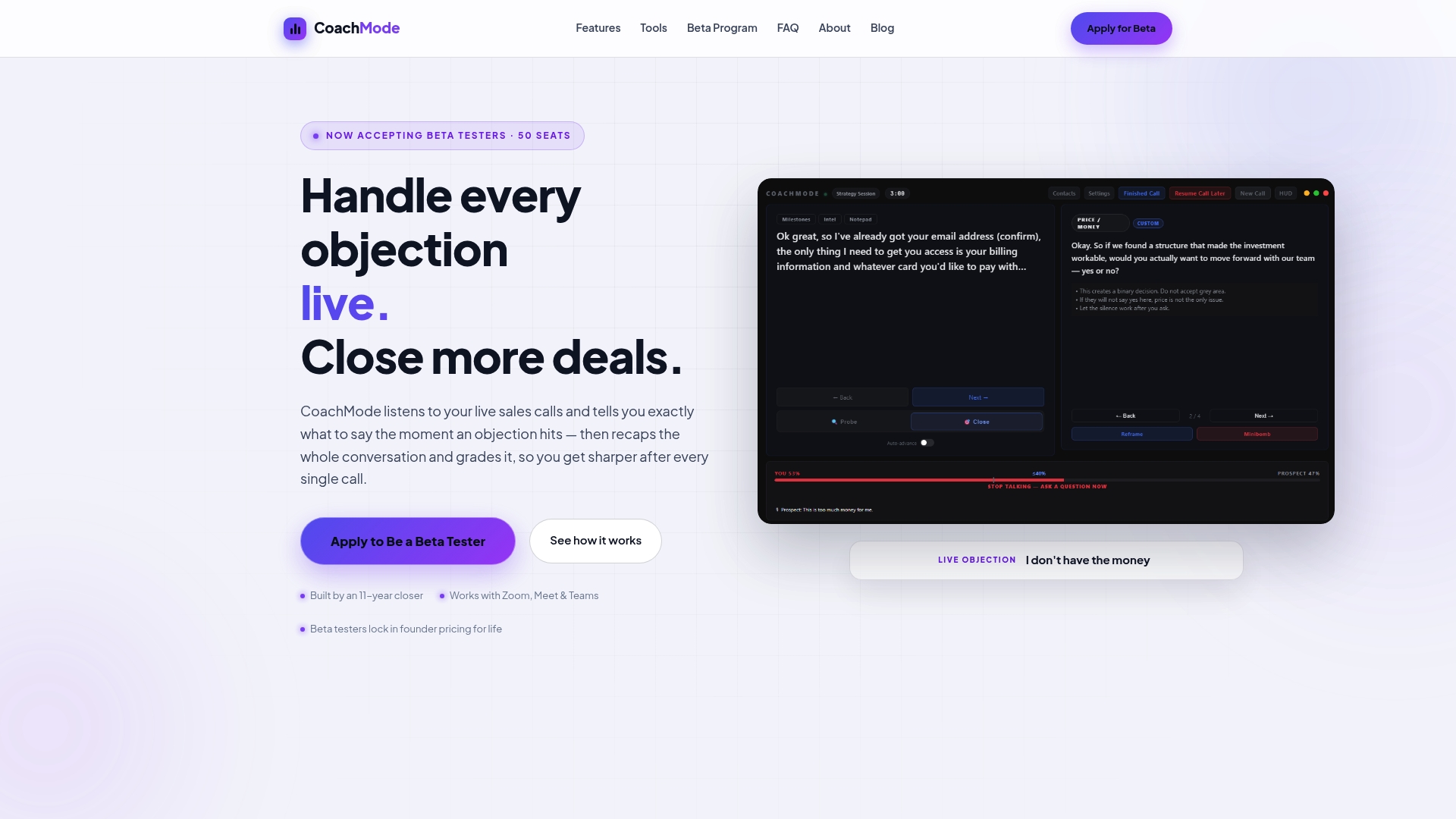
CoachMode listens in on the live call and surfaces the right response the moment an objection surfaces, so the urgency you built by responding to a signal in 60 minutes doesn’t get wasted on a fumbled answer three minutes into the call. It’s built specifically for the moment between “the signal got them talking” and “the conversation actually moves the deal forward.”
- Real-time prompts that suggest what to say as objections come up, not after the call ends.
- Direct integration with Zoom, Google Meet, and Teams, so it runs inside the calls reps are already taking.
- Post-call scoring that shows exactly which moments helped or hurt, turning every signal-driven call into a coaching opportunity.
If your team is already chasing buying signals but losing deals once the call starts, that’s a coaching gap, not a signal problem. Check out CoachMode’s real-time coaching for live sales calls and see what a demo looks like for your team.
Frequently Asked Questions
What is the difference between a buying signal and a lead?
A lead is a person or account in your pipeline. A buying signal is an event, like a pricing page visit or a verbal comment on a call, that tells you a lead is closer to deciding right now.
How many buying signals justify outreach?
One strong, explicit signal, like a demo request, is enough on its own. Weaker implicit signals, like a job posting, usually need a second signal stacked with them before outreach makes sense.
What are the strongest verbal buying signal phrases to listen for?
Phrases about timeline (“when could we start”), budget (“what’s the cost for a team our size”), and implementation (“how would onboarding work”) are among the clearest verbal signals a rep will hear on a call.
Can AI tools detect buying signals automatically?
Yes. Intent-data platforms and web visitor identification tools flag digital signals automatically, and some coaching tools flag verbal signals during live calls in real time, which shortens the gap between signal and response.
How fast should a sales team respond to a real-time buying signal?
Sub-hour signals like a pricing page visit or demo request deserve a response within 60 minutes. Same-day signals, like a job change into a buying role, can wait a few hours. Next-day signals, like funding news, are fine within 24 hours.
Sources
- Buying signals: Definition + 15 examples | Clearbit
- Buying signals | ZoomInfo
- What Are Buying Signals? The Complete 2026 B2B Guide | Reachly
- 13 Buying Signals & How Strong They Are | Cognism
- Buying Signals: 15 Purchase Intent Examples | Signado