Tighten qualification, fix discovery, and enforce a structured closing sequence, and most sales teams can raise their close rate by 10 to 25 percent within 30 days. That’s the ceiling most reps hit without touching pricing or headcount. The three levers that move fastest are ruthless lead qualification, discovery that actually uncovers buying criteria, and a closing sequence reps run the same way every time.
Do these five things starting today:
- Write down your qualification criteria and reject any deal that doesn’t meet them.
- Set a discovery minimum: no pitching before 40 percent of call time is spent asking questions.
- Standardize a three-step close (summary, trial close, direct ask) and drill it weekly.
- Route every booked call through a scheduling tool tied to your CRM to cut no-shows.
- Score last week’s five calls against a simple rubric before your next 1:1.
Pro Tip: Pull your last 20 closed-lost deals and tag the exact moment discovery broke down. You’ll usually find the same gap repeats in 60 percent or more of them.
Expect small wins in week one (fewer wasted calls), a measurable close rate shift by day 30, and compounding gains by day 90 as coaching habits stick.
Key Takeaways
Raising close rate consistently comes down to fixing qualification and discovery before optimizing closing language, then reinforcing both with weekly coaching and real-time support on live calls.
| Point | Details |
|---|---|
| Fix qualification first | Document criteria and reject bad-fit leads before touching your close script. |
| Enforce discovery time | Reps should spend 40 to 60 percent of first calls asking questions, not pitching. |
| Standardize the close | Use a summary close, trial close, then direct ask, in that order, every time. |
| Measure leading indicators | Track discovery completion and next-step commitment weekly, not just close rate. |
| Add real-time coaching | CoachMode delivers live objection prompts and post-call grading to reinforce training. |
Table of Contents
- Increase Close Rate This Week: A Quick-Action Checklist
- How Do You Calculate and Benchmark Close Rate?
- What Sales Tactics Actually Move the Needle?
- Which Training Drills Actually Improve Closing Skills?
- What Tools Reduce Friction and Support These Tactics?
- What Should a 30-Day Close Rate Test Plan Look Like?
- Where Should a Sales Manager Start First?
- How CoachMode Helps You Close More Deals Live
- Frequently Asked Questions
- Sources
Increase Close Rate This Week: A Quick-Action Checklist
You don’t need a quarter to see movement. You need one focused week and a manager willing to enforce new rules.
- Rewrite your qualification checklist (Day 1, sales manager, 30 minutes). Define budget, authority, need, and timeline thresholds that disqualify a lead automatically. Expect fewer opportunities in the pipeline but a higher percentage closing.
- Set a discovery time floor (Day 2, reps, ongoing). Reps should spend roughly 40 to 60 percent of a first call asking questions before pitching anything, a pattern top performers already follow according to Grade My Close’s closing framework.
- Standardize the close sequence (Day 3, sales manager, 1 hour to document). Train every rep on a summary close followed by a trial close, then a direct ask if the trial close lands. HubSpot’s research on closing techniques shows these phrases only work once discovery and qualification are solid.
- Add a scheduling link to every follow-up email (Day 4, reps, 5 minutes each). Removing the back-and-forth of finding a time is one of the simplest friction cuts available.
- Audit one call per rep against a scorecard (Day 5, sales manager, 20 minutes per call). Grade discovery completion and objection handling, not just outcome.
Pro Tip: Replace “Does that make sense?” with “What questions do you still have before we move forward?” The first invites a polite yes. The second surfaces the objection you need to handle right now.
How Do You Calculate and Benchmark Close Rate?
Close rate equals closed deals divided by qualified opportunities, multiplied by 100. If you closed 12 deals out of 60 qualified opportunities last quarter, your close rate is 20 percent. The formula only means something once you agree on what counts as “qualified” and enforce that definition consistently across the team, a point Alex Berman’s close rate guide makes clearly.
Track these columns for every deal to make the number actionable:
- Rep name and tenure
- Lead source and channel (inbound, outbound, referral)
- Deal size or contract value
- Qualification stage passed
- Call outcome and next step committed
Segment by motion before you compare numbers. An enterprise team closing 15 percent of qualified opportunities may be outperforming an SMB team closing 35 percent, because deal complexity and sales cycle length differ enormously. Compare rep to rep, channel to channel, and cohort to cohort, never against a single blended average.
Close rate benchmarks vary widely by industry and deal complexity. There’s no universal “good” number. What matters is whether your rate is trending up against your own historical baseline once you’ve segmented it correctly, a discipline Alex Berman’s guide to close rate treats as a prerequisite for setting any improvement goal.
What Sales Tactics Actually Move the Needle?
Most close rate advice is generic. These six categories have real mechanics behind them.
Qualification and lead scoring. Passing only your most engaged, best-fit leads from marketing to sales cuts wasted calls and raises the percentage of opportunities that convert, a strategy detailed in Calendly’s sales conversion research. A team that tightened its ICP and added lead scoring typically sees fewer low-fit opportunities enter the pipeline within a month, which alone can lift close rate without changing anything else.

Discovery depth. Reps who spend more time asking structured questions before pitching close at materially higher rates than reps who rush to demo, according to Grade My Close’s framework. A tighter sales question sequence surfaces the actual buying criteria instead of assumed ones.
Closing sequences. An assumptive close, followed by a trial close, followed by a direct ask, gives reps a repeatable path instead of guessing when to close. This only works once discovery is genuinely complete, per HubSpot’s closing technique research.
Value bridging on price objections. Reframing cost against the cost of inaction, not against a competitor’s price, tends to resolve price pushback faster. Framing this around what the buyer loses by waiting, rather than manufactured scarcity, keeps it honest, as covered in loss aversion framing for sales.
Social proof timing. Drop industry-specific proof points during discovery to build early credibility, again right after an objection to resolve doubt, and once more before the close to validate the decision. Grade My Close’s research found the timing matters as much as the proof itself.
Authentic urgency. Real deadlines (end-of-quarter pricing, limited onboarding slots) work. Manufactured scarcity backfires the moment a prospect senses it’s fake.
The reps who close more aren’t the ones with better pitches. They’re the ones who ask better questions and know exactly what to say when the room goes quiet.
Pro Tip: Run one A/B test per tactic, not five at once. Test the value-bridge language on price objections for 30 days against your current script, and measure only the objection-to-close ratio, not overall close rate, so you isolate the variable.
The biggest pitfall: urgency without a real reason. If a prospect asks “what happens if I wait?” and your rep doesn’t have a truthful answer, drop the scarcity language entirely.
Which Training Drills Actually Improve Closing Skills?
Reading about objection handling doesn’t build the skill. Rehearsing it does.
- Discovery role-plays. Pair reps up weekly and have one play a skeptical buyer who won’t volunteer information easily.
- Thirty-second objection drills. Call out a common objection (“it’s too expensive,” “not sure this is the right time”) and have the rep respond in real time, no notes.
- Silence technique rehearsals. After a trial close question, practice sitting silently for a full five seconds. Most reps fill the gap and accidentally invite a new objection instead of letting the buyer answer.
- Summary-close practice. Have reps recap the buyer’s stated pain points and desired outcomes before asking for the sale, then critique whether the summary was accurate.
Grade what actually predicts outcomes: discovery completion rate, talk-to-listen ratio, and objection handling quality, not just whether the deal closed. CoachMode’s sales call scorecard gives managers a consistent rubric for this.
Run a 30-minute coaching session weekly: review two recorded calls, score them against the rubric, and drill the single weakest skill live. Adding light gamification, points for completed drills or a leaderboard for objection handling scores, tends to increase participation in coaching routines.

Pro Tip: Score talk-to-listen ratio on every recorded call for two weeks before you touch anything else. Reps are consistently surprised by how much they talk during discovery.
What Tools Reduce Friction and Support These Tactics?
Five tool categories matter here: CRM, scheduling, real-time coaching, call recording, and proposal or e-signature tools. Each removes a different kind of drag on the sales process.
A CRM like Salesforce or HubSpot centralizes lead scoring and qualification data so reps aren’t guessing which opportunities deserve time. Calendly removes the scheduling back-and-forth that stalls momentum between a qualified call and the next step, an integration Calendly’s own conversion research ties directly to reduced funnel drop-off. CoachMode sits inside the live call itself, listening in real time on Zoom, Google Meet, or Teams, and surfacing objection responses and next-step prompts the moment a rep needs them, then grading the call afterward on talk ratio and discovery completion.
| Tool Category | Example | What It Solves |
|---|---|---|
| CRM | Salesforce, HubSpot | Lead scoring, pipeline visibility, qualification tracking |
| Scheduling | Calendly | Removes booking friction, syncs to CRM automatically |
| Real-time coaching | CoachMode | Live objection prompts and post-call scorecards |
| Call recording | (various) | Captures calls for coaching review and rubric scoring |
A typical stack: Calendly captures the booked call and pushes lead data into Salesforce or HubSpot, CoachMode listens live and grades the call, and the manager reviews the scorecard in the weekly coaching session. Buyer interest in tools built specifically for call acceleration shows up clearly in the review volume on platforms like G2’s coaching software category, where demand for this kind of tooling keeps climbing.
What Should a 30-Day Close Rate Test Plan Look Like?
Run this as a controlled test, not a permanent policy change, so you can measure lift before committing budget.
- Week 1: Baseline and qualification reset. Manager documents current close rate by rep and channel, then rolls out tightened qualification criteria.
- Week 2: Discovery enforcement. Reps hit the 40 percent discovery-time floor; manager scores three calls per rep.
- Week 3: Closing sequence and coaching drills. Roll out the standardized close; run weekly role-play sessions.
- Week 4: Measure and decide. Compare close rate, discovery completion, and next-step commitment against baseline.
| Week | Leading Metric | Lagging Metric |
|---|---|---|
| 1 | Qualification pass rate | Pipeline volume |
| 2 | Discovery completion rate | Objection resolution rate |
| 3 | Next-step commitment rate | Trial close success rate |
| 4 | Talk-to-listen ratio | Close rate vs. baseline |
If close rate improves by even a few percentage points against your own baseline by day 30, that’s a strong signal to fund the coaching program and tooling stack for the full quarter, a leading-indicator approach Grade My Close recommends over waiting on lagging close rate alone.
Where Should a Sales Manager Start First?
If I had to pick one lever, I’d fix qualification before touching a single script. Bad-fit leads waste discovery time and make every closing technique look worse than it is. Fixing that first is a quick win. Rebuilding a team’s discovery habits and coaching rhythm takes longer and requires real repetition, not a single training day.
How CoachMode Helps You Close More Deals Live
Everything above works better with support in the moment it matters most: mid call, when the prospect just raised a real objection. CoachMode listens in real time on Zoom, Google Meet, and Teams, and surfaces the exact objection response or next-step prompt a rep needs without breaking the flow of the conversation.
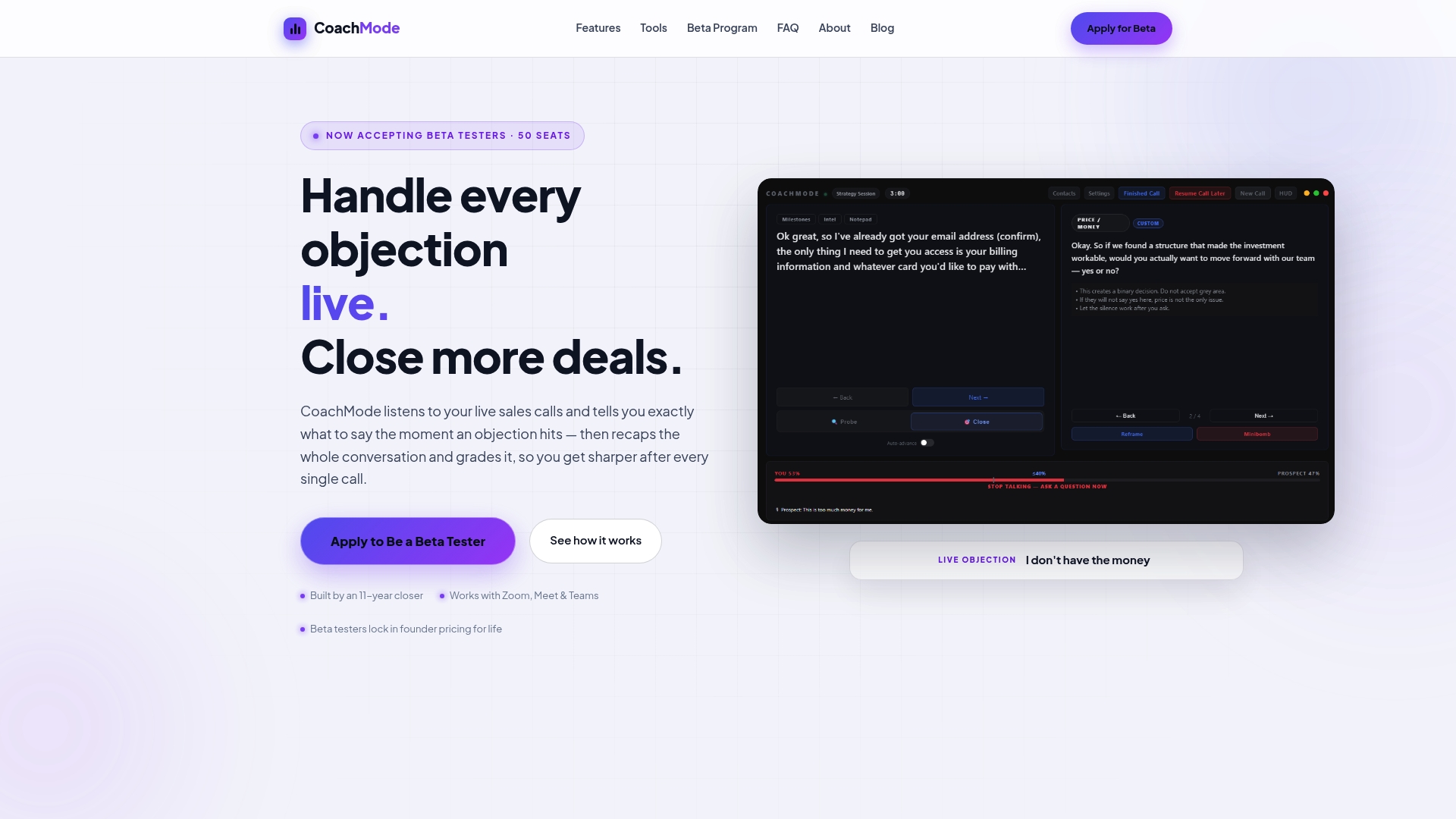
Every call gets graded afterward on talk ratio, discovery completion, and objection handling, turning the training drills above into measurable, repeatable coaching rather than guesswork. Teams testing this typically run a small pilot first: pick five reps, measure close rate and discovery completion for 30 days against a control group, and compare the lift.
If you’re running the 30-day test plan above, adding real-time coaching to weeks 2 through 4 is the fastest way to see whether live guidance moves the number more than training alone. Start a pilot with CoachMode’s AI sales coach and measure it against your current baseline.
Frequently Asked Questions
What is a good close rate for sales? It depends heavily on your motion. Enterprise deals with long cycles often close at lower percentages than transactional SMB sales, so compare your rate against your own segmented history rather than a single industry number.
How do I increase my closing ratio quickly? Tighten qualification criteria, enforce a discovery time floor, and standardize a closing sequence. Most teams see measurable movement within 30 days when they apply all three together rather than one at a time.
What’s the fastest way to improve sales effectiveness without more leads? Fix discovery. Reps who spend more time asking structured questions close at higher rates using the same pipeline they already have, according to Grade My Close’s research.
Does real-time coaching actually improve close rates? Live coaching that surfaces objection responses during the call, rather than after it, helps reps stay composed and handle pushback without losing momentum, which is the core mechanic behind tools like CoachMode.
Sources
- How to Improve Sales Conversion Rate (Calendly)
- Improve Closing Rates With These Sales Training Exercises (HubSpot)
- How to Improve Close Rate by 2x (Real Framework)
- Close Rate: What It Is & How to Improve It