If you handle objections for a living, you need five frameworks in your back pocket: LAER, CRAC, Feel-Felt-Found, Boomerang, and empathetic reframing. Start with LAER as your default for almost every objection, then swap in CRAC specifically for price pushback and Feel-Felt-Found for anything emotional or change-averse.
Here’s the one-line pattern to use on your very next call: acknowledge the concern in the prospect’s own words, ask one clarifying question, then respond to what they actually meant, not what they said. That’s LAER compressed into a single breath.
Before your next call, do this: roleplay LAER three times with a colleague, using a real objection from last week’s calls. Pitchbase recommends LAER as the default framework and reports it’s been tested across thousands of B2B sales calls, with reps layering in a second framework once they’ve internalized the first.
- LAER (default, use on almost anything)
- CRAC (price and budget pushback)
- Feel-Felt-Found (emotional resistance, change aversion)
- Boomerang (when the objection secretly contains the buying logic)
- Empathetic reframing (defusing tension fast)
Key Takeaways
Objection handling improves fastest when reps master one core framework, LAER, before layering CRAC, Feel-Felt-Found, Boomerang, and empathetic reframing for specific objection types.
| Point | Details |
|---|---|
| Start with LAER | Listen, Acknowledge, Explore, Respond prevents reps from answering before they understand the real objection. |
| Match framework to category | Use CRAC for price, Feel-Felt-Found for trust issues, Boomerang for competitive comparisons. |
| Practice in short, frequent drills | Weekly 15-minute roleplays beat rare, long training sessions for retention. |
| Track coachable metrics | Monitor pause time, talk-to-listen ratio, clarifying questions, and confirmation rate. |
| Consider real-time support | Getcoachmode surfaces frameworks and scripts live on calls and scores performance afterward. |
Table of Contents
- Why Prospects Object: The Psychology Behind the Pushback
- The Common B2B Objection Categories (and How to Spot Them Fast)
- Five Proven Frameworks: Step-by-Step and Micro-Scripts
- Word-for-Word Scripts for the Ten Toughest B2B Objections
- How to Practice: Roleplays, Battlecards, and Coachable Metrics
- How to Build an Objection-Handling Playbook for Your Team
- When an Objection Becomes a Real ‘No’
- How Real-Time Coaching Fits Into Objection Handling
- Sources
Why Prospects Object: The Psychology Behind the Pushback
Most objections aren’t about your product. They’re about risk. A prospect who says “I need to think about it” is usually running a mental cost-benefit analysis where the fear of a bad decision outweighs the appeal of a good one. Behavioral researchers call this loss aversion: people feel the pain of a potential loss roughly twice as hard as the pleasure of an equivalent gain, and in B2B sales, “loss” often means looking foolish in front of a boss.
Five psychological roots show up again and again in B2B deals:
- Risk aversion — the buyer fears an irreversible mistake more than they want the upside.
- Loss aversion — switching costs and sunk costs from a prior tool loom larger than they should.
- Social proof gaps — no one they trust has vouched for you yet.
- Priority conflict — your solution is real, but it’s competing with three other fires.
- Budget framing — the cost is measured against the wrong baseline (this quarter’s spend, not this year’s return).
Here’s how to tell a sincere objection from a stall: sincere objections come with specifics (“our fiscal year closes in March, and nothing new gets approved until Q2”). Excuses stay vague (“we’re just not ready right now”). When you hear vagueness, ask a clarifying question before you respond. This lines up with SPIN Selling’s core insight that structured questioning surfaces the real decision criteria hiding behind a polite brush-off, and it’s why Gong’s research on high-performing calls found that mirroring and clarifying questions increase how much a buyer elaborates, which is exactly the information you need to respond well.
The Common B2B Objection Categories (and How to Spot Them Fast)
Every objection you’ll hear in a B2B cycle falls into one of six buckets. Recognizing which bucket you’re in, fast, determines which framework you reach for.
- Price/budget — “This is more than we budgeted” or “I need to check with finance.” Reach for CRAC; the fix is almost always clarification, not a discount.
- Timing/urgency — “Let’s revisit this next quarter.” Often sincere, sometimes a soft no. Use LAER to explore what’s actually driving the delay.
- Need/relevance — “I’m not sure this solves our problem.” This is a discovery gap. Go back to LAER’s explore step before you respond at all.
- Authority/decision process — “I’ll need to loop in my team.” Not an objection to your product; it’s a process objection. Ask who else needs to weigh in and what they’ll ask.
- Competition/alternatives — “We’re already evaluating [competitor].” Boomerang works well here because comparison shopping usually reveals what the prospect actually values.
- Trust/credibility — “We’ve been burned before.” Feel-Felt-Found is built for exactly this.
Quota Training’s research backs up the category-to-framework mapping directly: different objection types call for different structures, and reps who try to force one framework onto every objection lose ground compared to those who match the tool to the trigger.
Five Proven Frameworks: Step-by-Step and Micro-Scripts
Here’s the mechanics of each framework, in the order you’re likely to reach for them.
-
LAER: Listen, Acknowledge, Explore, Respond. This is your default because it forces you to understand before you react. Listen means staying quiet past the point of discomfort. Acknowledge means reflecting the objection back without agreeing or arguing: “So budget approval is the sticking point right now.” Explore means one genuine question: “What would need to be true for budget to not be the blocker?” Respond comes last, and only after you know what you’re actually responding to.
-
CRAC: Clarify, Restate, Argue, Confirm. Built for price and budget objections. Clarify what “too expensive” actually means (compared to what? over what timeframe?). Restate it back so the prospect knows you heard them. Argue your case with a specific, relevant proof point, not a generic pitch. Confirm the objection is resolved before moving on. Example: “When you say it’s too expensive, is that against the budget you had allocated, or against the value you’re expecting to see?” That single clarifying question often does more work than any discount.
-
Feel-Felt-Found. The classic empathy-plus-social-proof structure: “I understand how you feel. Other clients in [industry] felt the same way before they switched. What they found was [specific outcome].” It’s dated if delivered word-for-word, but the underlying structure, feeling validated followed by peer evidence, still works especially well on change-averse or previously burned buyers. Use it sparingly; overuse makes it sound scripted.
-
Boomerang. This flips the objection so it becomes the reason to buy. If a prospect says “we don’t have time to implement new software right now,” you boomerang with: “That’s actually the exact reason most of our customers signed on, they didn’t have bandwidth for a six-month rollout, so we built onboarding to take two weeks.” The risk: boomeranging too aggressively can feel like you’re dismissing their concern rather than addressing it, so pair it with a genuine acknowledgment first.
-
Empathetic reframing. When a conversation gets tense or defensive, this resets the tone fast. Instead of debating the objection head-on, reframe what’s being discussed: “It sounds like the real question isn’t whether this works, it’s whether your team will actually adopt it. Is that fair?” Use it the moment you sense a prospect getting defensive or repeating themselves, since that’s usually a signal the conversation has stalled on the wrong point.
Pro Tip: Don’t try to master all five frameworks in one week. Nail LAER first until it’s reflexive, then add CRAC for your next price-heavy call. Layering frameworks one at a time, as Pitchbase’s own guidance suggests, builds real instinct instead of a mental checklist you fumble through live.
Word-for-Word Scripts for the Ten Toughest B2B Objections
Copy these, adapt the specifics to your product, and practice them out loud before you need them live.
-
“It’s too expensive.” Say: “Compared to what you’re spending on the problem today, or the budget line you had in mind?” Follow up: “What would this need to deliver for the price to feel fair?” Framework: CRAC. Personalization: swap in an ROI figure specific to their industry.
-
“We don’t have time to implement this right now.” Say: “That’s exactly why most of our clients started when things were busiest, they didn’t have room for a slow rollout either.” Follow up: “What would a low-effort onboarding need to look like?” Framework: Boomerang.
-
“I need to run this by my team.” Say: “Makes sense. Who else weighs in on a decision like this, and what will they want to know?” Follow up: “Would it help if I joined that conversation?” Framework: LAER (explore the real decision process).
-
“This isn’t a priority right now.” Say: “Understood. Can you help me understand what is the priority, so I know if this is worth revisiting in a month or a quarter?” Follow up: “What would need to change for this to move up the list?” Framework: LAER.
-
“We’re already looking at [a competitor].” Say: “Good, that means you’ve already done some of the homework. What’s standing out to you so far?” Follow up: “What’s the one thing that would make this an easy decision either way?” Framework: Boomerang.
-
“We had a bad experience with a similar tool before.” Say: “I hear that a lot, and it’s a fair concern. A few of our current clients felt the exact same way after a rough prior experience. What they found different this time was [specific proof point].” Follow up: “What went wrong last time, specifically?” Framework: Feel-Felt-Found.
-
“I’m not sure this will actually deliver ROI.” Say: “Fair. What would you need to see in the first 90 days to feel confident this was working?” Follow up: “Is there a metric your team already tracks that we could tie this to?” Framework: LAER.
-
“I’m worried about integration with our current stack.” Say: “That’s a legitimate concern. Can you walk me through what you’re running now?” Follow up: “Would it help to loop in your technical lead before we go further?” Framework: LAER.
-
“We don’t have the headcount to manage a new tool.” Say: “That’s actually the constraint we built around, most teams adopting this have zero extra headcount.” Follow up: “What does the current process take up in hours per week?” Framework: Boomerang.
-
“Legal and compliance will need to review this.” Say: “Absolutely, that’s normal for a decision like this. What’s their typical turnaround, and is there anything I can send ahead to speed that up?” Follow up: “Have they reviewed similar tools before?” Framework: LAER.
How to Practice: Roleplays, Battlecards, and Coachable Metrics
Frameworks stay theoretical until you say them out loud under mild pressure. Here’s a practice routine that works:
- Weekly 15-minute roleplay pairs. One rep plays the prospect using a real objection pulled from last week’s calls, the other practices LAER or CRAC live. Swap roles after five minutes.
- Timed drills. Give the “rep” three seconds of silence before responding, forcing the acknowledge and explore steps instead of an instant reflex answer.
- Record and review. Play back one call per week as a team and score it against the rubric below.
A basic battlecard needs five fields: the objection itself, the likely root cause, the recommended framework, one proof point, and a ready script. Keep it to one page per objection category; a battlecard nobody can scan in ten seconds during a live call won’t get used.
Track these coachable metrics:
- Pause time before responding to an objection (longer, within reason, usually beats instant)
- Talk-to-listen ratio during the objection-handling portion of the call
- Number of clarifying questions asked before a response
- Confirmation rate, meaning how often the rep confirmed the objection was actually resolved before moving on
Highspot’s playbook research points to these same behavioral signals, talk-to-listen ratio and clarifying-question frequency in particular, as the clearest predictors of which reps convert objections into next steps. And because retention of scripted language fades fast, spaced repetition research backs up what most sales managers already suspect: short, frequent drills beat one long training session every time.
How to Build an Objection-Handling Playbook for Your Team
A playbook isn’t a document you write once. It’s a process you run continuously.
- Collect systematically. Have reps tag every objection they hear, in a shared sheet or CRM field, right after the call while it’s fresh. Don’t rely on memory at the end of the week.
- Prioritize by frequency and deal impact. The objection that kills the most deals gets a battlecard first, not the one that’s most annoying to hear.
- Convert to battlecards. Use the five-field template from the practice section above for each high-priority objection.
- Set a cadence. Run short roleplay drills weekly, review battlecard performance monthly, and refresh the entire playbook quarterly as your market and competitors shift.
- Validate what you build. A/B test two different phrasings of the same response across similar deals, sample actual call recordings, and track whether confirmation rate and pipeline velocity actually move.
Salesforce’s guidance on discovery-first objection handling reinforces why this has to start with real call data rather than a manager’s best guess: the objections that show up in actual conversations rarely match what a sales team assumes reps are hearing. Teams that treat objections as signals about buying criteria, not shutdowns, tend to build better battlecards because they’re working from evidence instead of intuition.
When an Objection Becomes a Real ‘No’
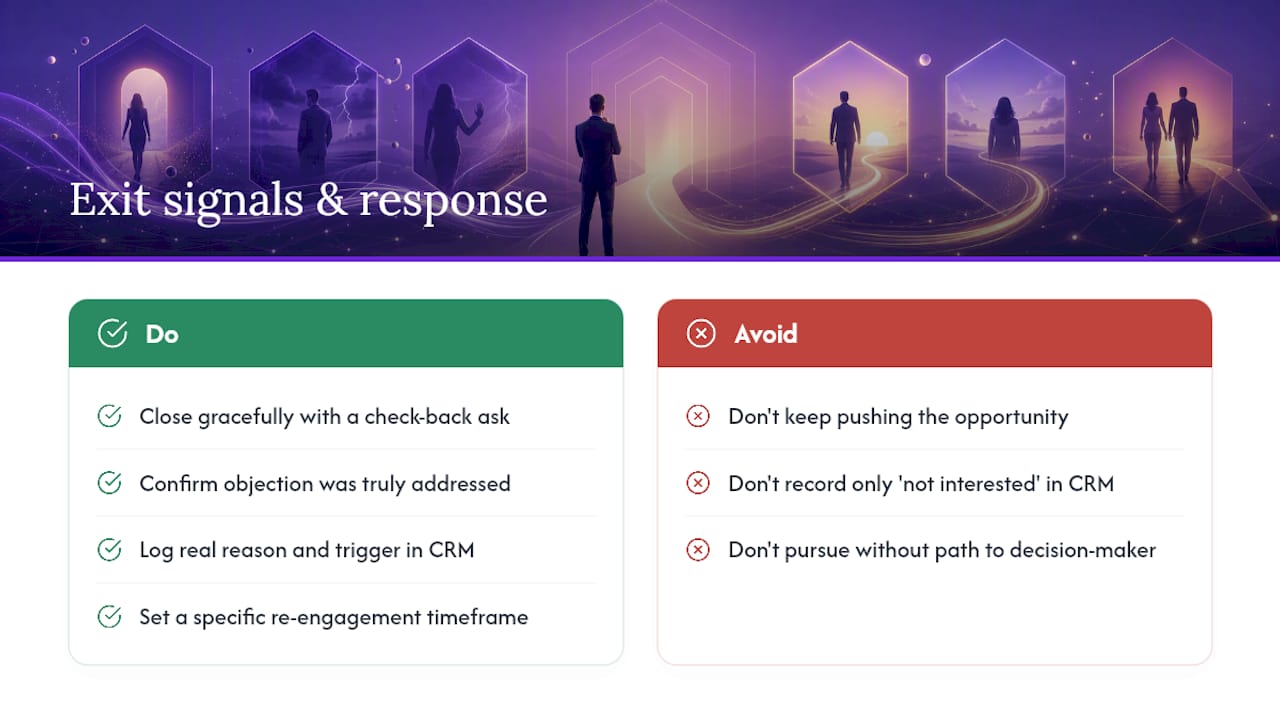
Not every objection deserves another round of reframing. Watch for these exit signals: no defined budget timeline even after two follow-ups, no identifiable path to a decision-maker, or an explicit refusal after you’ve already confirmed the real objection was addressed.
When you hit one, close gracefully: “It sounds like the timing genuinely isn’t right, and I don’t want to keep pushing on something that isn’t a fit today. Would it make sense to check back in [specific timeframe]?” Log the actual reason and the re-engagement trigger in your CRM, not just “not interested,” so the next follow-up starts from something real instead of a cold restart.
How Real-Time Coaching Fits Into Objection Handling
Frameworks work when you can recall them under pressure, and that’s the hard part live. Real-time coaching tools now listen to a call in progress and surface the right framework or script the moment an objection lands, rather than leaving a rep to recall CRAC from memory while a prospect is mid-sentence.
Practical use cases include:
- Live prompts that suggest a clarifying question or a script line as the objection is spoken.
- Post-call scoring that grades pause time, talk-to-listen ratio, and confirmation rate automatically.
- Battlecard integration, so the proof point tied to a specific objection surfaces instantly instead of requiring a rep to remember which document it’s in.
If you’re piloting this with a team, keep it small: run it with five reps, define two or three success metrics up front (confirmation rate, close rate, time to resolve an objection), and give it four weeks before drawing conclusions. Teams that pair structured objection frameworks with live coaching tend to see faster adoption than teams relying on quarterly training alone, simply because the coaching shows up at the exact second it’s needed instead of a week later in a debrief.
A Recommended Starting Point
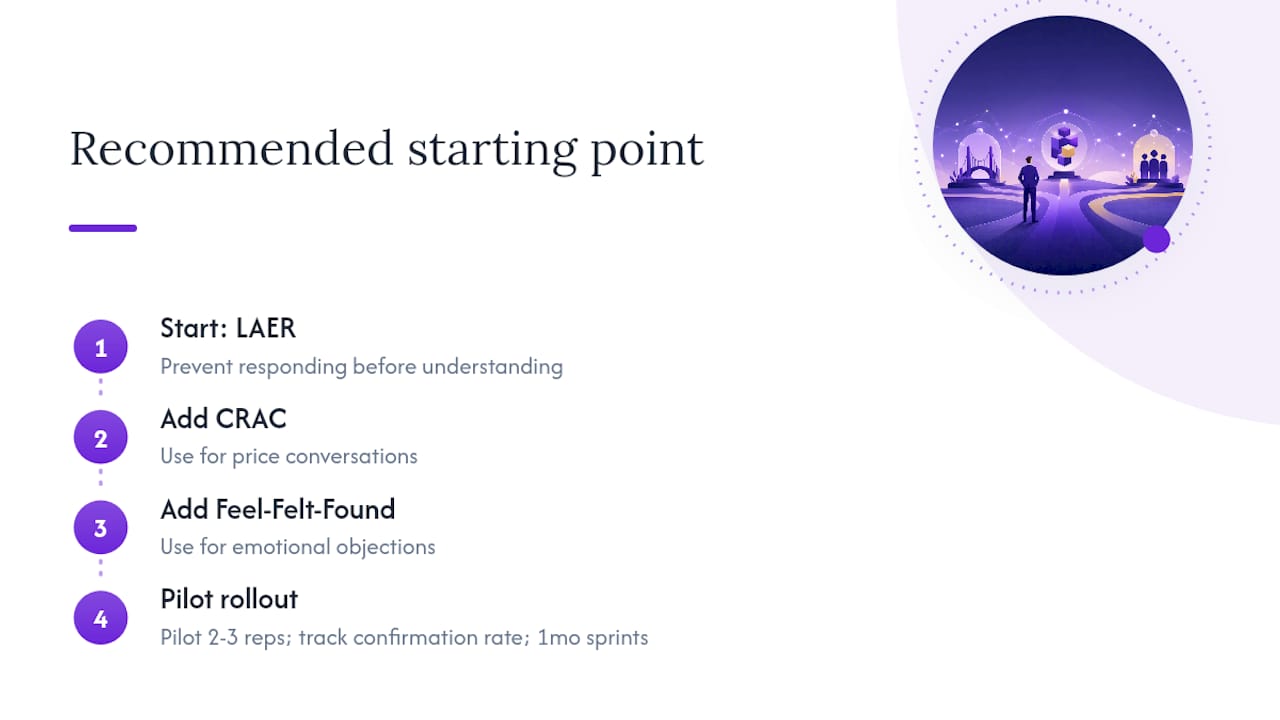
Start with LAER. It’s the framework that trains discipline, the discipline to stop responding before you understand what you’re responding to, and every other framework builds on that habit. Once LAER feels automatic, add CRAC for price conversations and Feel-Felt-Found for anything emotional. If you manage a team, don’t roll out all five frameworks at once: pick two or three pilot reps, define one metric you’ll actually track (confirmation rate is the easiest place to start), and run short roleplay sprints for a month before expanding further.
Real-Time Coaching That Puts the Right Words in Reach
Every framework in this article works better when a rep doesn’t have to recall it from memory mid-objection. Getcoachmode listens to your live sales calls and surfaces the exact framework, script, or clarifying question the moment a prospect pushes back, so reps stay in the conversation instead of scrambling for the right words. It also grades every call afterward on pause time, talk-to-listen ratio, and confirmation rate, turning the coachable metrics from this article into an automatic scorecard instead of a manual review process.
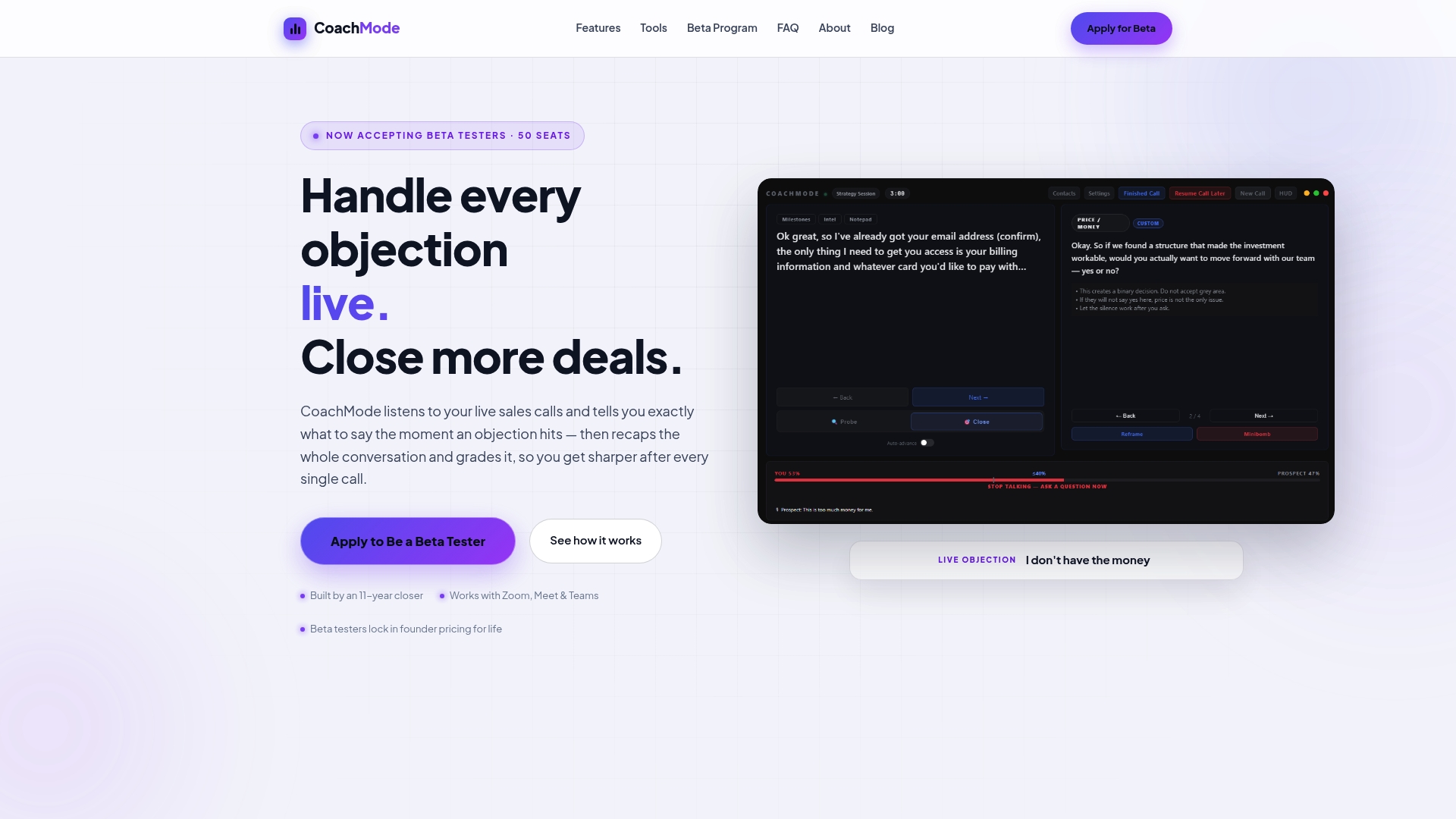
If you’re a sales manager weighing whether this fits your team, run a small, time-boxed pilot: pick five reps, define two success metrics (confirmation rate and close rate are a solid start), and give it four weeks. Start your pilot with AI sales coaching for live calls and see whether real-time support moves the numbers before you commit further.
Sources
- Objection Handling: 5 Frameworks + 10 Scripts | Pitchbase
- Objection Handling Frameworks: 5 Models Every Rep Needs — QUOTA Training
- 7 Winning Steps for Effective Objection Handling | Salesforce
- The Objection-Handling Playbook for B2B Sales Reps