Use this three-part checklist—before, during, and after—to run every sales call that closes. Before the call, timebox your prep to the meeting’s stakes. During the call, open with a clear reason for calling and hold your talk-to-listen ratio near 40/60. After the call, update your CRM and send a follow-up within hours, not days.
Before the call:
- Spend 5 to 15 minutes on account research, one must-learn insight, and your next-step ask.
- Scan CRM history for past touches, open tickets, or prior objections.
- Confirm attendees and map who else influences the decision.
During the call:
- Open with a 30 to 60 second reason for calling plus a quick agenda.
- Keep talking under 40% of total call time; let the prospect fill the rest.
After the call:
- Update five key CRM fields the same day.
- Send a follow-up email within a few hours while details are fresh.
- Lock a calendared next step before you hang up.
Full templates, scripts, and timeboxed variants follow below.
Key Takeaways
A timeboxed pre-call routine, a scripted opening, prioritized discovery questions, and same-day CRM follow-up together determine whether a sales call converts into a next step.
| Point | Details |
|---|---|
| Timebox your prep | Match 2, 5, 15, or 30 minutes of prep to the call’s stakes instead of prepping every call the same way. |
| Open with a clear reason | State why you’re calling and confirm the time within the first 60 seconds. |
| Ask more discovery questions | Top performers ask 11 to 14 discovery questions per call versus 4 to 6 for average reps. |
| Lock the next step live | Propose a specific day and time before the call ends rather than promising a follow-up. |
| Update the CRM same day | Log deal stage, next step, objections, stakeholders, and your must-learn insight within hours. |
Table of Contents
- Sales Call Checklist: The Pre-Call Prep Timebox
- Opening the Call: Scripts, Agenda, and the First 60 Seconds
- Discovery Questions and Qualification Frameworks
- Handling Objections and Closing for the Next Step
- Demo and Closing Call Checklist
- Post-Call Actions: CRM Update and Same-Day Follow-Up
- Checklist Variants by Call Type
- Templates and Scripts You Can Paste Right Now
- Common Mistakes and Small Habits That Fix Them
- How Real-Time Coaching Turns This Checklist Into a Habit
- Tips for Effective Note-Taking During the Call
- Building Rapport and Trust Early in the Call
- Summarizing and Confirming Agreement Mid-Call
- Managing Silence and Pauses on the Call
- Handling Different Buyer Personas on the Call
- What This Checklist Gets Right (and Where Most Advice Falls Short)
- Frequently Asked Questions
- Sources
Sales Call Checklist: The Pre-Call Prep Timebox
Most reps don’t fail on the call. They fail before it starts. Salesforce data cited in Sendspark’s pre-call research shows 62% of B2B reps spend under 10 minutes preparing, and Forrester found a significant portion of buyers say sellers can’t demonstrate real knowledge of their business. That gap is exactly where deals go to die.
The fix isn’t more prep. It’s the right prep, scaled to the call. A 2/5/15/30 minute timebox framework matches effort to stakes instead of treating every call like a final exam.
- 2 minutes (quick dial or rescheduled call): Confirm name, title, company, and the reason for the last touch.
- 5 minutes (warm inbound or referral): Add one LinkedIn scan for recent job changes or posts, plus a check of your CRM notes.
- 15 minutes (standard discovery call, the default for most reps): Define your single must-learn insight, review CRM history in full, scan LinkedIn and Google News for trigger events, and map who else might be in the room.
- 30 minutes (enterprise or executive call): Everything above plus a stakeholder map, a list of likely objections, and a review of the account’s public initiatives or earnings statements.
Skip the fluff. You’re not writing a dossier, you’re answering one question: what’s the one thing you need to learn, and what will you ask for at the end? Working backward from that next-step ask, rather than gathering everything you can find, keeps prep fast and focused.
| Timebox | Core Tasks | Best For |
|---|---|---|
| 2 minutes | Confirm identity, reason for call | Quick dials, reschedules |
| 5 minutes | LinkedIn scan, CRM glance | Warm/inbound leads |
| 15 minutes | Full CRM review, trigger event check, stakeholder notes | Standard discovery calls |
| 30 minutes | Stakeholder map, objection list, public research | Enterprise/executive calls |
Two things get skipped constantly: trigger events and landmines. Trigger events (such as a funding round, a new VP, or a product launch) show up fast on LinkedIn or Google News, and referencing one naturally can lift your connection rate. Landmines are the opposite: topics to avoid, like a recent layoff or a failed initiative the prospect doesn’t want revisited. Spotting them ahead of time keeps you from stepping on a live wire mid call.
Opening the Call: Scripts, Agenda, and the First 60 Seconds
You have about a minute to earn permission to keep talking. Use it to state your name, your company, and the specific reason you’re calling, then confirm the time you’re asking for. Buyers who hear an explicit next-step proposal agree to it 82% of the time, according to RAIN Group data cited by Prospeo, and that same explicitness works at the top of the call, not just the end.
A simple agenda script does the heavy lifting: “The plan is I’ll ask a few questions about how you’re handling [specific process] today, share how we typically help teams like yours, and if it makes sense, we’ll figure out a next step. Sound fair?” That’s it. No pitch, no filler.
- Cold opener: “I noticed [specific trigger], and I’m curious how that’s changed your approach to [relevant area].”
- Warm opener: “Thanks for the time. Last time we spoke about [specific detail], so I wanted to follow up on that.”
- Referral opener: “[Referrer name] mentioned you’re dealing with [specific challenge], which is exactly what we help with.”
- Voicemail script: Name, company, one specific reason, a callback window, and nothing longer than 20 seconds.
Pro Tip: Reference the trigger event as a genuine observation, not a hook. Say what you noticed and why it made you think of them. If it sounds like a script, it reads as one.
Discovery Questions and Qualification Frameworks
Three questions determine whether the rest of the call matters: What’s the actual problem costing you money or time? Who else needs to agree before you can move forward? What happens if you do nothing? Everything else is detail.
Build your discovery bank in tiers so you’re not scrambling mid call:
- Must-ask (qualification): What’s driving the urgency now? What’s the budget range or approval process? Who signs off on a decision like this?
- Should-ask (context): What have you tried before, and why didn’t it stick? How is this problem measured today? What does success look like in six months?
- Nice-to-ask (depth): Who else on the team feels this pain? What’s the cost of waiting another quarter? How does this rank against other priorities this year?
Top-performing reps ask 11 to 14 discovery questions per call, compared to just 4 to 6 for average performers. Volume alone isn’t the goal, it’s how those answers map to a framework. If you’re running BANT, listen for budget, authority, need, and timeline as they come up naturally. If you’re running MEDDPICC, track metrics, economic buyer, and decision criteria as separate threads. Frameworks work best as listening filters, not scripts to read from.
Hold your talk time under 40% during discovery. Every answer deserves a follow-up before you move to the next question. “That’s helpful. Can you walk me through what that actually looks like day to day?” does more work than five prepared questions in a row. A well-sequenced discovery question flow gets buyers talking instead of answering in one-word fragments.

Handling Objections and Closing for the Next Step
Objections are predictable. Most reps just haven’t written down their answers in advance.
- “It’s too expensive.” Reframe around cost of inaction: “Compared to what the current problem is costing you monthly, how does this compare?”
- “We’re already using [competitor].” Ask what’s working and what isn’t, then position around the gap, not a feature list.
- “I need to check with my team.” Ask who specifically, then offer to join that conversation directly.
- “Not the right time.” Ask what would need to change for the timing to work, and calendar a check-in around that trigger.
- “Send me some information.” Agree, then ask a clarifying question that keeps the conversation live instead of ending it.
A short customer story or a specific data point beats a generic reassurance every time. “A team in a similar spot saw their cycle time drop by roughly a third within two months” lands harder than “our customers love this.”
Pro Tip: Never end a call with “I’ll follow up.” End it with a specific day, time, and reason: “Let’s grab 20 minutes Thursday at 2pm to walk through pricing options.” Vague endings produce vague pipelines.
The close isn’t the pitch, it’s the calendar invite. If you don’t lock the next step before hanging up, you’re relying on a follow-up email to do work the call should have already done.
Demo and Closing Call Checklist
Demo calls die from one thing more than any other: feature dumping. The fix is preparation the day before, not the morning of.
- Confirm attendees 24 hours ahead. Know titles, roles, and whether the decision maker is actually on the call.
- Tailor the demo to the specific pains uncovered in discovery. Skip anything that doesn’t map directly to what they told you.
- Prepare two or three proof points, a case example, a specific metric, or a relevant integration, tied to their exact use case.
- Decide your pricing posture in advance. Know whether you’re leading with pricing or holding it until value is established, and stick to that plan.
- Run a tech check. Test screen share, audio, and recording tools 15 minutes before the call starts.
- Confirm recording and note-taking tools are active so you’re not scrambling to capture details live.
Skipping step three is the most common mistake. A demo without tailored proof points feels like a product tour. A demo built around the prospect’s own words feels like a solution.
Post-Call Actions: CRM Update and Same-Day Follow-Up
The call isn’t done when you hang up. What you do in the next hour determines whether the deal moves or stalls.
Update five CRM fields immediately, before you take the next call: deal stage, next step with a date, key objections raised, stakeholder names and roles, and your must-learn insight from the call. Skipping this step is exactly how 67% of lost deals end up with prior engagement nobody reviewed, the same mistake repeating itself call after call.
Send your follow-up email the same day, ideally within a few hours. Subject lines that reference something specific from the call outperform generic ones: “Following up on [specific pain point]” beats “Great chatting today.” Include a one-line recap, the agreed next step, and any resource you promised.
The window is shorter than most reps think. Research on online sales leads shows response speed directly affects conversion, and the same urgency applies to post-call follow-up, not just first contact.
For ongoing deals, a 2-2-2 cadence works well: a touch 2 days after the call, another at 2 weeks, and a check-in at 2 months if the deal has gone quiet. Escalate to a manager-assisted touch if three attempts pass with no response. Measure follow-up effectiveness by response rate within 48 hours, not by how many emails you sent.
Checklist Variants by Call Type
Different calls need different prep depth. Here’s the compact version for each:
| Call Type | Prep Time | Core Focus |
|---|---|---|
| Cold call | 2 minutes | Confirm name, title, and one talking point |
| Warm/inbound | 5 minutes | LinkedIn scan, CRM notes, one trigger reference |
| Discovery call | 15 minutes | Full CRM review, discovery questions, stakeholder notes |
| Demo/executive | 30 minutes | Stakeholder map, tailored proof points, pricing posture |
The discovery call variant is your default. Most reps run more discovery calls than any other type, so build fluency there first and scale up or down as the call demands.
Templates and Scripts You Can Paste Right Now
Keep these where you can grab them fast, in your notes app, a pinned doc, or your CRM template folder.
Openers:
- Cold: “I noticed [trigger], and wanted to ask how that’s affecting [specific area].”
- Warm: “Following up on [prior conversation detail], curious where things stand.”
- Referral: “[Name] suggested we talk given [specific challenge].”
Follow-up email subject lines:
- “Recap: [specific pain point] and next steps”
- “Following up on [date]’s call”
- “Quick resource on [topic discussed]”
- “Confirming our [date] time”
- “One thing I forgot to mention”
Discovery questions mapped to MEDDPICC cover metrics (“How do you measure this today?”), economic buyer (“Who owns this budget decision?”), decision criteria (“What matters most in choosing a solution?”), and identified pain (“What’s this costing you if nothing changes?”), among others.
Objection replies: Price, competitor comparison, and “need to think about it” each deserve a rehearsed one-line reframe, not an improvised one. Grab additional free templates and checklists if you want a starting library instead of building from scratch.
Common Mistakes and Small Habits That Fix Them
The counter to all five is small routines, not more discipline. A five-minute vocal and mental warm-up before a heavy call block sharpens tone and pacing. A 60 to 90 second post-call reflection, three quick notes on what worked, what didn’t, and one thing to change, builds pattern recognition faster than any training session.
Pro Tip: Score every call against five items: objective met, talk-to-listen ratio, objection handling, stakeholder map completeness, and next-step clarity. Five minutes of scoring after each call compounds into real skill gains within a month.
How Real-Time Coaching Turns This Checklist Into a Habit
A checklist only works if you actually run it under pressure, and live calls don’t pause while you flip through notes. This is where real-time coaching earns its place in the routine, not as a replacement for prep, but as backup when the prep meets an objection you didn’t expect.
- Pre-call rehearsal: Run your discovery questions and anticipated objections through a coaching tool before the call to catch gaps.
- In-call cues: Live prompts surface a rebuttal or next-step reminder exactly when the conversation calls for it.
- Post-call scorecard: A structured call scorecard turns a felt sense of “that went fine” into specific data on talk ratio and objection handling.
Reps stall most often at the exact moment an objection lands and the script in their head goes blank. Coaching that listens live and feeds the right words back in that second changes what happens next, not because the rep suddenly knows more, but because the pressure to recall it alone is gone.
Getcoachmode’s live-call coaching works this way: it listens during the call, surfaces objection responses in the moment, and grades the call afterward so the same gap doesn’t repeat next week.
Tips for Effective Note-Taking During the Call
Note-taking during a live call is a balancing act. Write too much and you disappear into your screen. Write too little and you lose the details that matter for the follow-up email.
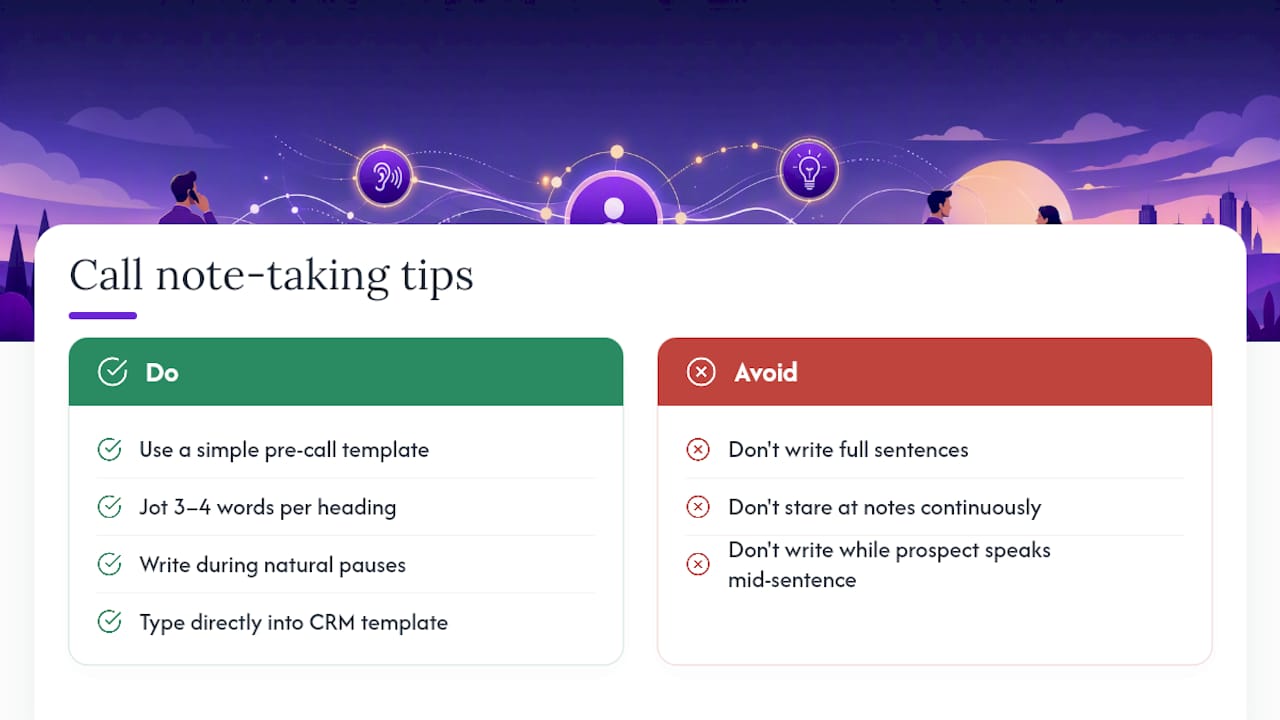
The fix is structured shorthand, not full sentences. Set up a simple template before the call starts: pain points, stakeholders mentioned, objections raised, and next-step commitments, each in its own quick section. When something comes up, jot three or four words under the right heading instead of trying to capture the full sentence.
Keep your eyes up more than they’re down. A trick that works well: write during natural pauses, like right after you ask a question and the prospect starts answering, rather than while they’re mid-sentence. That keeps your attention on tone and body language instead of buried in a notepad.
If you’re on video, glance at your notes app in short bursts rather than staring at it continuously. Prospects notice when a rep looks checked out, and it changes how open they are for the rest of the call.
Digital notes tied directly to your CRM save the most time later. Typing directly into a CRM template during the call means your five key fields, deal stage, next step, objections, stakeholders, and the must-learn insight, are already populated when you hang up. That’s the difference between a two-minute CRM update and a ten-minute one done from memory an hour later.
Building Rapport and Trust Early in the Call
Rapport isn’t small talk. It’s specificity. Generic warmth (“How’s your day going?”) reads as filler, while a specific reference (“I saw your team just closed that Series B, congrats”) signals you actually looked at who you’re talking to.
The fastest way to build trust in the first two minutes is matching energy and pace, not performing enthusiasm. If the prospect is direct and brief, mirror that instead of launching into a long-winded opener. If they’re chatty and relaxed, don’t rush past the small talk to get to your agenda.
Transparency works better than polish here. Saying “I’ll be direct, I want to understand if this is even a fit before I take more of your time” tends to land better than an over-rehearsed pitch, because it signals respect for their time rather than an agenda to push through regardless of fit.
Trust also compounds through follow-through on tiny promises. If you say “I’ll keep this to 20 minutes,” actually stop near the 20-minute mark. If you say you’ll send something after the call, send it that day. Prospects track these small signals more closely than reps assume, and a broken small promise early undoes rapport faster than any objection later in the call.
Summarizing and Confirming Agreement Mid-Call
Long discovery conversations drift. A prospect mentions five things across ten minutes, and without a checkpoint, both sides lose track of what actually got agreed on.
Build in a summary every few minutes rather than saving it all for the end. “So if I’m hearing this right, the biggest issue is [specific pain], it’s costing you roughly [impact], and the timeline pressure comes from [trigger]. Did I get that right?” This does two things at once: it confirms you understood correctly, and it gives the prospect a chance to correct or add detail you missed.
Confirming agreement works best as a direct question, not an assumption. “Does that match how you’d describe it?” invites a real answer. A rep who just nods along and moves forward risks building an entire pitch on a misread problem.
Save a fuller summary for the transition into next steps: “Here’s what I heard across our call today: [three key points]. Based on that, here’s what I’d recommend as a next step.” That structure makes the close feel like a natural conclusion to the conversation rather than a pivot into a sales pitch.
Managing Silence and Pauses on the Call
Silence makes most reps nervous, and that nervousness is exactly what causes bad decisions, like filling the gap with unnecessary detail or rephrasing a question the prospect was already about to answer.
After you ask a strong discovery question, let the pause sit. Prospects often need a few seconds to actually think through their answer, especially for questions about cost, priority, or internal politics. Jumping in early to “help” usually derails a more thoughtful answer that was on its way.
Video calls make silence feel longer than it is. A five-second pause can feel like thirty when you’re staring at a static face on screen. Count to five in your head before assuming the silence means confusion rather than thought.
If a pause does signal confusion, a soft check-in works better than repeating the question verbatim: “Take your time, or if it’s easier, I can rephrase that.” That gives the prospect an out without making them feel put on the spot. Silence on the prospect’s end after you’ve made your case is also often a buying signal, not a rejection. Resist the urge to talk through it.
Handling Different Buyer Personas on the Call
Not every prospect processes information the same way, and running one script across every personality type is a fast way to lose half the room.
Analytical buyers want data before they’ll engage emotionally. Lead with specifics, metrics, timelines, comparisons, and hold off on stories until they’ve validated the numbers. Rushing them toward a decision before they’ve processed the data usually backfires.
Relationship-driven buyers care more about trust and rapport than raw numbers. Spend more time in the opening minutes, ask about their team and priorities, and let the data support the relationship rather than lead it.
Skeptical or guarded buyers respond to direct acknowledgment of their skepticism. Naming it, “I get the sense you’ve been burned by a vendor promise before,” often lowers the guard faster than trying to talk around it.
Decisive, fast-moving buyers want the bottom line early. Lead with the outcome, keep the explanation tight, and don’t over-explain something they’ve already grasped. Matching their pace matters more than covering every talking point.
Reading which type you’re on the call with usually takes only the first few exchanges, tone, question style, and how they respond to your opener all signal it early.
What This Checklist Gets Right (and Where Most Advice Falls Short)
Most sales call advice treats preparation as a single fixed ritual: research the account, write questions, show up ready. That’s backward. The reps who consistently win aren’t the ones who prepare the most, they’re the ones who prepare the right amount for the specific call in front of them. A 30-minute research binge before a two-minute callback is wasted effort that should have gone into the next call instead.
The bigger blind spot in most training is what happens between calls. Reps get coached before the call and reviewed after it, but the moment that decides most deals, the live objection, the awkward pause, the buyer who suddenly goes quiet, happens with zero support. That gap is real, and it’s why scoring a call after the fact only gets you half the improvement curve.
If you take one thing from this guide, make it the reverse-order planning habit: define your must-learn insight and your next-step ask before you touch a CRM record. Everything else, the scripts, the frameworks, the timeboxes, exists to serve those two decisions.
Frequently Asked Questions
What should be on a pre-call checklist?
A solid pre-call checklist includes a review of CRM history, one clear must-learn insight for the call, a defined next-step ask, a quick stakeholder map, and a scan for recent trigger events on LinkedIn or Google News. Scale the depth to the call’s stakes using a 2/5/15/30-minute timebox.
How long should sales call preparation take?
It depends on the call type. A quick callback needs about 2 minutes, a warm inbound lead needs 5, a standard discovery call warrants 15, and an enterprise or executive call justifies up to 30 minutes of deeper research and stakeholder mapping.
What is a good talk-to-listen ratio on a sales call?
Keep your talking under 40% of total call time, especially during discovery. Letting the prospect talk more surfaces the details you need to qualify the deal and tailor your pitch later.
How soon should I follow up after a sales call?
Send a follow-up email the same day, ideally within a few hours while details are fresh for both sides. Faster follow-up correlates strongly with higher response and conversion rates.
What discovery questions should I ask on a sales call?
Prioritize questions that surface urgency, budget or approval process, and decision-making authority first. Follow with context questions about past attempts and how success gets measured, then deeper questions about team-wide impact if time allows.
How do I handle silence during a sales call?
Let it sit. A pause after a strong question usually means the prospect is thinking, not confused. If the silence clearly signals confusion, offer a soft rephrase rather than repeating the same question word for word.
Sources
This checklist draws on pre-call research from Sendspark’s B2B playbook, the timeboxed planning template from Prospeo, the before/during/after checklist framework, and the 40-item preparation system from Salesgear. For lead response urgency, see Harvard Business Review’s research on online sales leads.
- Sales call preparation: B2B pre-call playbook | Sendspark
- Pre Call Planning: 2-30 Minute Checklist + Template (2026)
- The short life of online sales leads | HBR