The best sales call openers ask permission or lead with value instead of pitching. Permission-based openers keep 71.4% of prospects on the line past the first 30 to 60 seconds, based on an analysis of 11,732 answered calls. Pitch-first openers, where reps launch straight into product benefits, retain fewer prospects by comparison. That gap alone should change how you open every call this week.
Here are opener styles worth testing today, each with a script you can adapt in under a minute:
- Permission opener: “Hey, this is [Name] from [Company]. I know I caught you cold. Got 20 seconds for me to explain why I called?”
- Value-first opener: “Hi [Name], we just helped a company like [similar company] cut onboarding time by a third. Wanted to see if that’s relevant to you.”
- Name-check opener: “[Name] from [Company] suggested I reach out. Do you have a quick minute?”
- Time-check opener: “This is a cold call, so I’ll keep it short. Is now a terrible time, or can I take 30 seconds?”
- Curiosity opener: “I’ll be honest, I’m not sure if this is even relevant to you. Mind if I ask one quick question to find out?”
Pitch-first openers (“We’re the leading provider of…”) underperform every style above because they ask for attention without earning it first. Save the pitch for after the prospect has agreed to listen.
Key Takeaways
Permission and value-first sales call openers outperform pitch-first approaches, and pairing the right style with a tight 20 to 30 second structure measurably improves continuation and meeting-booked rates.
| Point | Details |
|---|---|
| Lead with permission or value | These openers keep more prospects on the line past 30 to 60 seconds than pitch-first lines. |
| Keep openers to 20 to 30 seconds | Establish relevance, credibility, and tone fast, then invite a response. |
| Use the 3-3-3 rule for prep | Gather three company facts, three personal facts, three recent signals before dialing. |
| Track continuation rate weekly | It’s the clearest single signal of whether your opener style is working. |
| Pair scripts with live coaching | Tools like CoachMode surface phrasing and objection help during the call, then score performance after. |
Turn These Scripts Into Consistent Results With Live Coaching
Reading scripts is one thing. Delivering them under pressure, when a prospect goes quiet or throws an objection you didn’t rehearse, is where most reps lose the call. Getcoachmode listens in real time and surfaces the exact phrasing you need the moment a call goes sideways, so the opener you practiced on paper actually survives contact with a live prospect.
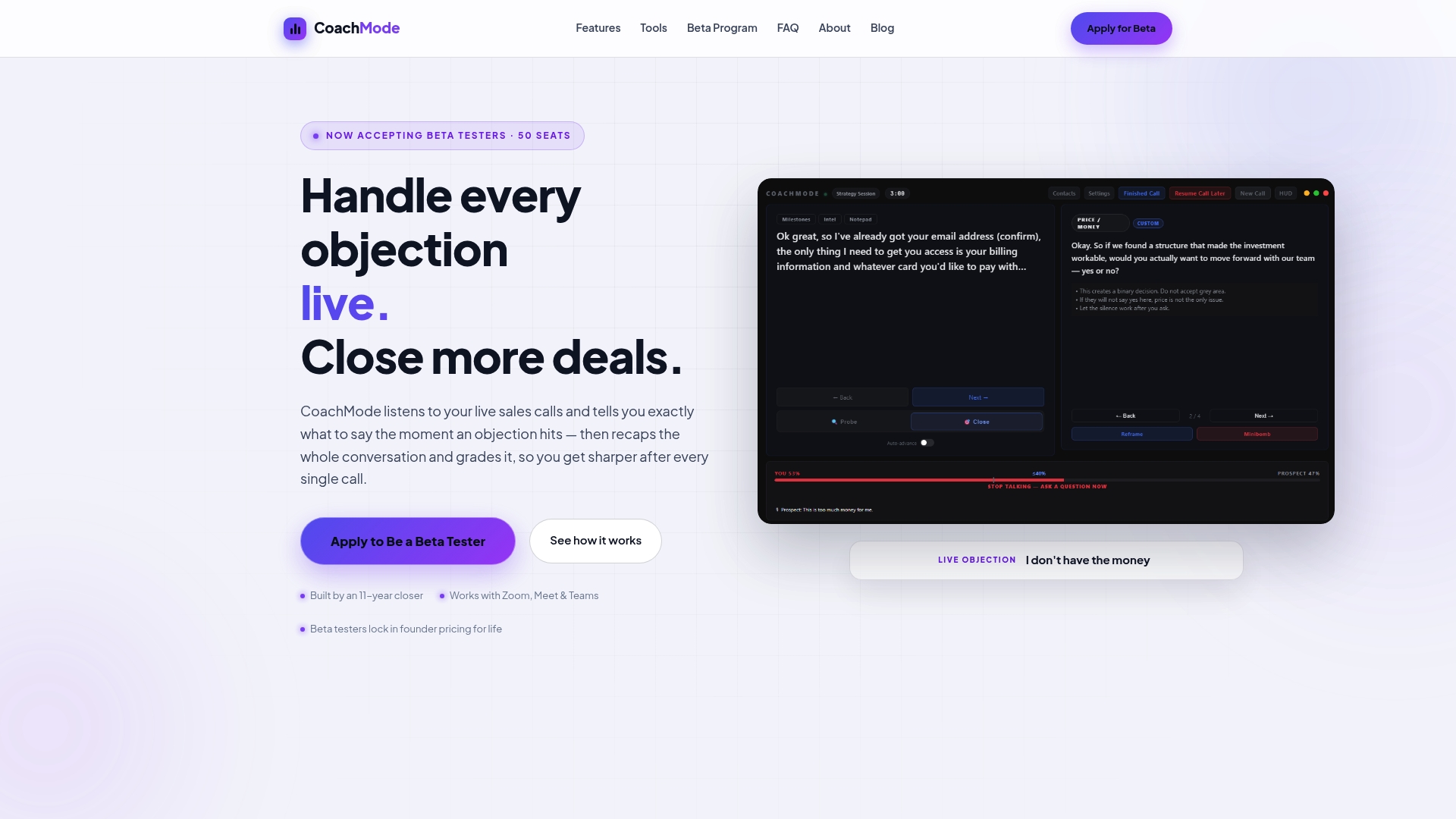
Every call also gets scored afterward, showing you which opener style, pacing, and talk ratio actually moved the conversation forward, so improvement doesn’t depend on guessing what went right. Teams testing this on live calls can start with a small pilot: a handful of reps, one week, one opener style compared against the score data. If you’re ready to see how your own openers perform under real coaching, explore Getcoachmode’s AI sales coaching for live calls and start your first session this week.
Table of Contents
- How To Start a Sales Call: The Anatomy Of An Opener That Works
- Which Opener Style Fits Your Prospect And Situation
- Personalize Every Opener Fast With The 3-3-3 Rule
- Timing And Pacing: How Long Should Your Opener Run?
- Common Opener Mistakes That Kill Calls Before They Start
- Measuring Opener Performance: The KPIs That Actually Matter
- How Real-Time Coaching Sharpens Opener Delivery
- Sources
How To Start a Sales Call: The Anatomy Of An Opener That Works
Every effective opener establishes three things in rapid succession: relevance, credibility, and emotional tone. Relevance tells the prospect why this call concerns them specifically. Credibility gives them a reason to believe you’re not wasting their time. Emotional tone, often the most overlooked piece, sets whether the call feels like an interrogation or a conversation between equals.
You can build all three into a memorable three-step structure:
- Introduce yourself and your company in one breath, no filler.
- Context the reason for the call in a single sentence tied to something real about their business.
- Invite them to opt in, either with a time-check or a direct question.
Here’s that structure in a sample script: “Hi Maria, this is Jake from Northside Analytics. I noticed your team just posted three open roles in revenue ops, which usually means growth is outpacing your reporting tools. Do you have 30 seconds for me to explain why I’m calling?”
Notice what’s missing: no apology, no rambling backstory, no “just checking in.” HubSpot’s guidance on opener length backs this up, recommending 20 to 30 seconds to establish rapport and purpose before moving into the conversation.
Pro Tip: Practice your opener out loud, not silently in your head. Openers that read fine on paper often sound stilted when spoken, and the only way to catch that is to hear yourself say it.
Which Opener Style Fits Your Prospect And Situation
Not every opener works for every call. Matching the style to the context matters as much as the words themselves.
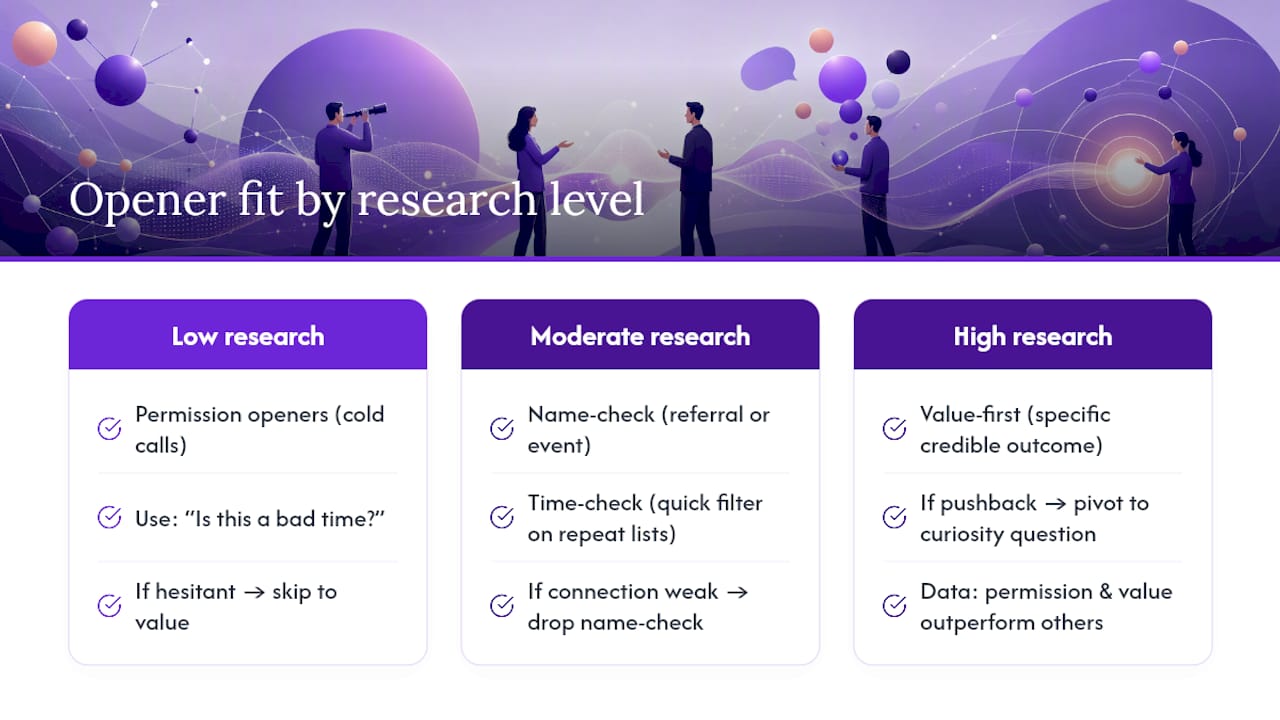
Permission openers work best on cold, unresearched calls where you have little to personalize. They lower resistance because you’re asking, not assuming. Try: “Is this a bad time?” or “Can I take 20 seconds to explain why I called?” or “Would you be open to hearing why I’m reaching out?” If the prospect hesitates or asks “what’s this about” immediately, that’s a signal to skip straight to value instead of repeating the permission ask.
Value-first openers shine when you’ve done enough research to name a specific, credible outcome. They work especially well in industries where prospects get pitched constantly and tune out generic openers. That’s what we fix. If the prospect pushes back with “we’re already handling that fine,” pivot to a curiosity question rather than defending the claim.
Name-check openers carry built-in credibility when you have a referral, mutual connection, or shared event. Use: “[Referrer] mentioned you’re the right person to talk to about X” or “We met briefly at [event], and I wanted to follow up.” These fail fast if the connection is weak or unverifiable. If the prospect says “I don’t really know them,” drop the name-check angle immediately and move to value.
Time-check openers work well for reps who call the same list repeatedly and want a fast, honest filter. Try: “I know this is out of the blue, got a quick 30 seconds?” or “I’ll be direct, this is a cold call, is now workable?” A flat “no” here is actually useful data. It tells you to schedule a callback rather than push through.
Curiosity openers perform best with skeptical or senior buyers who’ve heard every standard pitch. Example: “I’m not sure if this is even relevant to your team, mind if I ask one question to check?” If curiosity openers stall out with silence, the prospect likely wants you to get to the point faster, so shorten your next line.
Analyzed call data consistently shows permission and value-first openers outperforming the rest, but the right choice still depends on how much research you’ve done and who’s on the other end of the line.
Personalize Every Opener Fast With The 3-3-3 Rule
Generic openers get generic results. The 3-3-3 rule gives you a repeatable way to personalize without spending 20 minutes per prospect.
- Find 3 company facts: recent funding, a leadership change, a product launch, or a hiring surge.
- Find 3 personal facts: a LinkedIn post, a shared alma mater, a recent job change, or a conference appearance.
- Find 3 recent signals: a job posting that hints at a pain point, a press mention, or engagement with your company’s content.
You don’t need all nine data points for every call. Two or three solid ones beat a spreadsheet full of trivia. A quick template: “Saw your post about [topic] last week, that’s actually what prompted this call” works whether the signal is a LinkedIn update, a mutual connection, or a product change you noticed on their site.
For SDR teams making high call volumes, batch this research once a week for your entire list rather than scrambling before each call. Before you dial, run this checklist: one company fact confirmed, one personalization line drafted, one opener style chosen based on how much you know. That’s it. Sales question sequences that follow a strong opener tend to land better when the personalization already signaled you did your homework.

Timing And Pacing: How Long Should Your Opener Run?
Twenty to thirty seconds is the target window, confirmed by HubSpot’s research on effective call openings. Day and time still matter, though the data on “best” windows varies enough across industries that testing your own list beats copying someone else’s calendar.
In 20 seconds, you get one sentence of introduction and one line of context, nothing more. In 30 seconds, you can add a specific detail that shows research before inviting a response.
A time-check script built for the shorter end: “Hi [Name], this is [Rep] from [Company]. I know this is a cold call, got 20 seconds?” That’s it. Let the pause do the work; resist the urge to fill silence with more pitch.
Common Opener Mistakes That Kill Calls Before They Start
Most failed openers share the same handful of habits:
- Pitching immediately instead of earning permission first. Fix: lead with a question, not a feature list.
- Apologizing for calling (“Sorry to bother you”). Fix: replace with confident framing, “I’ll keep this short.”
- Rambling backstory before getting to the point. Fix: cap your intro at one sentence, always.
- Sounding rote or scripted, which prospects detect within seconds. Fix: practice enough that the script sounds conversational, not memorized.
Watch for red flags too. If a prospect says “I’m in a meeting,” offer a callback time instead of pushing forward. If they say “we’re not interested” before you’ve said anything of substance, that usually means your first line failed to establish relevance, not that the prospect is a dead end.
Measuring Opener Performance: The KPIs That Actually Matter
You can’t improve what you don’t track. Four metrics tell you whether an opener is working:
- Answered rate: how many dials connect at all, which reflects list quality more than opener skill.
- Continuation rate: the share of answered calls that pass the 30 to 60 second mark, the clearest signal of opener strength.
- Meeting booked per answered call: ties the opener directly to pipeline outcomes.
- Next-step conversion: whether booked meetings actually happen and progress, which Salesforce’s sales call guidance ties to setting clear expectations early in the call.
| Metric | What It Tells You |
|---|---|
| Continuation rate | Whether your opener earns attention past the first 30 to 60 seconds |
| Meeting booked rate | Whether the opener leads to a real next step, not just a longer chat |
| Next-step conversion | Whether momentum from the call carries into the pipeline |
Run A/B tests with a clear hypothesis: “Permission openers will beat value-first openers on continuation rate for this list.” Test against at least 50 to 100 calls per variant before drawing conclusions, and log results with simple call tags in your CRM or a shared note template your team reviews weekly.
How Real-Time Coaching Sharpens Opener Delivery
Live coaching tools listen during the call and surface phrasing suggestions and pacing nudges in the moment, not after the fact.
- Reps get objection responses fed to them live instead of freezing mid-call.
- Post-call scoring flags which opener style performed best, call by call.
- Teams report clearer phrasing and less anxiety once reps stop guessing what to say next.
Pro Tip: Run a small pilot: practice a new opener in roleplay, test it live with coaching support, then review the score before scaling it to your full team.
A Playbook Worth Repeating Every Day
Reps who improve fastest treat their opener like a living document, not a script frozen in a training deck. Rewrite one line a week based on what actually landed. Run one live roleplay before your first call of the day, even a rushed five-minute one. Watch a single metric, continuation rate is the simplest, and let that number tell you when to change course. Share what works with your team instead of hoarding a good line. The reps who test openers out loud, not just in their heads, are the ones whose scripts keep improving.
— Ryan
Sources
For deeper reading on opener structure and call performance, see HubSpot’s guide to starting a sales call, Klenty’s analysis of 11,732 answered cold calls, Northwood Group’s breakdown of the first three minutes, and Salesforce’s sales call best practices.