Conversation intelligence turns every sales call into two things at once: a coaching moment and a data point. Teams that use it report roughly 15% higher win rates and up to a 90% cut in manual documentation work, while 83% of AI-equipped sales teams grew revenue last year versus 66% of those without it. CoachMode applies that same idea live, coaching reps mid call instead of after the deal is already lost.
TL;DR:
- Conversation intelligence improves sales by identifying patterns that correlate with deal success, leading to higher win rates and faster deal cycles.
- Real-time coaching delivers immediate response suggestions during calls, making it more effective for high-stakes conversations than post-call reviews.
- Successful implementation requires defining clear success metrics, piloting with one team, and establishing call recognition and compliance protocols upfront.
- Adoption benefits emerge gradually over two to four months through improved CRM data, reduced admin tasks, and behavioral changes in sales reps.
- Starting with a focused pilot on key reps and tracking specific call behaviors provides better insights than broad, company-wide rollouts.
Table of Contents
- The Core Conversation Intelligence Benefits, at a Glance
- How Conversation Intelligence Improves Sales Performance
- How Conversation Intelligence Actually Works
- A Practical Rollout Checklist for Sales Teams
- What to Measure and When to Expect Results
- Why Real-Time Coaching Changes the Coaching Conversation
- Try Real-Time Coaching on Your Next Call
- Sources
The Core Conversation Intelligence Benefits, at a Glance
Most sales leaders come to conversation intelligence chasing one number, then discover it moves five. The technology touches revenue, coaching capacity, admin work, customer experience, and cross-team decisions all from the same data source: the call itself.
- Revenue uplift: higher win rates and shorter deal cycles from replicating what top closers actually say, not what the playbook assumes they say.
- Coaching at scale: managers move from spot-checking a handful of calls to reviewing patterns across the entire team’s pipeline.
- Admin automation: CRM fields, call notes, and follow-up emails get drafted without a rep touching a keyboard after hanging up.
- Customer experience gains: sentiment tracking flags frustrated buyers before they churn, which is part of why service quality scores improve by around 69% at companies that adopt it.
- Cross-team insight: marketing hears the exact objections prospects raise, and product teams get a running list of feature requests straight from the buyer’s mouth.
Each of those threads gets pulled apart in the sections below, starting with the one sales managers care about most: what actually changes on the call.
How Conversation Intelligence Improves Sales Performance
The mechanism is simpler than most vendors make it sound. The system listens to thousands of calls, tags what happens in each one (objection raised, pricing discussed, competitor mentioned), and then shows you which patterns correlate with closed deals versus lost ones.
Real-time coaching is the layer that turns pattern detection into in-call behavior change. Instead of a manager reviewing a recording three days later and saying “you should have handled that price objection differently,” the rep gets the better response while the prospect is still on the line. That timing difference is the whole argument for real-time coaching for high-ticket sales calls over post-call review alone: a coaching insight delivered after the deal is dead doesn’t help that deal.
Here’s what typically changes once a team starts acting on the data:
- Talk/listen ratio corrects itself. Reps who dominate calls get flagged, and the ones who ask more discovery questions start closing at a noticeably better clip.
- Objection responses standardize around what works. Instead of five reps improvising five different answers to “it’s too expensive,” the team converges on the phrasing that actually moves deals forward.
- Deal velocity improves modestly but consistently. Fewer calls get lost to vague next steps because action items get captured and assigned automatically.
Framed conservatively, a team converting even a few extra deals per quarter from win-rate gains in that 15% range justifies the tool on its own, before you count the time saved on notes.
Managers do the heavy lifting here, not the software. The AI surfaces the pattern; the manager decides it’s worth turning into a script update, a new onboarding module, or a Friday team call built around one recording. Salesloft’s overview of conversation intelligence notes that this shift lets managers coach from real examples instead of sampling the 5% of calls they happen to catch live.
Pro Tip: Pick one lost deal and one won deal that covered similar ground, then play both for your team back to back. The contrast teaches faster than any slide deck.
How Conversation Intelligence Actually Works
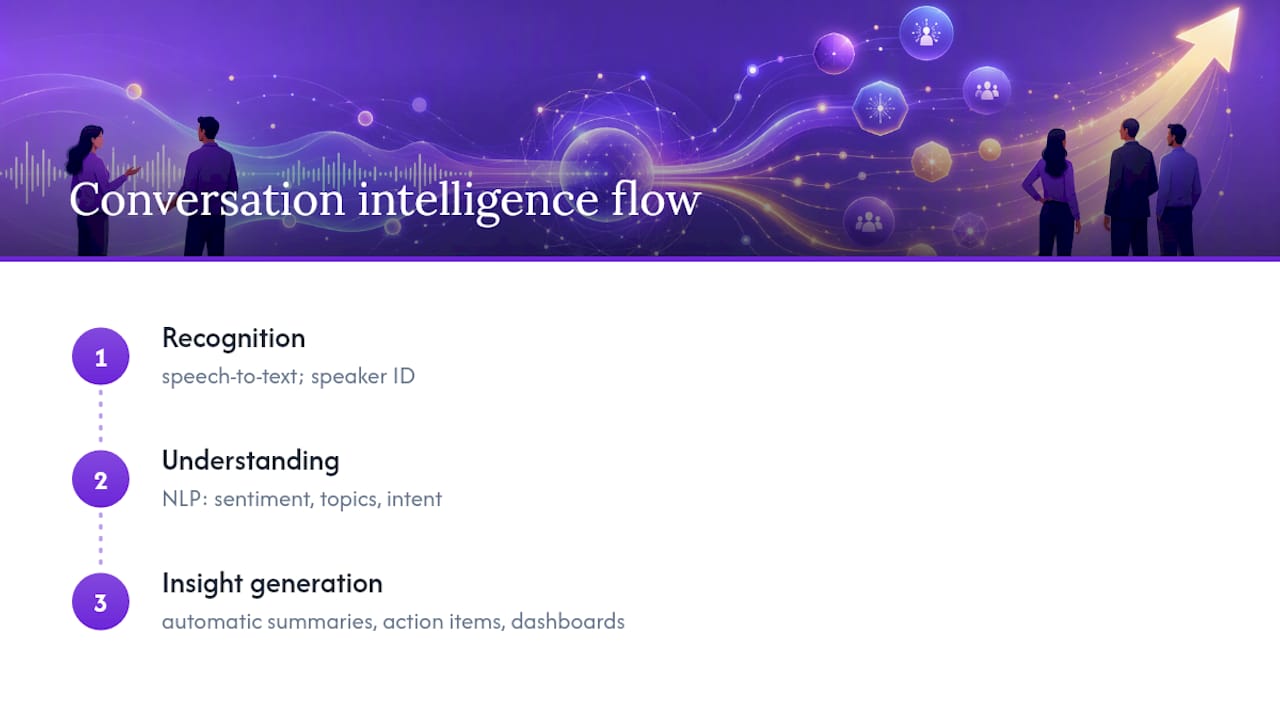
Strip away the marketing language and conversation intelligence runs on three steps: recognition, understanding, and insight generation. Recognition is speech-to-text plus speaker identification, so the system knows Rep A said this and Prospect B said that. Understanding applies natural language processing to detect sentiment, topics, and intent. Insight generation is where it becomes useful: summaries, action items, and trend dashboards get built automatically from that raw transcript.
The real-time versus post-call distinction matters more than most buyers realize. Real-time tools whisper the objection response while the prospect is still talking, which matters most for live, high-stakes conversations where phrasing changes outcomes on the spot. Post-call analytics matter more for contact centers running high call volume or product teams mining conversations for feature requests, where speed to insight matters less than depth of pattern.
On the integration side, expect the system to plug into your CRM (Salesforce, HubSpot, or similar), your calling platform (Zoom, Google Meet, Teams), and sometimes a ticketing system. Once connected, it should automate the parts nobody wants to do manually: updating CRM fields, drafting follow-up emails, and logging next steps. Generative CI can now analyze the full volume of calls rather than a sample, which is the difference between quality control that catches problems in minutes and one that catches them next quarter.
A Practical Rollout Checklist for Sales Teams
Buying the tool is the easy part. Getting a team to actually use it is where most rollouts stall. Work through this order:
- Set your success metrics before you shop. Decide upfront whether you’re optimizing for win rate, hours saved per rep, or CRM data completeness, because that choice shapes which features you prioritize.
- Pilot with one team, not the whole org. Narrow pilots produce clean before/after comparisons; company-wide rollouts produce noise.
- Build your keyword and taxonomy list early. Define what counts as a “coachable moment” (a missed discovery question, a weak close attempt) so the system flags the right things from day one.
- Clear privacy and compliance first. Confirm call recording consent requirements for your states and set a data retention policy before a single call gets recorded.
- Plan the adoption cadence. Weekly manager review of flagged calls, rep access to their own scorecards, and a feedback loop to refine keyword tags after 30 days.
Skip the pilot step and you’ll end up with a tool nobody trusts because it was tuned on the wrong assumptions from day one.
What to Measure and When to Expect Results
Set expectations by timeline, not by a single dashboard number. In the first month, watch CRM completeness, average time to log a follow-up, and how often reps actually open their call summaries. Between months two and four, track ramp time for new hires, the percentage of calls a manager can realistically review each week, and whether reps start adopting the flagged behaviors on their own.
Win-rate lift, churn reduction, and cross-team influence (marketing or product acting on call insights) show up over two or more quarters, not two weeks. Use the roughly 15% win-rate and 69% service-quality benchmarks as a directional target scaled to your team size, not a guarantee, and reclaiming even 5 to 14 hours per rep per week from automated notes and CRM updates pays for the tool well before the win-rate number moves.
Why Real-Time Coaching Changes the Coaching Conversation
Most sales coaching happens too late to help the deal it’s talking about. A rep fumbles a pricing objection on Tuesday, the manager reviews the recording on Thursday, and by then the prospect has already moved on to a competitor. That lag is the actual problem conversation intelligence solves, and it’s why real-time delivery matters more than any dashboard feature.
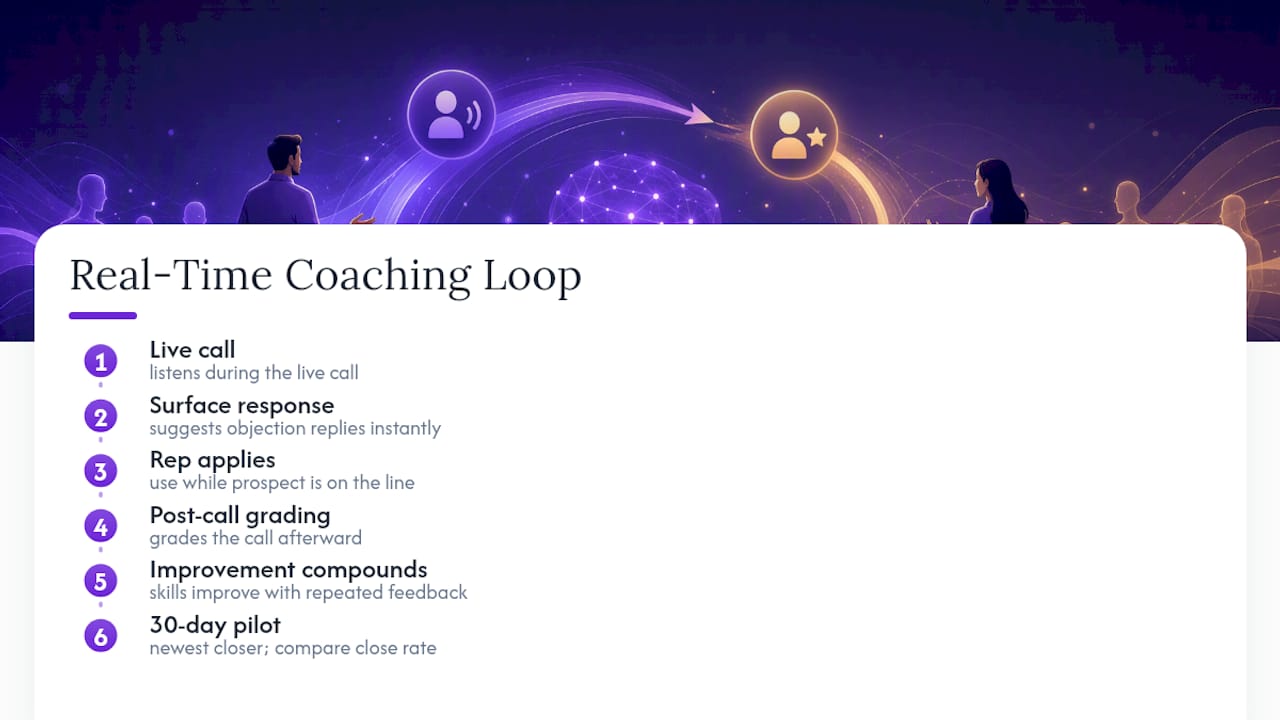
CoachMode’s approach reflects that logic directly: it listens during the live call and surfaces the right response to an objection while the rep still has the prospect on the line, then grades the call afterward so the improvement compounds. Reps using it report better clarity and steadier control of the conversation, which tracks with what you’d expect when someone stops improvising under pressure and starts pulling from a system that’s already heard a thousand similar objections.
My honest recommendation for any manager reading this: don’t roll this out to your whole team on day one. Pick your newest closer, run a 30-day pilot, and compare their close rate against the quarter before. The data will make the case for you far better than any pitch deck could.
— Ryan
Try Real-Time Coaching on Your Next Call
Everything covered above, faster wins, scaled coaching, less admin work, comes down to catching the moment while it’s happening instead of reviewing it afterward. That’s the specific gap CoachMode’s AI sales coach fills: it listens live, hands your rep the right objection response in the moment, and then produces a post-call scorecard so the improvement sticks past that one conversation.
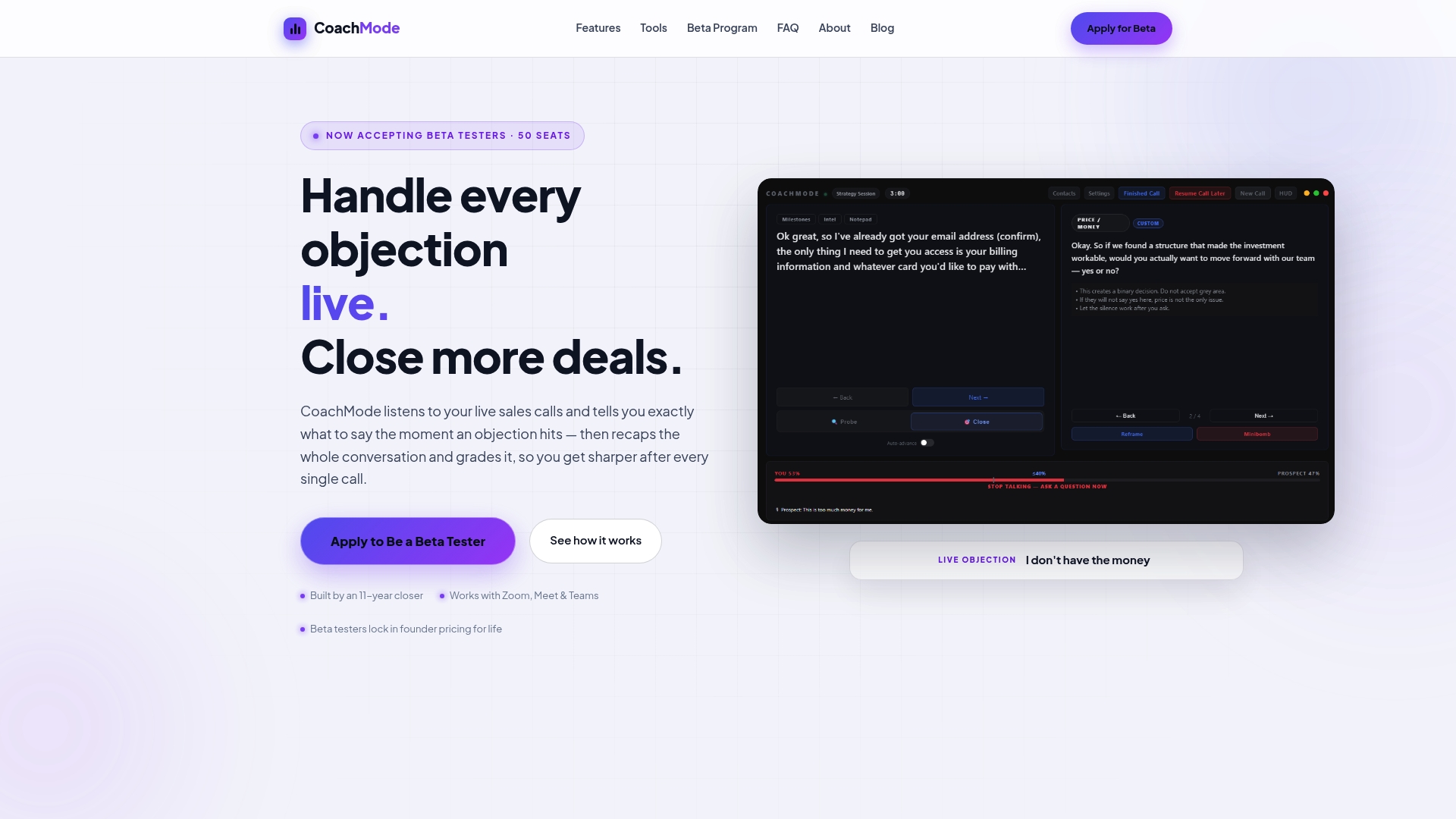
If you’re running high-ticket sales calls where one phrase can save or sink a deal, the objection answer hub gives reps a ready reference before they even need real-time prompts. Teams that want to test the water first can start with the free sales tools before committing to a full rollout. When you’re ready to see it running on a live call, book a walkthrough of CoachMode’s real-time AI sales coaching and bring your toughest recent objection with you.
Sources
- Conversation intelligence: The complete guide for 2026
- Conversation intelligence (Salesforce guide) — 2026
- What Is Conversation Intelligence Software? How It Works, Benefits, and ROI (2026)
- Conversation Intelligence: What It Is and Why You Need It | Verint