You can legally record a phone call under federal law with just one party’s consent, meaning your own is enough. But several states override that baseline and require every person on the line to agree first. The safest move if you run a business making calls across state lines: announce the recording every time, to everyone, without exception.
TL;DR:
- Recording calls with a single-party consent is legal federally, but over a dozen states require all participants’ knowledge and approval before recording.
- States like California, Florida, Illinois, Pennsylvania, and Washington enforce strict all-party consent rules, often demanding explicit affirmative agreement prior to recording.
- Valid consent methods include verbal or written agreement, pre-recorded disclosures, or implied consent through continued participation after notice; always prioritize clear, documented disclosures.
- Penalties for illegal recording are severe, including criminal charges with potential prison time and fines, as well as civil damages that can reach $10,000 per violation.
- When calling across state lines, treat the entire call as needing all-party consent if any participant is in a strict all-party state, due to courts prioritizing resident privacy protections.
Table of Contents
- Which States Require All-Party Consent for Call Recording?
- How Do You Get Valid Consent to Record a Call?
- What Happens If You Record a Call Without Consent?
- Which State’s Law Applies on an Interstate Call?
- Do Different Rules Apply to Law Enforcement or Workplace Calls?
- Where Can You Verify Your State’s Call Recording Rules?
- Why Getcoachmode Treats Consent as a Trust Signal, Not Just a Legal Box to Check
- Sources
Which States Require All-Party Consent for Call Recording?
Federal law sets the floor, not the ceiling. Under 18 U.S.C. § 2511, a call is legal to record if one participant, including the person doing the recording, consents. That’s the rule in most of the country. But states are free to impose stricter standards, and a meaningful cluster of them has done exactly that.
The commonly cited all-party consent states include California, Connecticut, Delaware, Florida, Illinois, Maryland, Massachusetts, Montana, Nevada, New Hampshire, Pennsylvania, and Washington. Every person on the call needs to know it’s being recorded, and in most of these states, they need to affirmatively agree, not just be informed after the fact.
Here’s where it gets messier than a simple list suggests. Legal surveys count around a dozen all-party states, though counts vary slightly depending on statute interpretation. It comes down to how a state’s statute is written. Some states apply all-party consent only to criminal wiretap statutes but leave civil remedies looser. Others distinguish between recording a call versus recording an in-person conversation, or carve out different rules depending on whether the recording happens over a landline, cellular network, or VoIP platform. Illinois, for example, rewrote its eavesdropping statute after a state supreme court struck down an earlier version, and the current law still trips up businesses that assume the old rules apply. Montana’s statute technically requires notification rather than full two-way consent, which functions differently in practice even though it lands in the same “all-party” bucket most guides use.
| State classification | Examples | Practical note |
|---|---|---|
| All-party consent | California, Florida, Illinois, Pennsylvania, Washington | Every participant must be notified and typically must agree before recording begins |
| One-party consent | Most other states, including Texas, New York, Ohio, Arizona | Only the recording party needs to consent |
| Hybrid or ambiguous | Connecticut, Nevada, Montana | Statute language splits civil and criminal treatment, or ties consent to notification rather than affirmative agreement |
Nevada is a useful example of the hybrid problem. Its supreme court has interpreted the state’s statute in ways that functionally require one-party consent for certain call types while the underlying language leans toward all-party. That’s the kind of nuance a quick internet search won’t surface, and it’s exactly why relying on a single blog post to make a compliance decision is risky.
The RCFP’s state-by-state legal survey remains one of the more reliable references for tracking these distinctions, and Justia’s 50-state survey breaks out exceptions and medium-specific rules that general “consent map” graphics tend to flatten. If your business operates in multiple states or takes calls from callers nationwide, checking the current statutory language for any state you touch regularly is worth the twenty minutes it takes. Statutes get amended, and a survey published even a year ago can miss a recent legislative change.
How Do You Get Valid Consent to Record a Call?
Consent isn’t a single legal concept with one accepted form. Courts and regulators generally recognize a few distinct methods, and which one you need depends on your state’s rule and how much risk you’re willing to carry.
Verbal or written consent before recording starts. This is the gold standard for all-party states. A sales rep says, “This call may be recorded for quality and training purposes, is that okay with you?” and waits for a yes. Written consent, common in contracts or terms of service, works too, but it needs to actually cover the specific calls being recorded, not just gesture vaguely at “communications.”
A pre-recorded IVR announcement. “This call may be monitored or recorded” played before the call connects to a live agent satisfies notice requirements in most jurisdictions, including several all-party states, because it gives every participant the chance to hang up before anything substantive happens. The catch: if the caller stays on the line after hearing it, most courts treat that as implied consent. Silence isn’t agreement everywhere, but continued participation after clear notice usually is.
An audible beep tone. Older but still valid in some contexts, a repeated beep every 15 seconds signals an active recording. It’s weaker evidence of consent than a verbal script because it doesn’t confirm the other party understood what the beep meant, so most compliance-conscious businesses have moved away from relying on it alone.
Implied consent, where someone keeps talking after hearing a disclosure, works fine for low-stakes calls. It gets shakier for anything involving sensitive information, financial transactions, or a caller who might later claim they didn’t understand the notice. When the stakes are higher, get an affirmative “yes” on the recording itself.
Here’s a practical checklist for rolling this out across a team:
- Default to all-party notice language regardless of where your business is headquartered, since you can’t always predict where a caller is physically located.
- Configure your phone system or CRM to play an automated disclosure before every call connects, not just for outbound sales.
- Keep time-stamped logs showing when the disclosure played and, where relevant, when consent was given.
- Limit who can access recorded calls internally, and set a retention policy that deletes recordings after a defined period rather than storing them indefinitely.
- Update agent scripts and run a short training session so reps deliver the disclosure naturally instead of mumbling through it.
Pro Tip: Build the consent line into the same opening moment where reps already introduce themselves. A disclosure that sounds like a compliance afterthought makes callers nervous; one that flows naturally into the greeting barely registers as a pause. Tools that guide reps through call openings, like Getcoachmode’s real-time coaching, can prompt this line automatically so it never gets skipped under pressure.
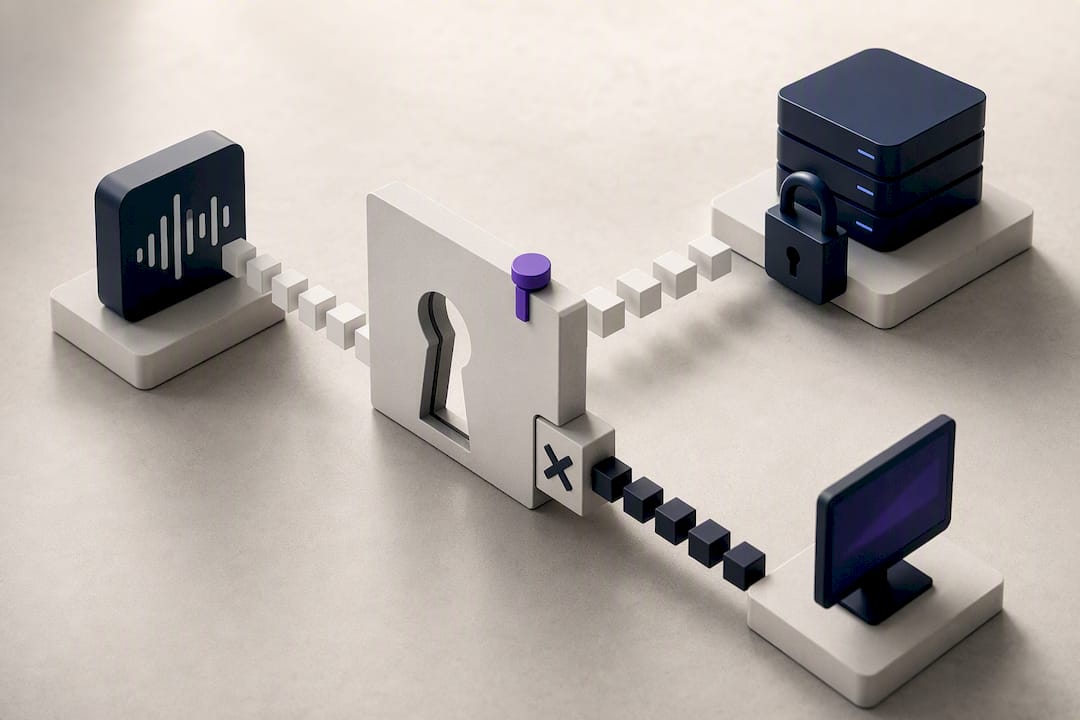
Retention and access controls matter more than most businesses assume. A properly disclosed recording can still create legal exposure if it’s stored insecurely or accessed by employees who have no business reason to hear it. Treat recorded calls with the same access discipline you’d apply to financial records.
What Happens If You Record a Call Without Consent?
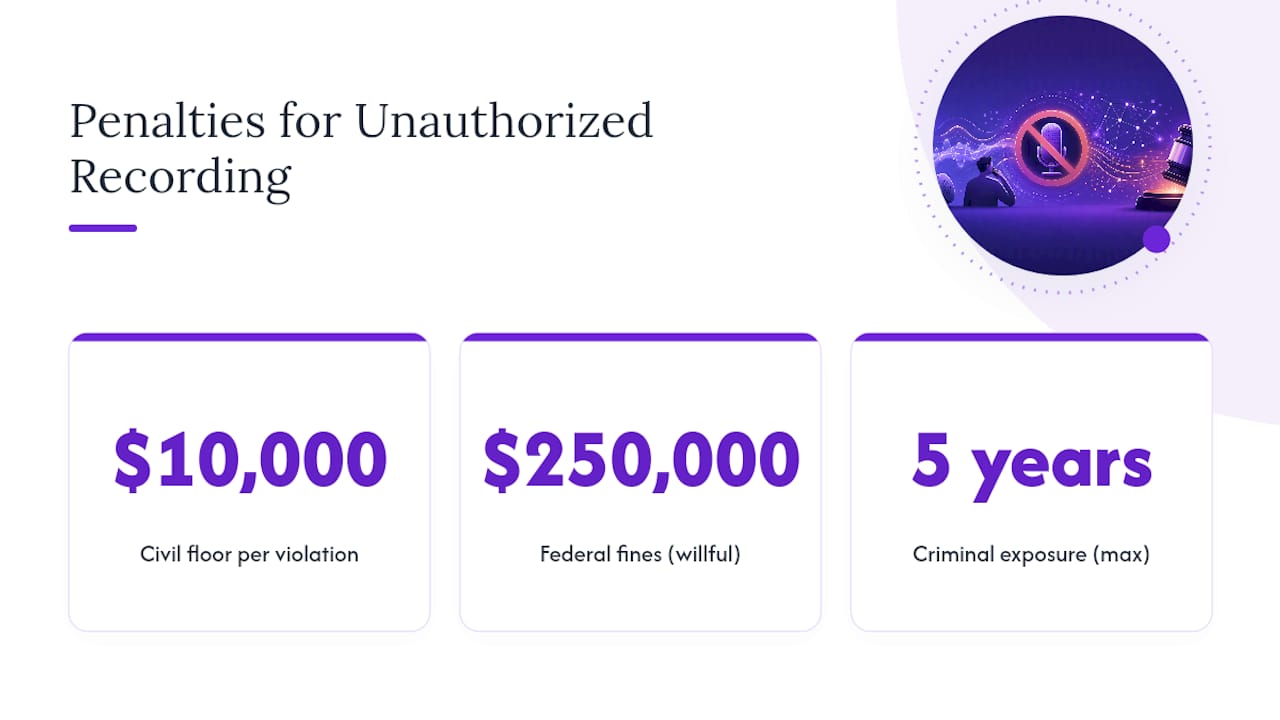
The penalties aren’t symbolic. Under 18 U.S.C. § 2511, unlawful interception of a call carries criminal exposure of up to five years in prison and fines reaching $250,000 for willful violations. Separately, § 2520 creates a civil cause of action, letting the affected party recover either actual damages or a statutory floor of $10,000 per violation, whichever is greater. That statutory floor is what turns a single unauthorized recording into a real financial problem, since a plaintiff doesn’t need to prove they were harmed to collect it.
States layer their own penalties on top. California’s wiretapping statute, part of the Invasion of Privacy Act, allows civil penalties similar to the federal structure and has generated a steady stream of class action lawsuits against companies that recorded California callers without proper notice. Pennsylvania’s wiretap act likewise permits civil damages, and its courts have been consistently unforgiving toward businesses that assumed a one-party consent state’s rules applied simply because the business itself was headquartered elsewhere.
The mitigation steps are straightforward even if the legal exposure is not: default every system to require disclosure, keep logs proving it happened, and get a lawyer’s opinion before rolling out any new automated calling or recording feature that touches multiple states. A quick legal review costs far less than a class action settlement.
Which State’s Law Applies on an Interstate Call?
The conservative rule that most compliance teams follow: if any participant is physically located in an all-party consent state, treat the whole call as if it needs all-party consent, regardless of where you’re calling from.
Courts have backed this approach directly. In Kearney v. Salomon Smith Barney, the California Supreme Court held that a company recording calls with California residents had to comply with California’s all-party consent rule, even though the company itself was based in Georgia, a one-party state. The logic: California has a strong interest in protecting its residents’ privacy expectations, and that interest doesn’t evaporate just because the other party dialed in from out of state.
The practical problem is that you often don’t know where a caller physically sits. Mobile numbers get carried across state lines, VoIP numbers can be provisioned anywhere, and area codes stopped being a reliable location signal years ago. Given that uncertainty, an all-party notice on every call costs you almost nothing and closes off the entire question.
Build these controls into your calling systems:
- Play an all-party consent announcement on every outbound and inbound call, not just calls to known all-party states.
- Don’t rely on caller ID area codes to determine which state’s rule applies.
- Log the disclosure timestamp on every call so you have evidence of compliance if a dispute arises later.
- Review any state-specific carve-outs if your business operates primarily within a single one-party state and rarely calls outside it.
Do Different Rules Apply to Law Enforcement or Workplace Calls?
Standard consent rules bend in a handful of recognized situations, and knowing them helps you avoid over-applying restrictions where they don’t belong, or under-applying them where they still do.
Law enforcement can record calls under a warrant or specific statutory exception, following procedures that private citizens and businesses don’t have access to. Exigent circumstances, like an active kidnapping or immediate safety threat, can also justify recording without the consent that would otherwise be required, though these exceptions are narrow and courts scrutinize them closely after the fact.
The “no reasonable expectation of privacy” doctrine matters too. A conversation happening in a public setting, like someone shouting into their phone on a crowded train, generally carries less privacy protection than a private call behind closed doors, even in an all-party state. This doesn’t give businesses a blanket excuse to record public-facing interactions, but it explains why courts treat some recordings differently based on context rather than location alone.
Workplaces add another layer. Employer policies can permit call monitoring or recording for quality assurance, provided employees are notified, typically through a handbook acknowledgment or posted policy. That internal notice satisfies most state consent requirements for employer-employee calls, but it doesn’t automatically extend to calls with outside customers, who still need their own disclosure.
Sector-specific rules can require even more. Healthcare-related calls touching HIPAA-covered information may need additional safeguards around storage and access beyond basic consent. Calls involving payment information fall under PCI compliance standards that govern how recorded card data gets stored or masked, regardless of what state consent law otherwise permits.
Where Can You Verify Your State’s Call Recording Rules?
Start with primary sources rather than secondhand summaries. The FCC’s consumer guidance on recording telephone conversations confirms there’s no federal rule barring individuals from recording their own calls, but it explicitly directs callers to state law for anything beyond that baseline. The federal statute itself, 18 U.S.C. § 2511, is worth reading directly rather than through a paraphrase, especially the penalty provisions. For a broader jurisdiction-by-jurisdiction view, both the RCFP’s recording guide and Justia’s 50-state survey are maintained references that legal teams cite regularly.
If you’re still uncertain after checking these, most states let you contact the attorney general’s office or public utilities commission for guidance on intrastate questions, which the FCC itself recommends for anything involving state-specific wireline rules.
A short action list to close out this week:
- Update your IVR or call system to play a clear recording disclosure on every line.
- Retrain agents on the exact script wording and when affirmative consent is required versus implied.
- Turn on timestamped logging for every recorded call.
- Loop in counsel before launching any new automated dialing or recording feature that spans multiple states.
Why Getcoachmode Treats Consent as a Trust Signal, Not Just a Legal Box to Check
Most compliance advice treats consent disclosure as friction to minimize, something you rush through so the “real” conversation can start. That framing misses what’s actually happening on the call. A buyer who hears a clear, confident disclosure at the top of a conversation reads it as a signal that the person on the other end runs a tight operation. A buyer who finds out later, or not at all, that they were recorded reads it as a red flag, even if the recording itself was completely legal.
The businesses that get this right treat the disclosure line the same way they’d treat any other part of the opening: something worth saying well. A rep who delivers “this call may be recorded for quality purposes” with the same ease as their greeting doesn’t lose momentum. A rep who fumbles it, or worse, skips it because they forgot, creates exactly the kind of hesitation that kills trust before the real conversation even starts.
This is where live coaching tools earn their place. A platform that prompts a rep with the disclosure line at the right moment, without breaking the flow of the call, solves a problem that scripts alone don’t. People forget scripts under pressure. Getcoachmode’s live-call coaching was built around exactly that kind of in-the-moment prompting, not just for objection handling but for the small compliance moments that reps otherwise treat as an afterthought. Consent shouldn’t feel like a hurdle you clear before the pitch starts. Done well, it’s the first proof point that you’re someone worth trusting with the next ten minutes.
— Ryan
Sources
- 18 U.S.C. § 2511 — Cornell Law School
- Introduction to the Reporter’s Recording Guide — RCFP
- Recording telephone conversations — FCC
- Recording phone calls and conversations — Justia 50-state survey