A sales call recap has one job: confirm both sides understood the same thing and make the next step impossible to miss. That means opening with the buyer’s goal in their own words, listing two to four aligned points, and closing with next steps tagged by owner, action, and date. Send it the same day for high-stakes calls, or within 24 hours otherwise.
TL;DR:
- Recaps should focus on confirming decisions, action items, owners, and deadlines, rather than providing a verbatim or overly detailed summary of the call.
- The ideal recap is short, clear, and structured with one primary question, using the buyer’s own words early to boost credibility and forwardability.
- Sending the recap within the same day for high-stakes calls or within 24 hours otherwise maintains momentum and ensures relevance.
- The follow-up should be brief, with a specific reference to the original ask and a clear, firm next step with designated responsibility and date.
- Incorporating real-time coaching and automated draft recaps can improve consistency and clarity in high-volume or complex sales pipelines.
Table of Contents
- What Makes a Sales Call Recap Actually Work
- Three Recap Templates You Can Send Today
- How to Format Next Steps So They Actually Stick
- How to Write in the Buyer’s Own Words
- Getting Recaps Opened: Subject Lines, Timing, and Mobile Formatting
- Why Recaps Go Nowhere and How to Revive Them
- How Live Coaching Changes What Goes Into the Recap
- Making the Recap Sound Like the Buyer, Not the Vendor
- Keeping the Recap Short Enough to Actually Get Read
- Timing the Send and Keeping the Thread Clean
- What Actually Belongs in the Recap Body
- What a Recap Is Actually For
- The Mistakes That Quietly Kill Good Recaps
- Adjusting the Recap for Different Buyer Personas
- Following Up After the Recap Lands
- Ryan’s Perspective: Recaps as a Repeatable Discipline
- An Alternative Workflow Worth Considering
- Sources
What Makes a Sales Call Recap Actually Work
A recap works when it reads like a receipt, not a transcript. The buyer should glance at it, nod, and forward it to their boss without editing a word. That’s the real test, and most recaps fail it because they try to prove the rep was paying attention instead of confirming what got decided.
Sybill’s research recommends structured summaries over verbatim notes, built around call outcome, buyer pain points, objections, decision makers, and next steps with named owners and dates. A recap covering a 30 to 45 minute call should land in the 300 to 500 word range. Anything longer starts to feel like homework, and busy buyers skip homework.
The other standard worth knowing: MeetWave’s guide centers on decisions made, action items with owners and deadlines, and three to five bullets of key discussion points, plus a line for anything unresolved. That’s the industry consensus. A sales meeting recap template that hits those beats will outperform one built from memory every time, because it forces you to separate what was decided from what was merely discussed.
Here’s the distinction that trips people up: a call summary documents what happened. A recap email drives what happens next. You can write a technically accurate summary that still kills a deal, because it buries the ask under six paragraphs of context the buyer already knows. The templates below are built to avoid that.
Three Recap Templates You Can Send Today
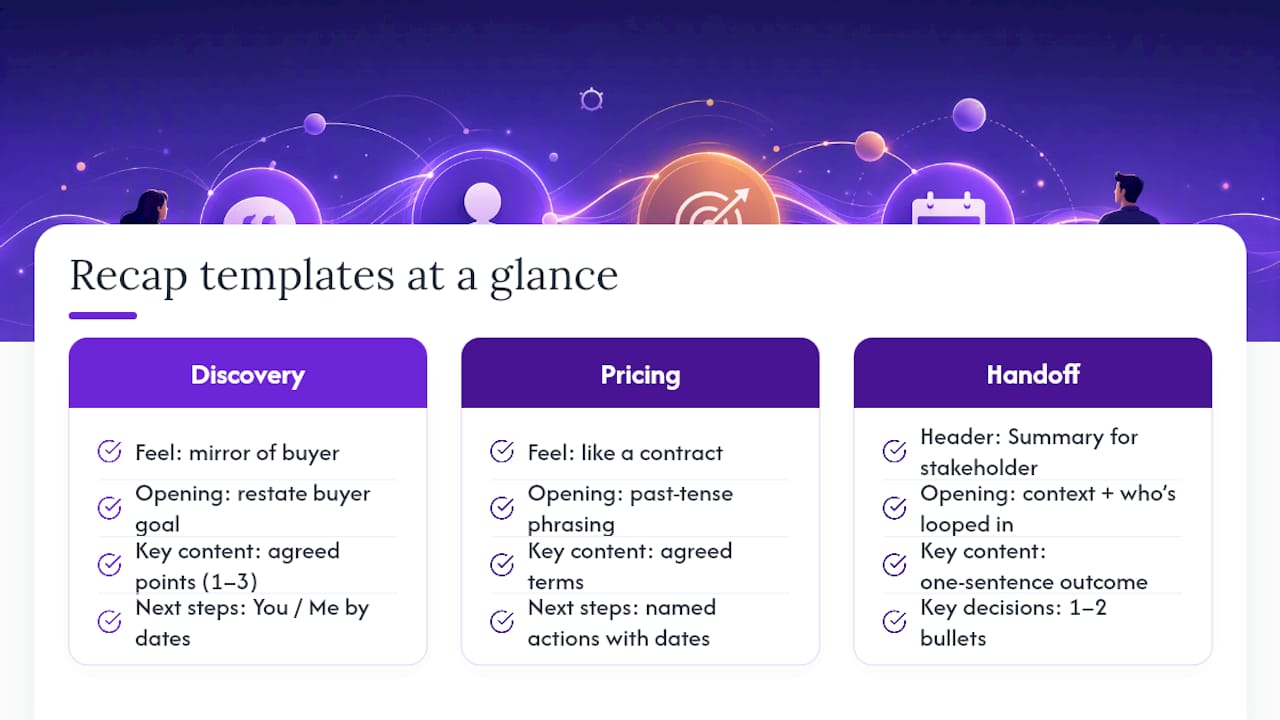
Different calls need different recaps. A discovery call recap should feel like a mirror. A pricing call recap should feel like a contract. A stakeholder handoff should feel like a briefing memo written for someone who wasn’t on the call.
Discovery call recap template:
Subject: Recap: [Buyer’s stated goal] + next steps
Hi [Name], good talking today. Sounds like the priority is [restate their goal in their words], mainly because [their stated pain]. Here’s where we landed:
- [Point 1 you both agreed on]
- [Point 2 you both agreed on]
- [Point 3, if genuinely relevant]
Next steps:
- You: [action] by [date]
- Me: [action] by [date]
One ask: can you confirm [single clear question] by [date]?
This structure works because the first line proves you listened, not that you talked. For calls that surface multiple pain points worth tracking, a structured discovery approach helps you capture the right language while the conversation is still live.
Pricing and negotiation recap template:
Past-tense phrasing like “we agreed to” does real work here. It signals a decision was made, not a possibility floated, which matters when the recap gets forwarded to procurement.
Stakeholder handoff recap template:
Subject: Summary for [internal stakeholder] — [Buyer]/[Company] call
[Name], looping in [Stakeholder] since [reason]. Short version: [one-sentence outcome]. Key decisions: [1-2 bullets]. [Stakeholder], your input is needed on [specific item] by [date].
Hunter’s meeting recap templates follow this same logic: open with context that proves attention, confirm shared understanding, close with named next steps.
How to Format Next Steps So They Actually Stick
Vague next steps are where deals quietly die. “We’ll follow up soon” gives nobody a job. The fix is a three-part format: Owner, Action, Date. No exceptions, no soft language.
Each column earns its place. Owner removes ambiguity about who’s responsible, which matters more than it sounds because buyers often assume the rep owns everything, including tasks that are actually theirs. Action should be a verb, not a topic. Date should be a real date, not “early next week.” Action-item formats naming both an owner and a due date are consistently linked to fewer stalled deals in sales operations practice, largely because vague ownership is the easiest excuse for inaction on either side.
Here’s a compact version you can drop straight into an email:
| Owner | Action | Date |
|---|---|---|
| Buyer (Sam) | Confirm budget range with finance | Friday, March |
| Rep (You) | Send updated proposal with tiered pricing | Wednesday, March |
| Both | Schedule technical demo with IT lead | Next week |
Three formatting rules matter beyond the table itself:
- Use past tense for agreements (“We agreed to move forward with Option B”) rather than future tense (“We’ll probably go with Option B”). Past tense reads as settled; future tense invites renegotiation.
- Separate buyer commitments from internal tasks visually, even if it’s just bolding “You” and “Me.” Mixing them makes the buyer scan past their own obligations.
- Never list more than four next steps. If there are more than four real actions, the call probably needs a follow-up call, not a longer email.
How to Write in the Buyer’s Own Words
The single biggest credibility signal in any recap is the first sentence. If it restates the buyer’s goal in their own phrasing, it proves the rep was listening. If it opens with generic sales language, it reads like a template with names swapped in, because it usually is one.
Naming the buyer’s goal in their own words in that first line also makes the email more forwardable inside the buyer’s organization. Internal stakeholders trust a recap more when it sounds like their colleague, not the vendor.
Compare these two openers:
Before: “Thanks for the call today. We discussed your current sales process and some of the challenges your team faces.”
After: “Sounds like the real issue is that your reps close fine on the first call but lose momentum when a deal needs a second approver, which matches what you said about Q3 slipping.”
The second version could only have come from that specific call. The first could have been sent to anyone.
To capture usable buyer language, run this quick extraction check right after hanging up:
- What phrase did they use for their problem, word for word?
- What number or deadline did they mention unprompted?
- What did they say would make this a “yes” internally?
- Did they name a stakeholder, and how did they describe that person’s concern?
Pro Tip: Keep a running note during the call titled “buyer’s exact words.” Even three phrases jotted verbatim will do more for your recap’s tone than ten minutes of polishing generic sentences afterward.
Getting Recaps Opened: Subject Lines, Timing, and Mobile Formatting
A perfectly written recap that never gets opened accomplishes nothing. Three variables control open rates: subject line, timing, and how it reads on a phone screen.
Subject lines that work tend to reference something specific from the call rather than a generic label:
- “Recap: [specific outcome or number] + next steps”
- “Following up on [buyer’s stated priority]”
- “Quick summary + one question for you”
Avoid “Great chat today!” or “Following up” with nothing else. Buyers skim subject lines before deciding whether an email deserves attention, and generic ones read as mass-sent.
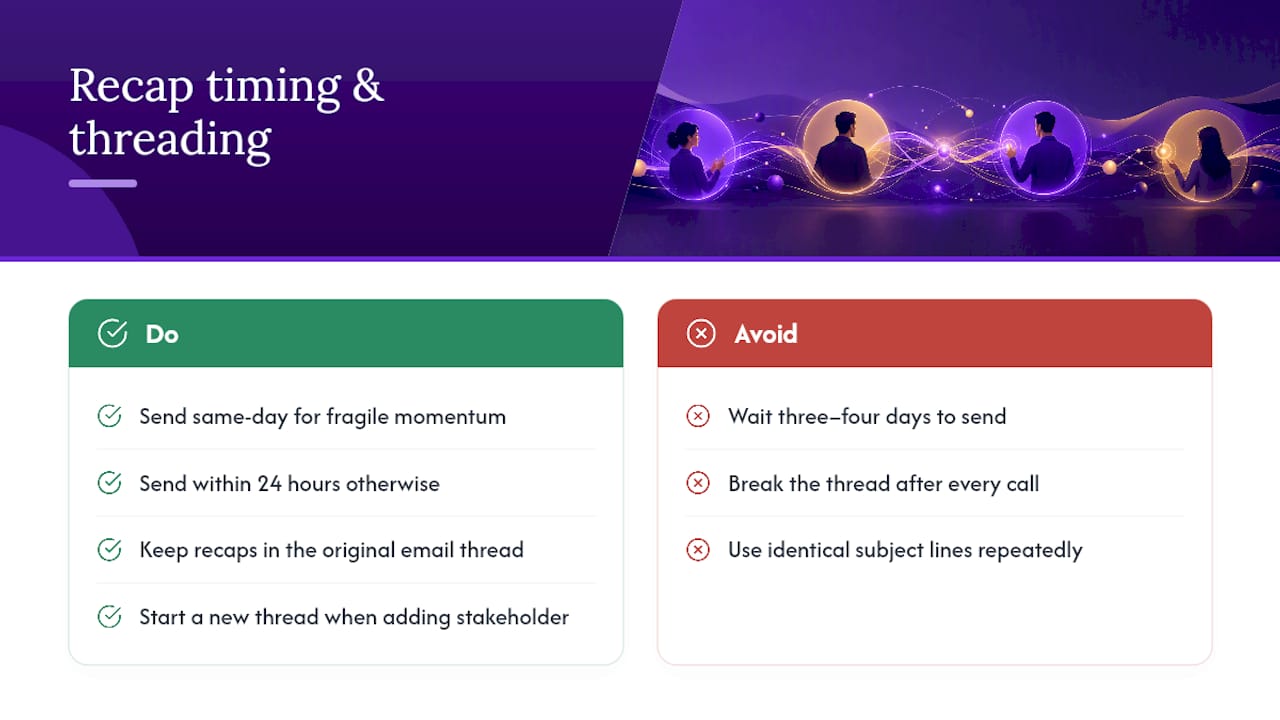
Threading matters more than most reps realize. Keep the recap in the same email thread as the original meeting invite or prior correspondence unless you’re adding a new stakeholder, in which case starting fresh with a clear subject line avoids confusing someone who wasn’t looped in before. On timing, send same day for high-stakes calls (final pricing discussions, calls with new stakeholders, anything where momentum decays fast) and within 24 hours for everything else, a window echoed across multiple template guides.
Mobile formatting rules are simple but often ignored: two to four bullets maximum, a bolded “Next steps” label so it’s scannable even skimming, and a total reading time around 30 seconds. Effective recaps generally stick to two to four aligned bullets and a single clear ask, because more than that overwhelms a buyer trying to make a fast decision on a phone between meetings.
Why Recaps Go Nowhere and How to Revive Them
Most stalled recap threads die from one of four causes: the ask is buried under paragraphs of context, the next steps only list what the rep will do, deadlines are vague (“soon,” “next week” with no day), or nobody named a decision owner on the buyer’s side.
The fix is usually a short, direct reopen message rather than a longer explanation.
- Pick-a-time fix: “Wanted to bump this back up. Does Thursday or Friday work better for a quick 15-minute call to close out the remaining question?”
- Ownership fix: “Circling back. Who on your end would be the right person to confirm [specific item]? Happy to loop them in directly.”
- Park-until-date fix: “Sounds like timing isn’t right yet. Should I check back in [specific month], or is there a better trigger point to watch for?”
Escalate to a call when the recap has stalled twice with no response, or when the next decision genuinely needs real-time back-and-forth (pricing negotiation, multiple stakeholders with conflicting input). Park the opportunity when the buyer has explicitly said timing isn’t right and a third follow-up would just add noise. A three-message reopen sequence gives structure to that decision instead of guessing case by case.
How Live Coaching Changes What Goes Into the Recap
The quality of a recap depends heavily on what actually happened during the call, and reps who feel rattled by an objection tend to write vaguer, less specific recaps afterward because they’re reconstructing a conversation they didn’t fully control.
Real-time coaching during the call itself changes that dynamic. When a rep gets objection responses and next-step prompts while the conversation is happening, commitments tend to come out clearer, because the rep isn’t scrambling mentally while trying to also listen.
Post-call scoring and an automated recap draft turn each call into a feedback loop instead of a one-off event. The rep sees exactly where the conversation gained or lost clarity, and the draft recap gives them a head start instead of a blank page.
That automated draft is a starting point, not a finished product. Human review still matters for catching a wrong date, a misheard number, or a tone that doesn’t match the relationship. Treating an AI-generated draft as a first draft, not a final one, preserves both accuracy and tone.
Making the Recap Sound Like the Buyer, Not the Vendor
Buyer-first framing isn’t a soft skill add-on. It’s the structural difference between a recap that gets forwarded and one that gets ignored. When a recap opens with a generic line like “Thanks for your time today,” it signals the rep is following a script. When it opens with the buyer’s actual phrasing about their problem, it signals the rep was actually in the room.
This matters most at the point of internal distribution. A buyer forwarding a recap to their boss or a budget holder is essentially vouching for it. If the language sounds like sales copy, the buyer has to rewrite it before sending, which creates friction and delay. If the language already sounds like something the buyer’s team would say internally, it moves without editing.
The practical habit: draft the recap’s opening sentence using only words the buyer said on the call, not words you’d naturally reach for. If they said “we’re bleeding time on manual data entry,” write that, not “your team is experiencing operational inefficiencies.” The second version is accurate. The first version is theirs, and it reads that way.
This also means resisting the urge to make the recap sound polished in a generic sense. A slightly rough recap that uses the buyer’s own vocabulary beats a smooth one that sounds like it could have been sent to any prospect. Buyers notice the difference, even if they can’t always articulate why one email felt more credible than another.
Keeping the Recap Short Enough to Actually Get Read
Length kills more recaps than bad writing does. A recap that runs eight paragraphs might be thorough, but thoroughness isn’t the goal here. The goal is a document a buyer can read standing up, on a phone, between two other meetings, and still walk away knowing exactly what happens next.
The 30-second read isn’t a arbitrary constraint. It reflects how buyers actually process post-call email: fast, often on mobile, often while doing something else. A recap built for that reality needs a specific shape. Open with one sentence stating the outcome or the buyer’s goal. Follow with two to four bullets covering what was aligned on. Close with a clearly labeled next-steps block and one ask.
Anything beyond that belongs somewhere else. Detailed technical specifications belong in a separate document or the CRM. Full pricing breakdowns belong in a proposal attachment, not the recap body. Background on your company’s history definitely doesn’t belong here at all.
One practical test: read the recap out loud at a normal speaking pace and time it. If it runs past 30 seconds, cut something. Usually the first thing to go is context the buyer already has, since reps often over-explain the call itself instead of trusting the buyer remembers what was said an hour ago.
Short recaps also age better across a sales cycle. If a deal takes six weeks and involves five calls, five long recaps become tedious to search through later. Five short ones, each anchored to a specific decision point, are easier for either side to reference when someone asks “wait, what did we agree to on the second call?”
Timing the Send and Keeping the Thread Clean
When a recap goes out often matters as much as what’s in it. Same-day sends work best for calls where momentum is fragile: final pricing discussions, first calls with a new stakeholder, or any conversation where a competitor is actively in the mix. Waiting even a full day on those can let urgency fade or let a competing vendor’s follow-up land first.
For everything else, a 24-hour window is the practical standard. It gives enough time to write a considered recap without letting details go stale. Waiting three or four days, on the other hand, means the buyer has likely moved on mentally, and the recap ends up re-explaining things they’ve partly forgotten.
Threading discipline is a smaller detail that has an outsized effect on how organized a deal feels. Keeping every recap in the same email thread as the original meeting invitation creates a running record either side can scroll back through. Breaking the thread every time, starting a new email chain for each call, scatters the history and makes it harder for a buyer to find what was said three weeks ago.
The one exception is adding a new stakeholder. Starting a fresh thread there, with a clear subject line explaining who’s new and why, avoids dropping someone into a long chain full of context they don’t have. Automation tools built for follow-up sequencing, like email follow-up automation platforms, can help enforce this threading discipline automatically across a full pipeline instead of relying on memory deal by deal.
Subject lines should evolve slightly call to call rather than staying identical, so a buyer scanning their inbox can tell which recap covers which conversation without opening each one.
What Actually Belongs in the Recap Body
Every recap needs five things, no more and no fewer: aligned points, decisions, owners, dates, and one ask. Skip any of these and the recap either bloats or loses its function.
The aligned points, kept to two to four bullets, should cover only what both sides explicitly agreed on during the call, not everything that was discussed. If the buyer mentioned a concern in passing that never got resolved, it doesn’t belong in the aligned section. It belongs in a separate line noting it as open or unresolved.
Decisions deserve their own visual space, separate from discussion points, because a decision carries more weight than a topic that was merely covered. “We agreed to move forward with the enterprise tier” is a decision. “We talked about pricing options” is not.
Owners and dates attach to every next step without exception. A next step with no owner defaults to being nobody’s job, which is functionally the same as not writing it down at all.
The single ask is the part most recaps get wrong by including too many. A recap with three separate questions asks the buyer to make three decisions before they can respond, and busy buyers often respond to none of them rather than sort through which to answer first. One specific, answerable question, tied to a date, gets a faster response than three vague ones. If there are genuinely multiple things you need from the buyer, rank them and only lead with the one that unblocks the deal.
What a Recap Is Actually For
The purpose of a sales call recap goes beyond politeness. It’s a working document that does three jobs at once: it locks in shared understanding before memory fades, it creates a paper trail that protects both sides if terms get disputed later, and it gives internal stakeholders on the buyer’s side something they can act on without needing a full briefing.
The shared-understanding function matters more than most reps give it credit for. Two people can leave the same call with meaningfully different impressions of what was decided, especially on calls involving pricing, scope, or timelines. A recap forces both sides to react to the same written version of events within a day, which surfaces misunderstandings while they’re still cheap to fix.
The paper-trail function becomes valuable later in a deal cycle, particularly for anything involving procurement or legal review. A dated record of “we agreed to X” carries more weight than a memory of a phone call from three weeks ago.
The internal-distribution function is the one most reps underuse. A buyer champion often needs to sell the deal internally to a boss or a budget committee. A recap written to be forwardable, meaning it stands on its own without needing the buyer to add context, effectively hands that champion a ready-made pitch. Structured summaries focused on decisions and action items are also what sales managers actually reference when prepping for the next call, rather than digging through a full transcript.
The Mistakes That Quietly Kill Good Recaps
The most common mistake is writing a summary instead of a recap: documenting everything that was said rather than confirming what was decided and what happens next. A recap that reads like meeting minutes buries the one thing that actually matters under paragraphs of context nobody needs re-explained.
A close second is one-sided next steps, where every action item belongs to the buyer and none to the rep. This reads as pushy and shifts all the risk of follow-through onto the other side, which rarely lands well.
Vague deadlines cause more stalled deals than almost anything else on this list. “Early next week” gets interpreted five different ways by five different people. A specific date removes that ambiguity entirely.
Missing decision owners is another quiet killer. When a next step says “the team will review the proposal” with no name attached, there’s no one to follow up with, which makes a natural, non-awkward check-in nearly impossible.
Generic openers that could apply to any buyer signal a templated approach even when the rest of the recap is thoughtful. And burying the ask under multiple questions or too much detail means busy buyers often skip the response entirely rather than sort through what’s actually being requested. Each of these mistakes is fixable with a five-minute reread before hitting send, asking one question: could this exact email have been sent to a different buyer without changing a word?
Adjusting the Recap for Different Buyer Personas
The same recap structure works across deals, but the emphasis shifts depending on who’s reading it. A technical buyer, an economic buyer, and an executive sponsor all want different information first, even from the same call.
For a technical evaluator (an IT lead, an engineer, an ops manager), lead with specifics: integration details, technical requirements confirmed, and any limitations discussed. This buyer is scanning for red flags before anything else, so front-load the details that would make them hesitate if left vague.
For an economic buyer (a budget holder, a CFO, a procurement lead), lead with numbers and commitments: pricing agreed, payment terms, and what approval is still needed. This buyer reads a recap to confirm financial exposure, not to relive the conversation.
For an executive sponsor who wasn’t on the call, write the stakeholder handoff version: one sentence of outcome, the business impact in their language, and a specific ask for their input. Executives generally skim for outcome and action, not process.
For a champion inside the buyer’s org who’s selling the deal internally, write the recap assuming it will be forwarded unedited. Use language that sounds like something they’d say to their own boss, not sales language they’d have to translate first.
The core template stays the same across all four. What changes is which section gets the most detail and which gets trimmed to a single line.
Following Up After the Recap Lands
Sending the recap isn’t the end of the interaction. It’s the start of a short window where momentum either builds or fades. If the buyer doesn’t respond within the timeframe implied by the ask (usually a few days for most B2B cycles), a follow-up nudge works better than silence or a second full recap.
Keep that follow-up shorter than the original recap, not longer. A single line referencing the specific ask, not a rehash of the whole call, respects the buyer’s time and makes responding easy. Something like “Just floating this back up. Does Thursday still work for the confirmation you mentioned?” does more work than a paragraph restating context they already have.
Watch for signals in how (or whether) the buyer engages with the recap. A quick reply confirming next steps is a strong signal. Silence for a week, especially after a positive-feeling call, often means something changed internally, whether that’s a budget freeze, a competing priority, or a stakeholder who wasn’t fully bought in. That’s worth a direct question rather than another polite nudge: “Curious if something shifted on your end since we last talked.”
Use the recap itself as a reference point in every follow-up. Rather than asking “any updates?”, ask about the specific item from the Owner/Action/Date block that’s now overdue. That specificity signals the rep is tracking details, not just checking in for the sake of checking in, and it gives the buyer a concrete thing to respond to instead of a vague prompt they can easily ignore.
Ryan’s Perspective: Recaps as a Repeatable Discipline
Most sales managers treat recaps as a rep’s personal style choice. That’s backwards. Requiring Owner+Action+Date on every deal, backed by a shared template library, turns recap quality from a talent into a system. The quickest managerial win is simply scoring recaps the way you’d score any other call skill, then requiring a second look on anything above a certain deal size.
— Ryan
An Alternative Workflow Worth Considering
Writing a strong recap is easier when the call itself went well, and that’s where a different piece of the workflow comes in. Some platforms give reps real-time coaching during the live call itself: instant objection responses and next-step prompts delivered while the conversation is happening, not reconstructed afterward from memory. That changes what actually makes it into the recap, because the commitments were clearer when they were made.
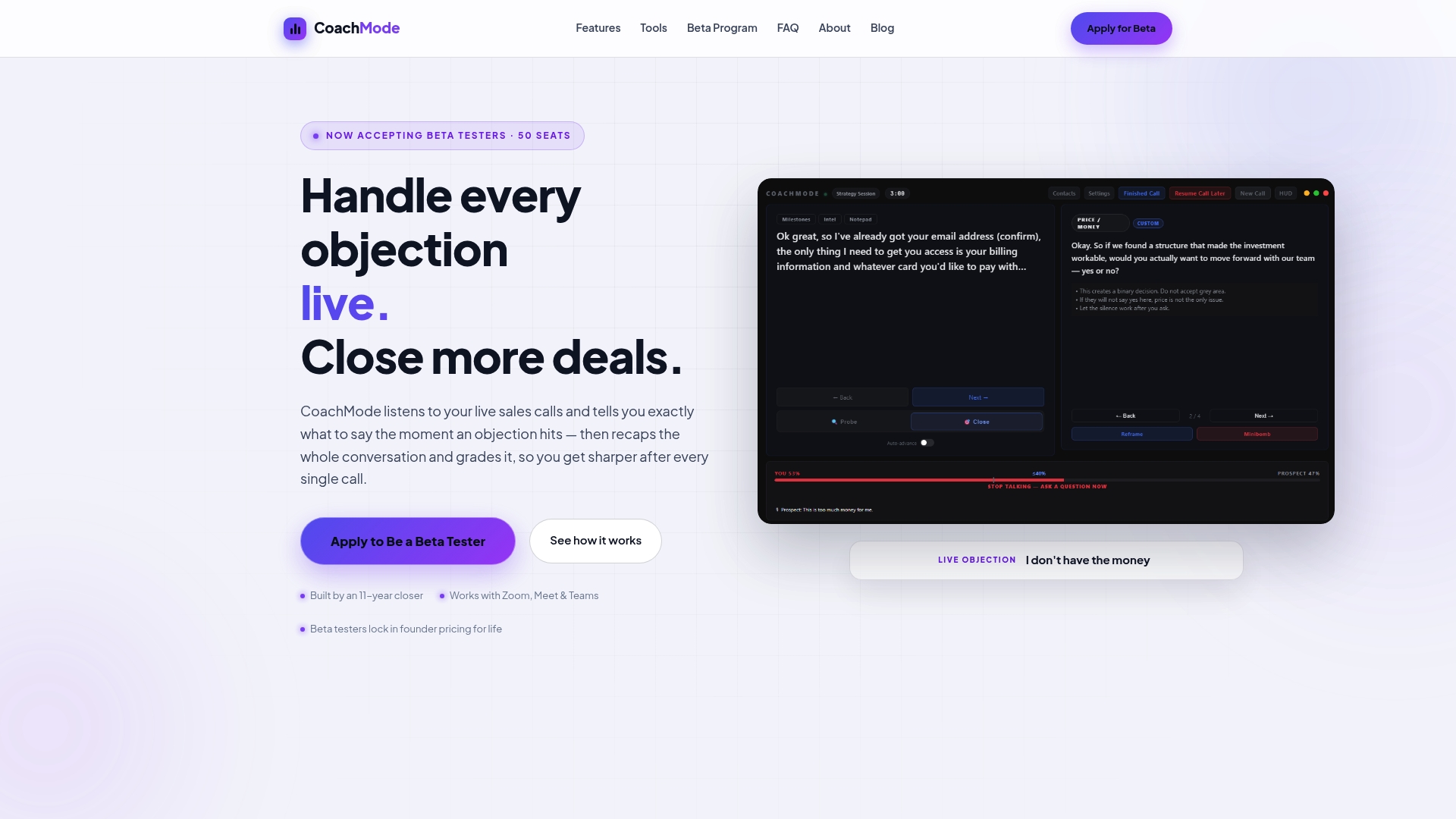
After the call, some solutions generate a scored recap draft automatically, built around the same decisions-and-next-steps structure covered throughout this piece. A rep still reviews it, confirming dates, names, and tone before it goes out, but the blank-page problem disappears. For teams running high volumes of high-ticket calls where consistent follow-up quality is the difference between a fast close and a stalled pipeline, that combination of live coaching plus an automated first draft removes the two weakest points in most sales workflows: performance under pressure during the call, and rushed, inconsistent recaps right after it. Explore how real-time AI sales coaching fits into your current call process and see what a scored recap draft looks like for your next deal.
Sources
For readers who want more downloadable formats or expanded examples beyond what’s covered here, a few sources are worth bookmarking. Sybill’s guide breaks down the seven sections a strong call summary should cover. Template.net’s editable recap template gives you a ready structure to adapt directly. AfterTheCall’s template pairs a summary format with a follow-up email draft built to export into a CRM. And for teams exploring meeting-note automation more broadly, Minuted turns calls into scannable notes automatically, worth a look if recap writing is eating more time than the calls themselves.
- Sales call summary guide — Sybill
- Call summary guide — MeetWave
- Meeting recap and our next steps — Hunter