When a prospect says “not interested,” acknowledge it in one line, reframe with a single specific question tied to their world, and ask for a tiny next step or exit cleanly. Something like: “Totally fair. Quick one, is this a bad time, or is the whole topic just not relevant right now?” That single move recovers more conversations than any rebuttal script ever will.
TL;DR:
- Most “not interested” responses are reflexive reactions, often tied to timing, misunderstanding, or internal approval rather than genuine rejection.
- Reading tone and pacing in the moment helps distinguish between irritation, distraction, or genuine disinterest, guiding appropriate responses.
- A three-step approach—acknowledge, reframe with a specific reason, and ask for a tiny commitment—improves chances of continuing the conversation.
- Speed, volume, and rapid rebuttals undermine recovery efforts; pausing and using a calm tone increases the likelihood of re-engagement.
- Logging tone, reason, and follow-up timing accurately enables better training, data-driven coaching, and higher objection recovery rates.
Table of Contents
- How to Handle the Not Interested Objection Without Sounding Pushy
- A Three-Beat Response Plus Six Scripts You Can Use Today
- Dos and Don’ts That Separate Recovery From Annoyance
- When to Stop and How to Log the Call
- Practice Drills, KPIs, and Scaling Better Responses
- Why Prospects Say No Before They’ve Even Heard the Offer
- Building Trust Before the Objection Ever Comes Up
- B2B and B2C Calls Need Different Playbooks
- The Mistakes That Turn a Maybe Into a Definite No
- Turning Objection Data Into a Repeatable System
- Coach Your Team Through Every Not Interested Objection Live
- Sources
How to Handle the Not Interested Objection Without Sounding Pushy
Most “not interested” replies aren’t decisions. They’re reflexes. The initial seconds of any cold call are dominated by an interruption response, the same instinct that makes you say “I’m fine, thanks” to a stranger who startles you on the sidewalk. The prospect hasn’t processed what you said. They’ve just processed that their phone rang and a stranger is talking.
That reflex is why treating an early “not interested” as final loses conversations that were never actually over. The words are identical whether someone is mildly annoyed or genuinely done with you, but the delivery tells you everything the words don’t.
Listen to how it’s said, not just what’s said:
- Clipped and sharp (fast, flat, cutting you off): usually reflex or irritation at the interruption itself, not rejection of the offer.
- Distracted or tired (“yeah, not interested,” trailing off, background noise): timing problem, not a content problem.
- Slow and thoughtful (a pause before the words, calmer tone): closer to a real assessment, and worth taking seriously.
Behind a generic brush-off, five things are usually really going on: they didn’t understand what you offer, you’re talking to the wrong person entirely, the timing is bad this quarter, they already have an incumbent vendor, or your opener tripped a mental “this is spam” filter. Tone and timing, more than the specific phrasing used, are what separate a genuine no from a reflexive one, and reading that signal correctly changes how hard you should push in the next 10 seconds.
A Three-Beat Response Plus Six Scripts You Can Use Today
The pattern is short: acknowledge, reframe, ask for a micro-commitment. Acknowledging removes the friction of being argued with. Reframing gives them one specific, low-stakes reason to keep talking. The micro-commitment asks for almost nothing, thirty seconds, one detail, a yes/no, so saying yes to it costs the prospect nothing.
This works because it mirrors the clarify, respond, confirm structure that turns an objection into a real conversation instead of a standoff. You’re not overcoming the objection. You’re finding out what it actually means.
Here are six variants, each suited to a different moment:
- The honest reset. “Fair enough, most people say that on a cold call. Can I ask one quick thing before you go?” Use this in the first five seconds when you sense pure reflex.
- The specificity hook. “Got it. Is it that [specific pain point] isn’t a priority, or that you already have something covering it?” Use this when the tone sounds distracted rather than annoyed.
- The wrong-person redirect. “No problem at all. Would this be more useful for whoever handles [specific function] on your team?” Use this when you suspect you dialed the wrong extension.
- The two-week ping. “Understood. Mind if I check back in a few weeks in case timing shifts?” Use this when the tone is calm but the “no” seems tied to bad timing, not disinterest.
- The contrast question. “Makes sense. Out of curiosity, what are you using for that right now?” Use this when you suspect an incumbent vendor is the real blocker.
- The graceful exit with a hook. “Understood, I’ll let you go. If it’s ever useful, [resource] is free, no pitch attached.” Use this when tone is sharp or clearly final, and you want to leave the door open without pushing.
For email, one short reply template covers most cases: “Appreciate the honesty. If it’s ever relevant, happy to send over [one specific resource] with no follow-up required.” That single line does more for your reply rate than a longer pitch ever would, because it asks for nothing back.
Dos and Don’ts That Separate Recovery From Annoyance
Tone and pace decide more than the words you choose. Slowing your speech and lowering your volume right after the objection signals confidence instead of desperation, and desperation is what prospects smell fastest.
Do this:
- Pause for a full second before responding, don’t rush to fill the silence.
- Drop your volume slightly. It reads as calm, not defensive.
- Validate the response before doing anything else (“fair enough” beats “but wait”).
- Ask exactly one gentle question, never a string of them.
- Make the ask as small as physically possible.
Don’t do this:
- Speed up your speech, it signals panic and triggers more resistance.
- Argue with the objection or explain why they’re wrong to feel that way.
- Guilt-trip (“I just need thirty seconds of your time” said twice).
- Repeat the same pitch, louder, as if volume fixes disinterest.
- Auto-enroll every “no” into the identical follow-up sequence without reading the tone first.
Pro Tip: Silence is a tool, not a gap to fill. After you ask your one question, stop talking completely. Most reps break their own recovery by adding a second sentence before the prospect answers the first. Count to three in your head if you have to.
When to Stop and How to Log the Call
Not every “not interested” deserves a second attempt, and pushing past a real no costs you more than the call. It costs list health, reputation, and sometimes compliance standing.
Treat these as final-no signals, stop immediately when you hear them:
- An explicit opt-out request (“take me off your list,” “please don’t call again”).
- A raised voice or genuine anger, not just clipped tone.
- A second or third repeated request to be removed after you’ve already acknowledged once.
That last point is the three-no rule: if a prospect tells you no three separate times across a call or a sequence, stop. Continuing past that point isn’t persistence, it’s just annoying someone who has already told you clearly. On timing, a callback window of a few weeks generally works, shorter for warm inbound leads who cited bad timing, longer for cold outbound where the incumbent or budget cycle is the blocker.
For email, a short and gracious closing reply does real work. Something like “Understood, I’ll close this out on my end. If anything changes, feel free to reach back out” protects your sender reputation and often produces useful feedback that a silent unsubscribe never gives you.
Practice Drills, KPIs, and Scaling Better Responses
Scripts memorized cold rarely survive a live call. What survives is a rep who has drilled the reaction enough times that tone and pacing become automatic under pressure.
- Run a three-stage drill weekly. Record a real objection moment, slow-play it back at half speed so the rep hears their own pacing and word choice, then have a peer critique tone specifically, not content. Five to ten minutes per rep is enough to move the needle.
- Track three numbers, not ten. Objection recovery rate (percent of “not interested” calls that continue past 30 seconds), call-to-conversation rate, and follow-up conversion rate on logged two-week pings. Pairing this measurement with short, consistent practice sessions is what actually moves scripts forward, not a one-time training day.
- Use live tools during the call itself. Getcoachmode listens in real time and surfaces a reframe question or micro-commitment prompt the moment it detects an objection pattern, then scores the call afterward so reps see exactly where tone or pacing broke down. Pulling from a structured sales objection library during practice keeps the six-script framework fresh instead of stale.
- Run a 10-minute objection clinic every week. Pull two or three real call snippets, play the moment right before and after the objection, and rewrite the response as a group using the response generator as a starting point. Iterate the script, don’t just repeat it.
Why Prospects Say No Before They’ve Even Heard the Offer
The interruption reflex isn’t just about rudeness, it’s wired into how people process unexpected requests. Saying no costs nothing in the moment, while saying “tell me more” feels like a small commitment the brain wants to avoid making to a stranger. That’s loss aversion showing up in a two-second decision.
There’s also pattern recognition at work. Most people have taken enough cold calls to recognize the shape of one within the first sentence, and their brain fast-forwards to the ending before you’ve finished your opener. The “no” arrives before genuine evaluation even starts, which is exactly why acknowledging it first, rather than immediately defending your offer, breaks the pattern instead of confirming it.
Worth separating clearly: this sales reflex has nothing to do with clinical loss of interest, a mental-health symptom sometimes called anhedonia. That’s a genuine and different condition worth taking seriously in its own context, but it’s not what’s happening on a cold call, and conflating the two misreads what’s actually a social and cognitive shortcut, not disengagement from life itself.
Status and control matter too. A prospect who feels like they’re being sold to reflexively protects their autonomy by refusing, even when the offer might genuinely help them. That’s why a tiny, low-pressure ask works better than a bigger one: it doesn’t threaten their sense of control the same way.
Building Trust Before the Objection Ever Comes Up
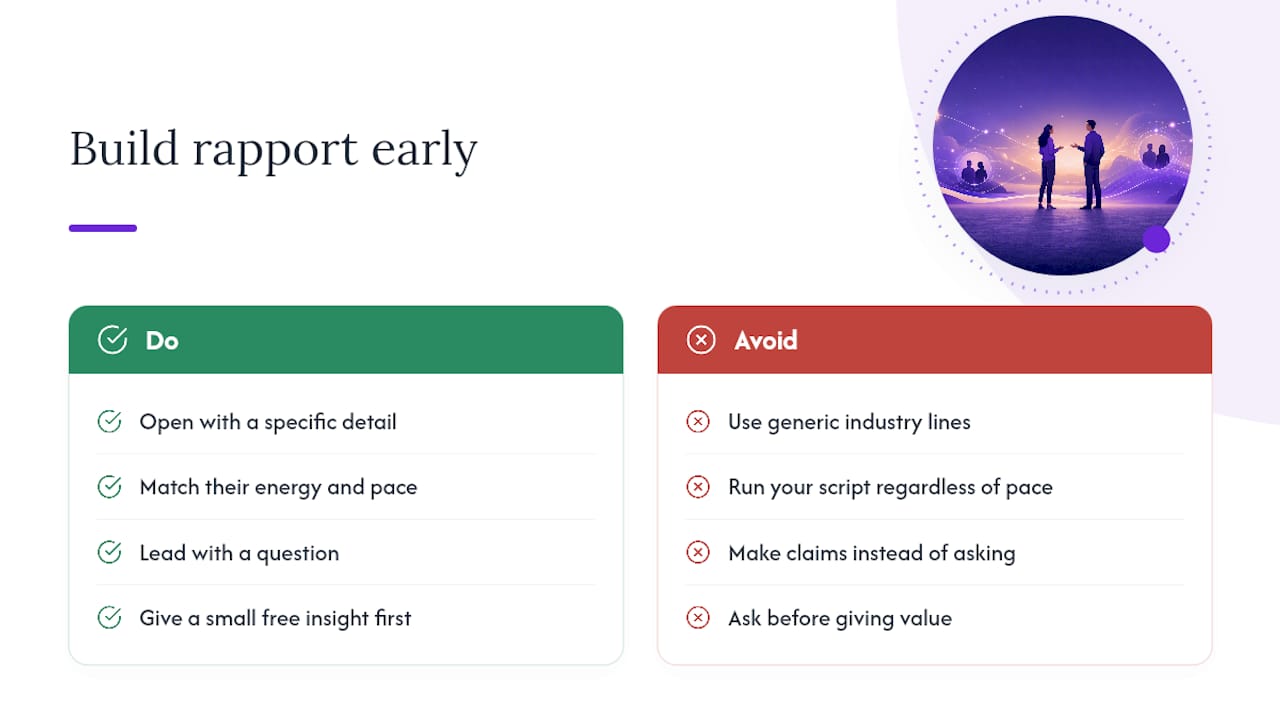
The best objection response is the one you never need because rapport was built before resistance kicked in. A few habits change how often “not interested” even shows up.
Open with something specific to them, not a generic industry line. “I noticed your team just expanded into [specific detail]” lands differently than “I help companies like yours grow revenue,” because it proves you did homework instead of dialing from a list. Specificity signals respect for their time, and respect lowers defensiveness before you’ve asked for anything.
Match their energy and pace instead of running your script at your own speed. If they answer slowly and thoughtfully, slow down. If they’re brisk and businesslike, get to the point fast. Mismatched pacing reads as tone-deaf even when the words are fine.
Lead with a question instead of a statement whenever you can. “Are you currently handling [specific function] in-house or outsourcing it?” invites a response. “We help companies handle [function] better” invites a brush-off, because it’s a claim, not an opening.
Give something away before you ask for anything. A relevant insight, a quick observation about their industry, a resource with no strings, these small unpaid deposits build enough trust that a request for thirty seconds doesn’t feel like an imposition. Reps who skip this step and go straight to the ask are the ones who hear “not interested” most often, and it’s rarely about the product.
B2B and B2C Calls Need Different Playbooks
Handling “not interested” in B2B looks different from B2C, mostly because of who’s actually deciding and what’s at stake for them personally.
In B2B, the person answering often isn’t the final decision maker, and their “not interested” might really mean “this isn’t my call to make” or “I don’t want to champion something internally right now.” The wrong-person redirect script does heavy lifting here, and a two-week or longer follow-up window makes sense because budget cycles and internal approvals move slowly. Multiple touchpoints across a sequence are normal and expected in B2B, since the sales cycle itself is longer.
In B2C, the person you’re talking to almost always is the decision maker, so “not interested” carries more finality on average. Personal budget, mood, and immediate relevance matter more than org charts. Shorter follow-up windows work better, often just a few days to two weeks, because personal circumstances shift faster than corporate budget cycles. The specificity hook and contrast question scripts tend to outperform the wrong-person redirect here, since there’s rarely a wrong person to redirect to.
The through-line in both contexts: acknowledge first, ask one question, and size your ask to match how much trust you’ve actually earned in the conversation so far.
The Mistakes That Turn a Maybe Into a Definite No
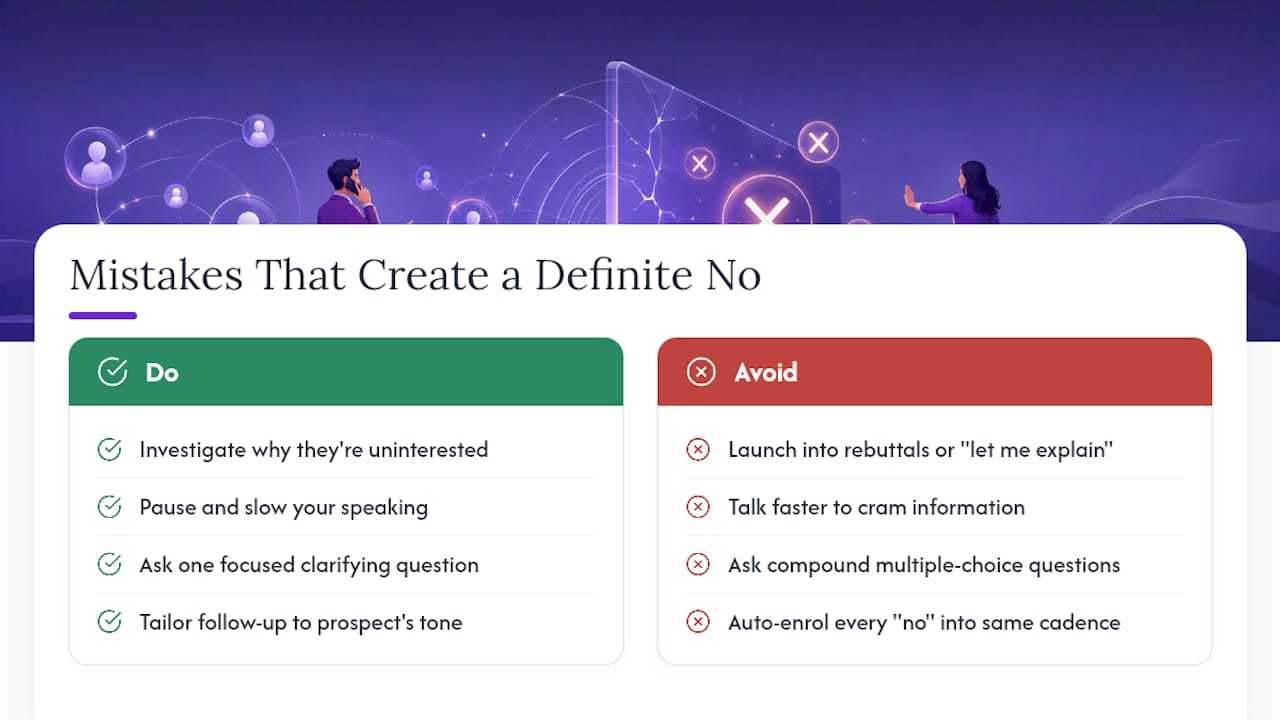
The single biggest mistake is treating “not interested” as a wall to push through rather than a signal to investigate. Reps who immediately launch into a rebuttal, “but have you considered,” “let me just explain,” confirm the prospect’s worst assumption: that this call is about the pitch, not about them.
Speeding up is a close second. Under pressure, reps instinctively talk faster to get more value in before the prospect hangs up, and that acceleration reads as anxiety, which makes prospects trust the offer less, not more.
Asking a compound question is another common trap. “Is it the price, the timing, or that you already have a solution?” forces the prospect to do work sorting through three options, and most people default to “just not interested” rather than parse a multiple-choice question from a stranger.
Auto-enrolling every “no” into the same follow-up cadence, regardless of tone, wastes the signal you just received. A sharp, angry “not interested” and a distracted, rushed one deserve completely different next steps, and treating them identically means you’ll keep annoying the people who told you clearly to stop while under-following-up with people who were simply busy.
Finally, many reps skip logging the disposition accurately, marking everything as a generic “no” instead of noting tone, likely reason, and appropriate follow-up timing. That data gap means the next rep, or the next campaign, repeats the same mistake with the same prospect.
Turning Objection Data Into a Repeatable System
Training reactions matters more than memorizing rebuttals, because the objection itself is never the real problem. The tone underneath it is. A rep who can read clipped versus distracted versus thoughtful in real time will outperform a rep with twenty scripts memorized but no ear for delivery.
The rollout that works isn’t complicated: weekly clinics using real call snippets, consistent call scoring against the same few KPIs, and a logging standard that captures tone and likely reason, not just “no.” Teams that skip the logging step lose the compounding value entirely, because next quarter’s follow-up plan depends on this quarter’s data being accurate.
What surprises most managers is how little the actual script matters once tone and pacing are dialed in. The same six words, said slower and with one genuine pause, recover calls that a faster, “better-worded” version never would.
— Ryan
Coach Your Team Through Every Not Interested Objection Live
Reading tone correctly and picking the right script variant sounds simple on paper. Doing it in real time, mid call, with a prospect already halfway to hanging up, is a different skill entirely, and it’s the exact moment most reps freeze or default to a rebuttal that makes things worse.
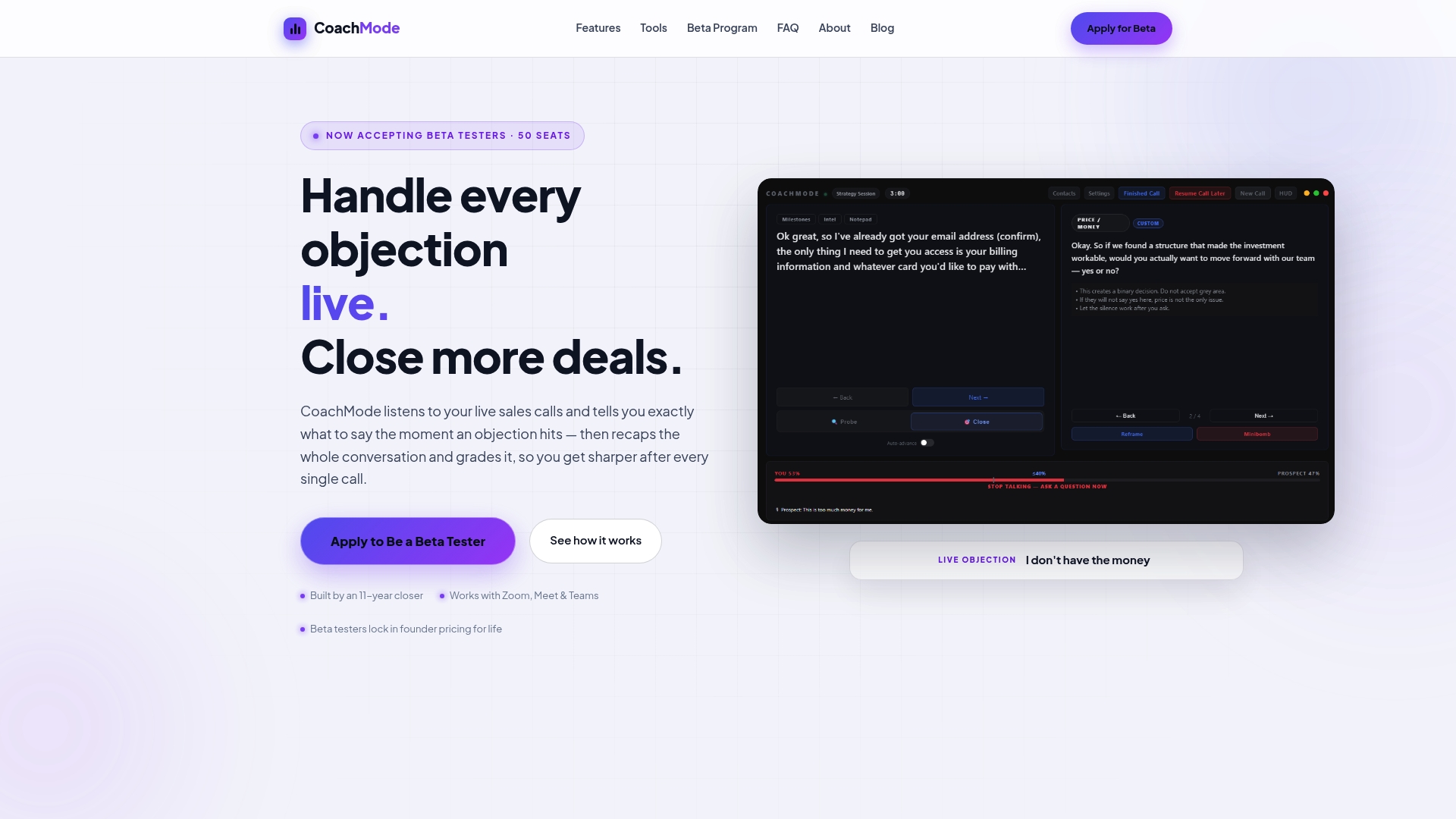
Real-time AI sales coaching software can listen to live calls and surface specific reframe questions or micro-commitment prompts the moment a “not interested” pattern is detected, helping reps get the right words at the moment they need them. After the call, post-call scoring shows exactly where tone or pacing broke down, turning every objection into a data point instead of a guess. Sales managers running weekly objection clinics can pilot real-time coaching tools on live Zoom, Google Meet, or Teams calls and see the recovery rate shift within a few weeks. Start a trial of real-time sales coaching software and run objection clinics with real-time prompts backing up your reps instead of memorized scripts alone.
Sources
- How to Handle ‘Not Interested’ on Cold Calls and Cold Email (2026) | MapsLeads
- We’re Not Interested: What It Really Means and How to Respond
- How to Respond to ‘Not Interested’ in Sales | LogicNotes
- Otter
- Things to Do If You Feel a Loss of Interest | Verywell Mind