Most sales call red flags fall into four buckets: engagement, decision process, financial terms, and behavior. When you spot one, the move is almost never to keep pitching. It’s to probe once with a specific question, then disqualify or escalate based on the answer. Everything below gives you the exact wording for both.
TL;DR:
- Deals are most likely to die when there is no decision-maker present or the decision process is unclear, making early qualification essential.
- Slow response times, silence after proposals, and unqualified stakeholder groups often indicate a deal is stalling or no longer a priority.
- Vague timelines and price inquiries before defining the problem suggest prospects are collecting quotes or avoiding internal discussions, not evaluating fit.
- Regularly logging and reviewing red flags in your CRM helps identify patterns that can prevent overestimating deal certainty and improve forecast accuracy.
- Disqualify deals based on patterns of evasiveness or unresolved flags, using a structured process to protect your pipeline’s integrity and time.
Table of Contents
- The Sales Call Red Flags That Predict a Dead Deal
- How to Probe: Questions That Force a Real Answer
- Buying Signals vs. Red Flags: When to Stop Pitching
- When to Disqualify: A Next-Steps Framework
- How Live Coaching Catches What Reps Miss
- Why Red Flags Wreck Forecast Accuracy More Than Bad Luck
- Building a System to Track Red Flags Instead of Just Noticing Them
- Why Buyers Send These Signals in the First Place
- Getting a Stalled Deal Back on Track
- How Red Flags Shift Across Sales Industries
- A Manager’s Weekly Routine for Catching Red Flags
- Catching Red Flags Live, Not After the Call Ends
- Sources
The Sales Call Red Flags That Predict a Dead Deal
Not every warning sign carries the same weight. A prospect who talks over you is annoying, but a prospect who won’t name a decision date is the one killing your forecast. Order matters here, so the list below moves from the flags with the highest predictive power (timing and ownership) down to ones that matter but rarely sink a deal alone.
-
No decision-maker in the room. If the person on the call can’t approve spend, you’re doing discovery for someone who isn’t there. Response: “Who besides you needs to say yes to this, and can we get them on a 10-minute call this week?”
-
Vague timeline with no trigger event. “We’re looking at this sometime next quarter” with no reason attached usually means there’s no real urgency yet. Response: “What happens if you don’t solve this by [date]? What’s driving the timing?”
-
Asks for price before you’ve discussed the problem. This isn’t always bad, but paired with short answers elsewhere, it signals they’re collecting quotes, not evaluating fit. Response: “I can get you a number, but it’ll be way more useful if I understand what you’re trying to fix first.”
-
“Just send me some information.” This line is more often a polite exit than genuine interest. Follow up by testing specificity instead of re-pitching: “Happy to. What specifically do you want the deck to cover so I’m not wasting your time?”
-
Loss of velocity. Response times stretch from hours to days, meetings get rescheduled twice. Slow, subtle momentum loss kills more deals than any objection does, according to SalesIntroverts’ analysis of deal-killing patterns. Response: “I’ve noticed things have slowed down on our end. Is this still a priority, or has something shifted?”
-
Silence after a proposal. No response for a week after you’ve sent pricing is a stall, not a maybe. Response: a short, direct check in rather than another follow-up pitch: “Should I take this off your plate for now?”
-
Constant scope creep or new requirements. Every call adds a feature request with no urgency to close. Response: “Let’s lock the scope we’ve discussed and revisit additions after we’re live.”
-
Unfavorable payment terms or margin pressure. Watch for demands for extended terms, heavy discounts, or hidden-cost objections. SalesFuel’s guidance on financial red flags treats these as early signs the deal won’t be profitable even if it closes. Response: “Here’s what we can flex on, and here’s what we can’t.”
-
Too many stakeholders, no clear owner. A growing committee with nobody accountable for the decision is one of the clearest signs a deal is stalling, not maturing. Response: “Of everyone involved, who actually makes this call?”
-
Evasive or contradictory answers. Budget answers change between calls, or the “why now” story shifts. The Brooks Group’s list of qualifying red flags puts evasiveness right alongside unresponsiveness as reasons to disqualify early rather than chase.
-
Disrespect or manipulative pressure tactics. Threats to walk, dismissive comments about your time, or attempts to pit you against a competitor’s lowest quote. Response: hold your position calmly, then decide if this is a client relationship worth having.
Pro Tip: Keep this list next to your CRM during calls. The moment you hear one of these, write it down immediately, even mid-sentence. Reps who wait until after the call to log red flags forget the exact wording, which is usually the most useful part.
How to Probe: Questions That Force a Real Answer
Vague answers deserve a specific follow-up, not a re-pitch. The goal is curious, not confrontational: you’re asking because you want to help them build a case internally, not because you’re suspicious.
- Timeline: “What would it take to start by [specific date]? Who needs to approve that internally?”
- Budget: “What budget has been allocated for this priority this year?”
- Decision process: “Who else needs to sign off, and can we get them on a quick call this week?”
- Competitor context: “What other solutions are you evaluating, and what’s drawing you to them?”
Each of these questions has one job: replace a soft, non-committal answer with a name, a number, or a date. If the prospect can’t answer with specifics after a direct ask, that’s information too. SalesGravy’s advice on handling red flags is blunt about this: top performers question red flags the moment they appear rather than hoping the deal resolves itself.
Pro Tip: Log the answer in your CRM the same minute you get it, and move the deal stage right then. A red flag you note but don’t act on in your pipeline is worse than one you never caught. Discovery frameworks like these hidden buying criteria can help you build these probes into a repeatable sequence.
Buying Signals vs. Red Flags: When to Stop Pitching
Buying signals and red flags often show up in the same call, and confusing them is what wrecks forecasts. Strong buying signals include questions about implementation, contract terms, or “when” instead of “if” language, plus requests for paperwork. Negative signals include the flat “just send me information” line, vague “maybe next quarter” answers, and dead silence after a proposal goes out.
Video calls add their own tells. Camera off during a demo, visible multitasking, or note-taking with no follow-up questions are red flags. New stakeholders quietly added to the invite without context can be either, depending on whether an owner is driving it.
The decision rule is simple: when a cluster of buying signals appears, stop presenting and propose a specific next step. One useful heuristic from that same research is that the second time a prospect asks a timing question, that’s your cue to name a start date on the spot rather than keep explaining features.
- Strong signal: two timeline questions in one call. Act: propose a start date immediately.
- Strong signal: they ask for the contract or SOW. Act: send it within the hour.
- Weak/negative signal: “send me info” with no follow-up question. Act: test specificity before re-pitching.
- Weak/negative signal: silence for a week post-proposal. Act: a short check-in, not another pitch.
When to Disqualify: A Next-Steps Framework
Disqualifying isn’t giving up. It’s protecting your pipeline’s accuracy and your own time. A repeatable framework beats gut calls made mid-call under pressure.
- Align. Restate what you’ve both agreed on: “So the plan was to get budget approval by Friday. Is that still accurate?”
- Propose. Give one specific next step with a deadline: “If we don’t have a signed budget confirmation by [date], I’ll assume this isn’t a priority right now.”
- Decide. If the deadline passes with no movement, close the opportunity in your CRM rather than let it linger as a phantom forecast line. If there’s a real reason for delay, park it with a specific re-engagement date instead of leaving it open indefinitely.
The trigger for step three is usually two or more unresolved flags: no named owner plus a missed deadline, or repeated evasiveness plus silence after a proposal. One flag alone rarely justifies walking away. A pattern does.
Disqualify with respect, not with a cold drop. A short, honest note (“Looks like the timing isn’t right, let’s reconnect in Q3”) keeps the door open and keeps your reputation intact for the next deal with that same buyer.
How Live Coaching Catches What Reps Miss
Most reps don’t miss red flags because they don’t know the list. They miss them because they’re mid-sentence, managing their own nerves, and the moment passes before they react.
- Real-time prompts surface the right probe question the instant a flag appears, instead of three minutes later when the conversation has moved on.
- Suggested objection language keeps a rep from freezing when a prospect pushes back on terms or timeline.
- Post-call scoring flags which probes got skipped, turning a vague feeling of “that call didn’t go well” into a specific coaching point.
This shifts skill-building from something that happens after the damage is done to something that happens inside the call itself, which is exactly where these flags need to be caught.
Why Red Flags Wreck Forecast Accuracy More Than Bad Luck
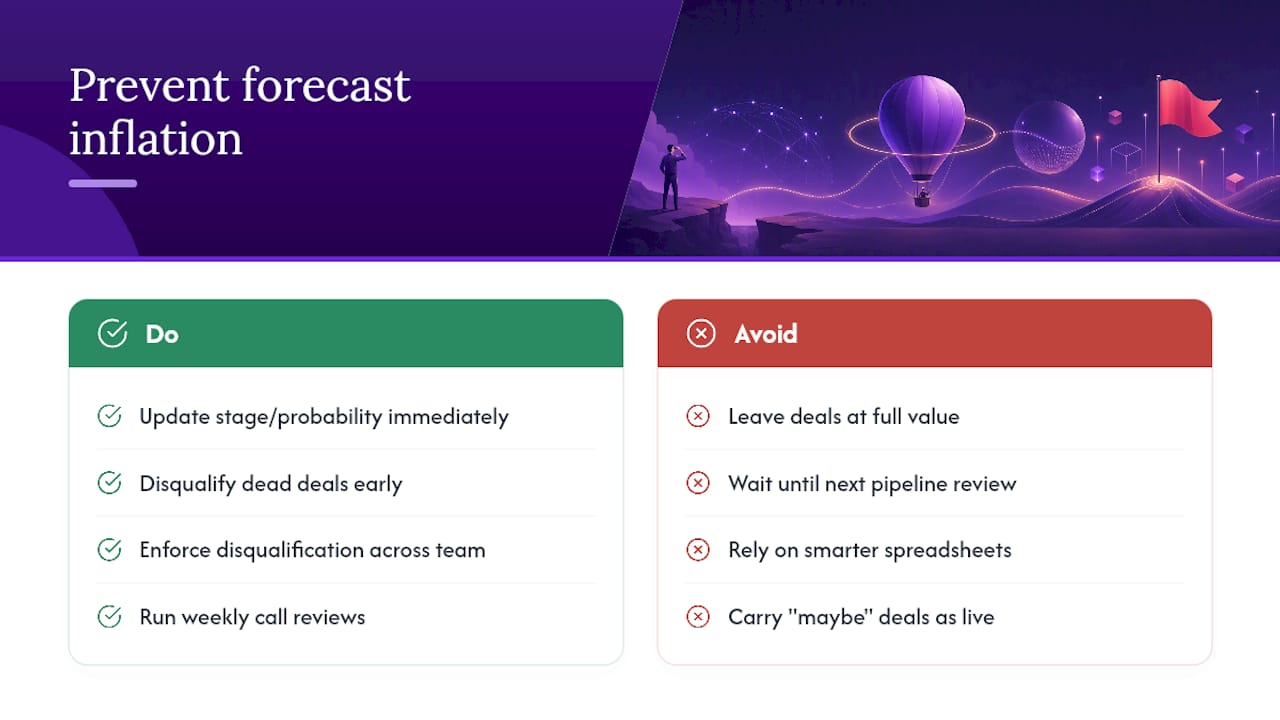
A pipeline full of unresolved red flags is a pipeline built on hope, not data. When reps note a flag but don’t act on it, that deal stays in the forecast at full value, inflating the number a sales manager reports upward. The gap between forecasted and actual close rate almost always traces back to deals that should have been disqualified two or three calls earlier.
This compounds at the team level. If five reps each carry two “maybe” deals that are really dead, a manager’s quarterly forecast can be off by a meaningful chunk of pipeline, not because reps are bad at their jobs, but because nobody enforced the disqualification step. Weighted forecasting models assume a rep’s stage assignments reflect reality. A deal sitting in “proposal sent” for six weeks with no response isn’t a 60% probability close. It’s closer to zero, and leaving it staged incorrectly throws off every roll-up above it.
The fix isn’t a smarter spreadsheet. It’s discipline at the point of contact: the moment a red flag appears, the deal stage or probability score gets updated immediately, not at the next pipeline review. Managers who build this into weekly call reviews consistently report cleaner forecasts, because the data reflects what actually happened on the call rather than what a rep hoped would happen next.
Building a System to Track Red Flags Instead of Just Noticing Them
Noticing a red flag mid-call is only useful if it gets captured somewhere that changes what happens next. Most reps mentally note a flag and move on, which means the same warning sign shows up again three calls later with nobody connecting the dots.
A simple system works better than a complex one. Add a custom field to your CRM for red flag type (engagement, decision process, financial, behavioral) and log it the same day, ideally the same hour, as the call. Pair it with the specific quote or moment that triggered the note, not just a checkbox. “No owner identified, prospect said ‘I’ll loop in my boss eventually’” is more useful six weeks later than a generic flag tag.
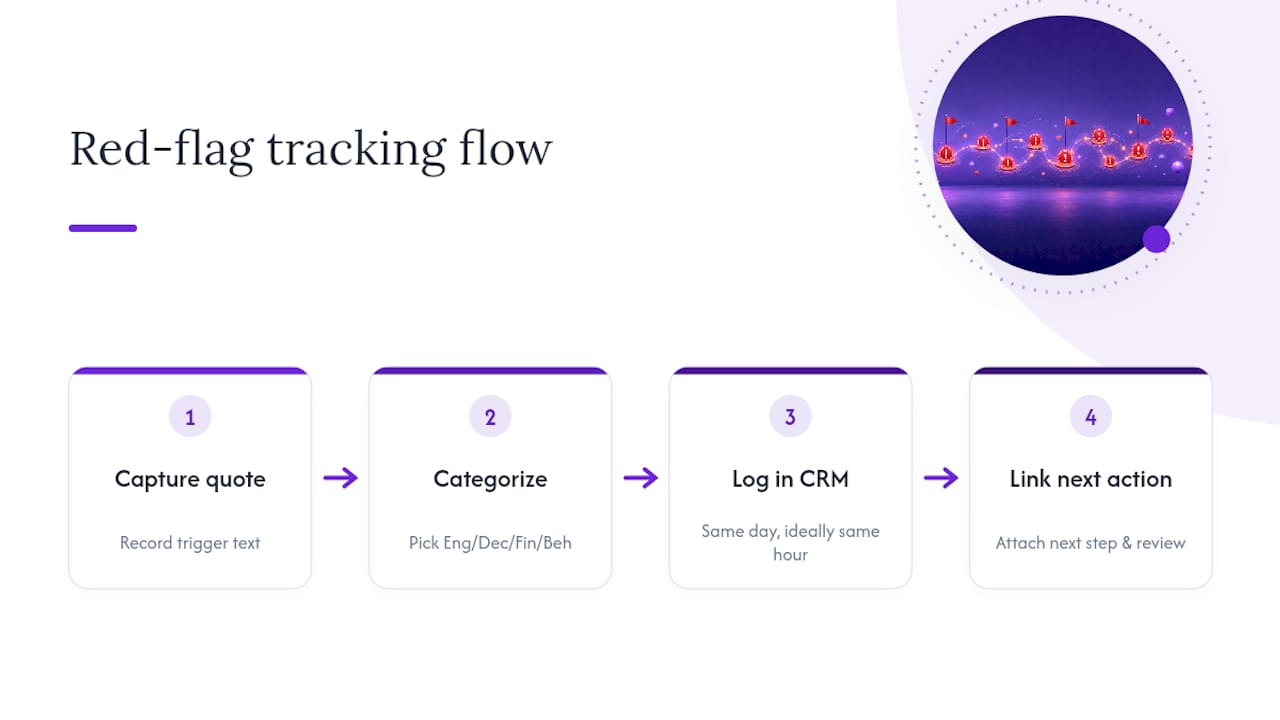
Managers should review flagged deals as a category during pipeline meetings, not just deal by deal. Patterns emerge fast this way: if a third of one rep’s flagged deals are all “no decision-maker,” that’s a discovery-call problem, not a bad-luck streak. Tools built for tracking sequences from discovery to decision make this easier because the flag and the question that surfaced it live in the same record.
Why Buyers Send These Signals in the First Place
Most red flags aren’t manipulation. They’re avoidance. A buyer who says “just send me info” usually isn’t trying to dodge you specifically. They’re avoiding the harder internal conversation of admitting they don’t have budget authority, or that their boss hasn’t bought into the project yet.
Vague timelines work the same way. Committing to a specific date creates accountability the buyer may not be ready to own, especially if they’re not fully convinced internally. Silence after a proposal often means the buyer is stuck between wanting the solution and dreading the internal selling job required to get it approved. It’s easier to go quiet than to admit “I don’t think I can get this approved.”
Understanding this changes how you build their internal case. Instead of treating a vague answer as resistance to push through, treat it as a signal the buyer needs help building their internal case. A question like “What would make this an easy yes for your boss?” often gets further than pressing harder on the original ask, because it reframes you as an ally solving their internal problem instead of another vendor asking for a decision.
Getting a Stalled Deal Back on Track
A red flag doesn’t have to mean the deal is dead. It means the current approach isn’t working, and continuing to send the same follow-up email won’t change that.
The most effective re-engagement move is to change the value of the message, not just the timing. Instead of “just checking in,” bring something new: a relevant case result, a change in pricing or terms, or a direct question about what changed on their end. Silence after a proposal often means priorities shifted internally, so asking “has something changed on your end?” gets a far better response rate than a generic nudge.
Give re-engagement a real deadline in your own pipeline, not an indefinite “keep following up” status. A common approach: three attempts with genuinely different angles over three to four weeks, then park the deal with a specific future check-in date tied to a known trigger, like a renewal cycle or budget season. This keeps your forecast honest while still leaving room for the deal to come back when circumstances actually change.
How Red Flags Shift Across Sales Industries
The core red flags stay consistent across industries. The severity and meaning of specific flags shift depending on what you’re selling.
In high-ticket B2B software, the biggest flag is usually stakeholder sprawl without a named owner, since enterprise deals often route through procurement, legal, and multiple department heads before a signature happens. In agency or consulting sales, price-first questions carry more weight as a red flag, because a prospect focused purely on cost before scope is often shopping, not evaluating fit. In real estate or high-ticket physical goods, silence after a walkthrough or demo tends to signal a financing concern the buyer hasn’t voiced yet, rather than lost interest. In subscription SaaS, the “send me info” line is often less damaging than in high-touch sales, since a self-serve trial can quietly answer questions a call never will.
Recognizing which flags matter most for your specific sale keeps you from treating every warning sign as equally urgent, which is its own kind of mistake.
A Manager’s Weekly Routine for Catching Red Flags
Run one role-play a week where you play a prospect throwing out a classic red flag, mid-call, no warning. Swap roles halfway through. It’s uncomfortable at first, and that discomfort is exactly why it works better than a slide deck on qualification.
Pull call scorecards across the team monthly, not just per rep. If three reps are all missing the same probe, that’s a training gap, not a coincidence. Reward reps who disqualify a bad-fit deal cleanly and on time. Protecting capacity for real opportunities is worth more than a padded pipeline that looks good in a Monday meeting but falls apart by quarter’s end.
— Ryan
Catching Red Flags Live, Not After the Call Ends
Every red flag on the list above shares one problem: reps notice them but react too late, usually after the call, when the moment for a sharp probe has already passed. A real-time coaching tool listens in real time and surfaces the exact question or objection response you need while the prospect is still talking, whether that’s a probe for a missing decision-maker or a script for pushback on payment terms. After the call, its scoring shows exactly which probes got skipped, so the next call is sharper than the last.
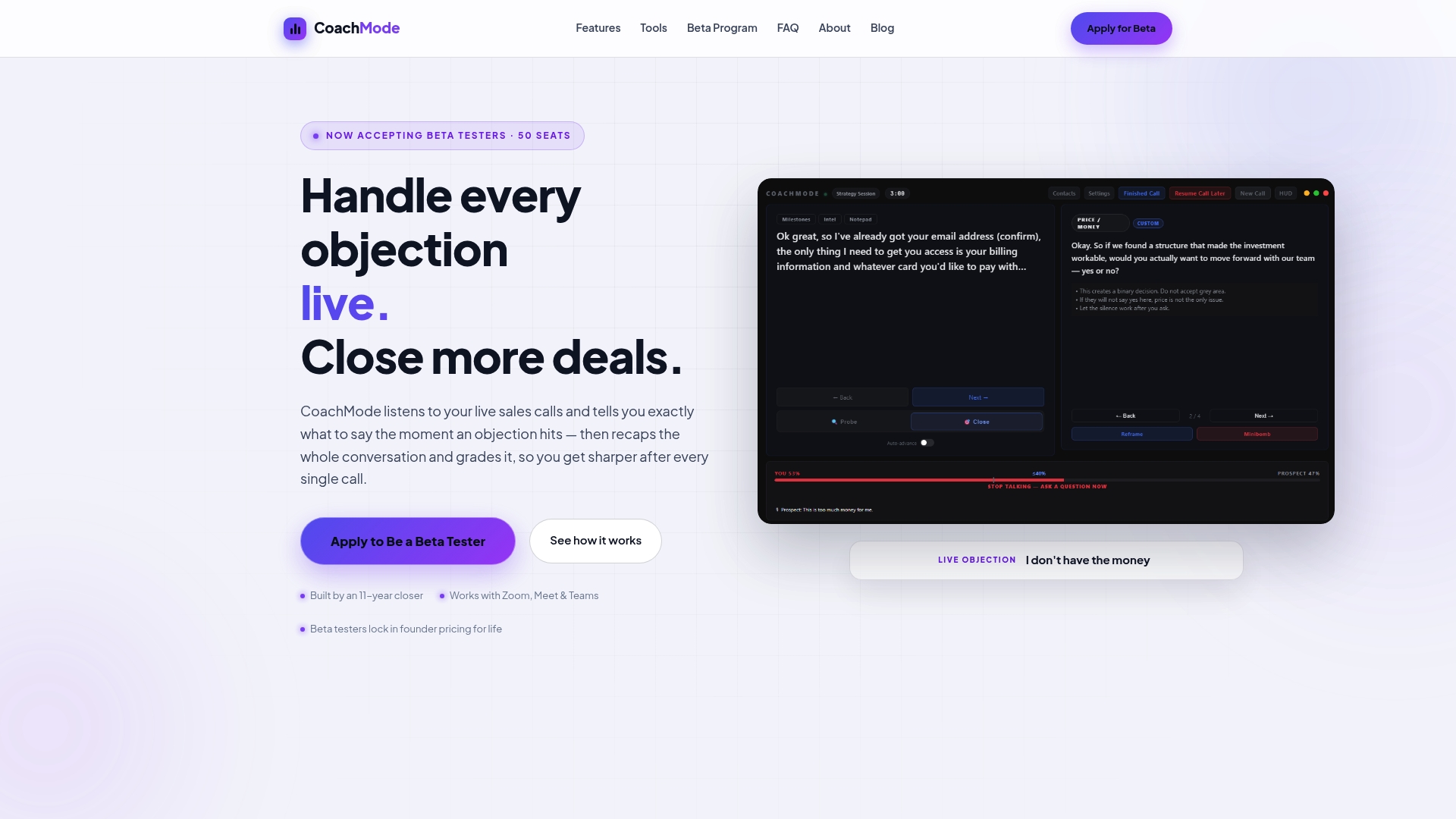
If you’re evaluating any live-call coaching tool, check four things before committing: does it integrate with the platforms you actually use (Zoom, Google Meet, Teams), how much lag exists between what’s said and what’s suggested, can you customize prompts to your own script, and is the post-call scoring specific enough to coach from rather than just a generic grade. Some tools are designed specifically for high-ticket closers and sales teams running live discovery and qualification calls.
See how it works on live calls with AI sales coaching built for real-time objection handling, or get the full picture on the CoachMode product page and start a trial to see it on your next call.
Sources
- Qualifying Sales Prospects: 8 Red Flags Your Buyer Isn’t Ready
- 10 Sales Deal Warning Signs That Kill Deals Before You Know It
- Verbal vs Non-Verbal Buying Signals (With Examples)
- How To Deal With Red Flags