A tight demo built on real discovery, followed by an explicit ask before you hang up, is the single biggest lever on your demo-to-close rate.
TL;DR:
- A demo based on real discovery and ending with an explicit call to action can significantly boost the demo-to-close rate, especially when combined with a disciplined 25-minute structure.
- Proper qualification before booking a demo involves confirming a clear pain, budget, decision owner, and timeline, with rescheduling if two or more criteria are missing.
- Segmenting demo success metrics by deal size and rep helps identify where process improvements or coaching are most needed to increase closing rates.
- Implementing real-time AI coaching during demos improves objection handling, keeps demos concise, and reinforces disciplined techniques that outperform charisma alone.
- Following up within the first week with a recap, ROI summary, and next steps sustains momentum and increases the likelihood of deal progress.
Table of Contents
- What Does “Demo to Close” Actually Measure?
- Why Discovery Determines Whether the Demo Can Close
- The 25-Minute Demo: A Minute-by-Minute Structure
- How Do You Ask for the Close on a Demo Call?
- What Should Happen in the First Week After the Demo?
- [Which Sales Performance Actually Predict Close Rate Improvement?](#which-sales-performancehttpssales-phoenixcomsales-performance-actually-predict-close-rate-improvement)
- Where Real-Time Coaching Fits Into the Demo Motion
- Why Discipline Beats Charisma on a Demo Call
- Get Live Coaching on Every Demo Call With CoachMode
- Sources
- FAQ
What Does “Demo to Close” Actually Measure?
Demo-to-close is the percentage of demos that end in a signed deal, and it’s easy to confuse with two other metrics that measure something different. Demo-to-next-step tracks whether the buyer agreed to any forward motion, a follow-up call, a trial, a proposal review. Demo-to-opportunity, used more by marketing and SDR teams, tracks whether a demo produced a qualified pipeline entry at all. Only demo-to-close tells you whether your presentation actually turns into revenue.
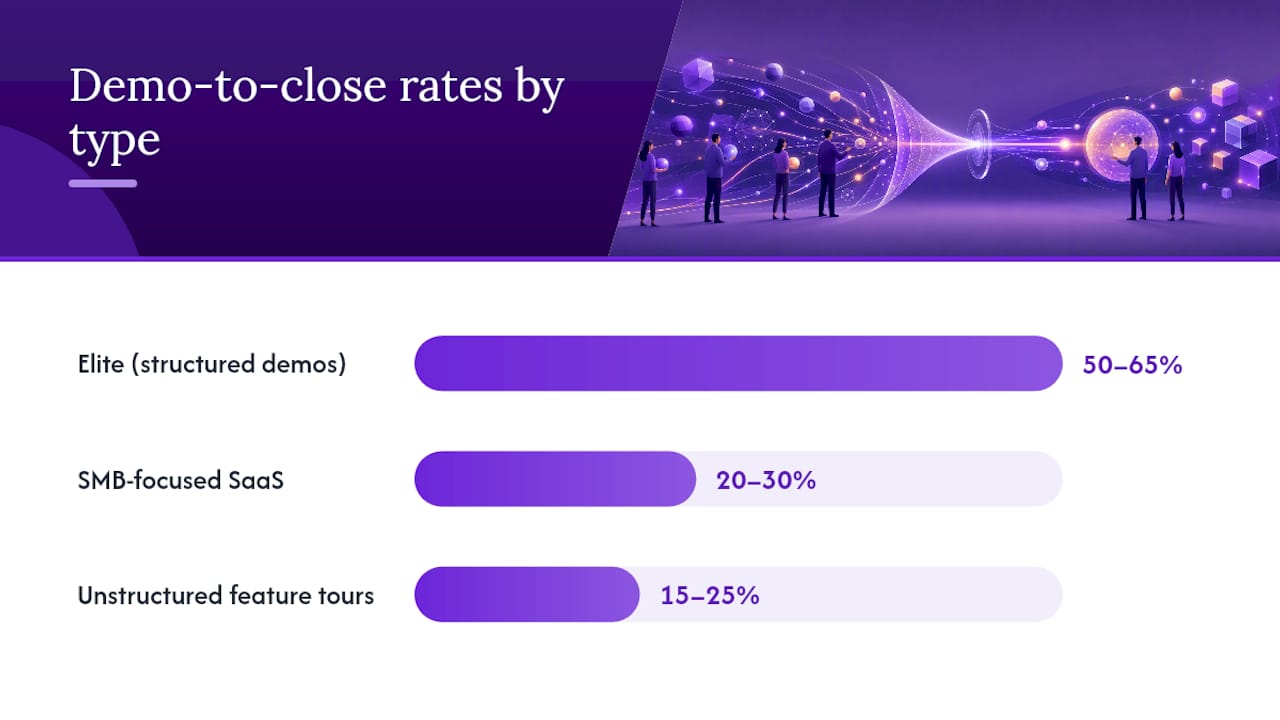
Benchmarks vary sharply by deal size and buyer type. SMB-focused SaaS with shorter sales cycles and single decision-makers often see demo-to-close rates in the 20 to 30% range, while enterprise deals with committees and procurement steps tend to run lower per individual demo since multiple demos happen before a decision. The gap between average and elite performance is enormous: teams running a disciplined, structured demo process can reach demo-to-close rates of 50 to 65%, compared with 15 to 25% for reps running unstructured feature tours.
To set your own baseline:
- Pull your last 90 days of completed demos and divide closed-won deals by total demos delivered.
- Segment that number by deal size, industry, and rep, since blending them hides where the real problem sits.
- Set a 90-day target improvement of 10 to 15 percentage points rather than an arbitrary “double it” goal, which is rarely achievable without changing the underlying process.
Quick benchmark: Demos built on real discovery close roughly 40% more often than demos where the AE skips straight to a feature walkthrough.
Why Discovery Determines Whether the Demo Can Close
A demo can’t close a deal that was never qualified to close. Before you book the call, you need four things confirmed, not assumed: a named pain the buyer will admit to out loud, a rough budget range or willingness to discuss one, a clear decision owner (even if they’re not on the call yet), and a timeline tied to a real business event, not “sometime this quarter.”
Four questions do most of the work in a discovery call:
- “What happens if this doesn’t get solved in the next two quarters?” This surfaces the cost of inaction, which is your ROI anchor later.
- “Who else touches this decision, and what do they care about?” This builds your stakeholder map before the demo, not during it.
- “What would need to be true for you to say yes at the end of a demo?” This gets the buyer to state their own success criteria, which you can then mirror back in minute one of the demo.
- “Has budget been discussed for solving this, even informally?” A vague “we’d need to figure that out” is a yellow flag, not a dealbreaker, but it changes how hard you push for a close ask.
If two or more of the four qualification criteria are missing, don’t book the demo yet. Reschedule into a second discovery call instead. A demo run against a half-qualified buyer wastes a slot that could go to a deal ready to move, and it trains the buyer to see your product as informational rather than decision-grade.
Pro Tip: Ask the timeline question twice, once early and once right before you book the demo. Buyers often soften their urgency once they realize a real evaluation is starting, and catching that shift before the call saves you from pitching to someone who was never going to move this quarter.
The 25-Minute Demo: A Minute-by-Minute Structure
A disciplined 25-minute structure outperforms the open-ended, hour-long walkthrough most AEs default to, largely because it forces you to cut everything that isn’t tied to a named pain. Here’s the breakdown:
- Minutes 0 to 3, mirror discovery. Restate the three pains the buyer mentioned in your discovery call, in their language, and confirm nothing has changed. This does two things: it proves you listened, and it locks the buyer into the frame you’re about to demo against.
- Minutes 3 to 15, three features, three pains. Show exactly three capabilities, each mapped directly to one of the pains you just restated. Resist the urge to add a fourth “cool feature” tangent. Buyer recall and engagement drop sharply once a demo runs past 25 to 30 minutes of product content, so every extra minute you spend on something unrequested is a minute stolen from the close.
- Minutes 15 to 20, ROI and pricing. Walk through the cost of the problem versus the cost of your solution using numbers the buyer gave you in discovery, not generic industry averages.
- Minutes 20 to 25, the explicit ask. State plainly what you want to happen next and ask for it.
Choosing the right three features matters as much as the timebox itself. Pull them straight from your discovery notes, not your default demo script, and prepare a real example or data point for each one rather than a generic screen click-through.
To keep the buyer engaged instead of watching passively:
- Ask “does this match what you were picturing?” after each of the three feature segments, not just at the end.
- Hand control back to the buyer periodically: “Want me to click into that, or should we move to pricing?”
- Watch for a stakeholder going quiet, and pull them back in by name: “Sarah, does this change anything from a finance angle?”
How Do You Ask for the Close on a Demo Call?
The last five minutes of the demo are where most AEs go soft, and it’s the single most fixable habit in the whole process. Two asks work consistently:
- The paperwork ask: “Based on what we’ve covered, I’d like to send over the agreement today. Is there anything blocking us from getting this signed this week?” This surfaces objections you can handle live instead of over email three days later.
- The next-step owner and date ask: “Who owns getting this in front of [decision maker] and what date works to reconvene?” Naming an owner and a date, not just “let’s touch base soon,” is what separates a real next step from a polite brush-off.
When the buyer stalls with “we need to think about it,” don’t accept it at face value. Ask: “What specifically do you need to think through, budget, timing, or fit?” That question alone converts a vague stall into a workable objection more often than not.
When they say “I need to involve others,” respond with: “Makes sense. What would help them say yes, a short recording of what we just covered, or a one-page summary of the numbers?” This turns a stall into a concrete leave-behind task you control.
If the ROI conversation stalled earlier in the call, rerun it live rather than promising to “follow up with numbers.” Say: “Let’s do the math together right now, it takes two minutes.” Buyers trust math they watched you build more than math you email them later.
Pro Tip: Never let “we need to think about it” end the call unchallenged. It’s the sales equivalent of a buyer politely closing a door you haven’t finished walking through, and one clarifying question usually reopens it.
What Should Happen in the First Week After the Demo?
Momentum decays fast after a demo, and the follow-up sequence you run in the first seven days determines whether that momentum survives contact with the buyer’s internal politics.
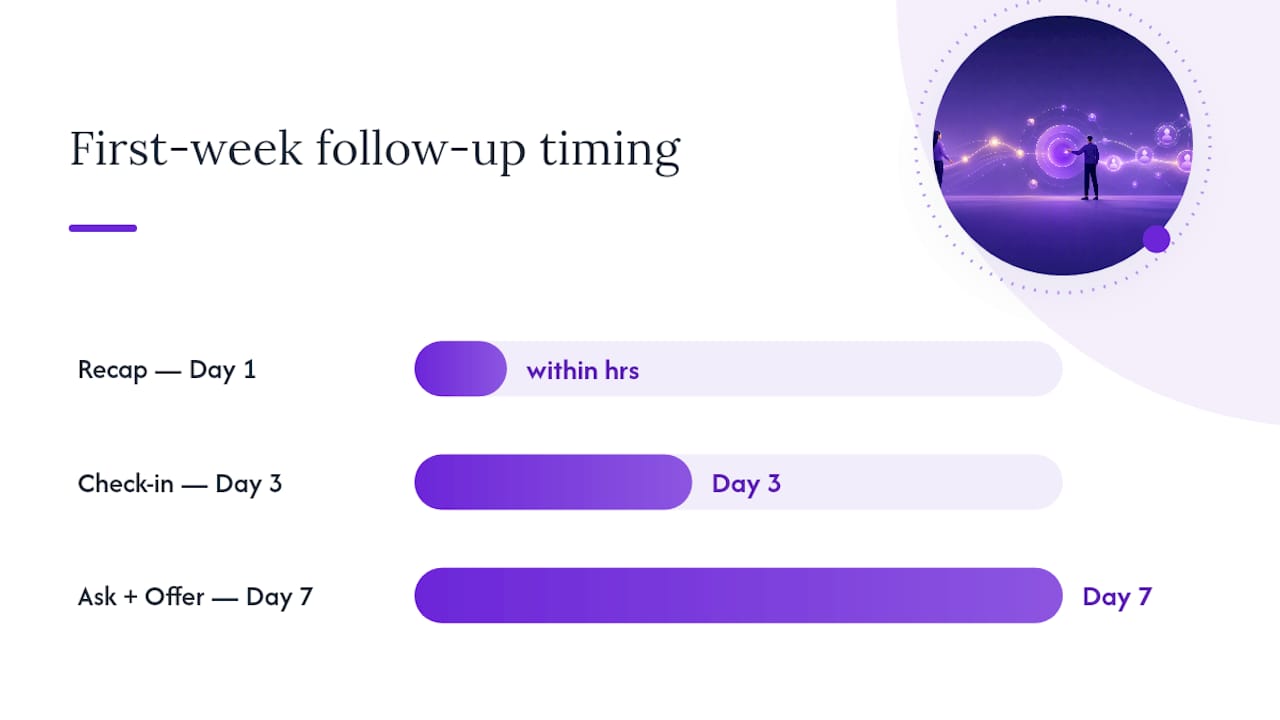
Send a same-day recap that includes five elements: a short written recap of what was covered, an ROI snapshot using the buyer’s own numbers, a leave-behind one-pager, the demo recording if the call was recorded, and named next steps with dates attached. Short leave-behind decks and same-day recaps are standard practice among teams that consistently protect deal momentum.
The follow-up cadence after that:
- Day 1: the recap email above, sent within hours, not the next morning.
- Day 3: a check-in tied to a specific open question from the call, “Did finance have thoughts on the ROI numbers we ran?”, not a generic “just checking in.”
- Day 7: a direct ask about where the deal stands internally, paired with an offer to join a call with the additional stakeholders.
Multithreading matters here too. Give your champion a one-page ROI summary and a short clip of the demo they can forward internally without you in the room. If a technical reviewer enters the picture, loop them in with a scoped, shorter technical session rather than repeating the full demo. For structured phrasing on any of these touches, a three-message follow-up sequence gives you a reusable template instead of writing from scratch every time.
Which Sales Performance Actually Predict Close Rate Improvement?
Three primary metrics matter most: demo-to-close rate itself, demo-to-next-step rate (a leading indicator that catches problems before they show up in closed deals), and time-to-next-step, how many days pass before the buyer commits to something concrete. Secondary engagement metrics, like talk ratio and how many questions the buyer asked, help explain why a demo underperformed.
- Segment every metric by deal size and by rep. A rep with a strong overall close rate but a weak demo-to-next-step number is probably closing easy deals and struggling on harder ones.
- Run two simple experiments: strict 25-minute timeboxing on half your demos for two weeks, and a tailored one-page leave-behind versus a generic deck on the other half.
Benchmark to watch: the conversion gap between 15 to 25% and 50 to 65% close rates usually traces back to who’s driving the call and whether the buyer gets asked to choose a next action repeatedly during the demo, not to product quality differences.
Where Real-Time Coaching Fits Into the Demo Motion
Even a well-rehearsed 25-minute structure breaks down the moment a buyer throws an objection you didn’t prep for. That’s the exact gap real-time AI coaching is built to close: it listens during the live call and surfaces a response while you’re still on mute, so you’re not improvising against a stakeholder who just said “your pricing is way higher than what we’re paying now.”
- Instant objection prompts during the ask phase, when reps most often go quiet or over-explain.
- Post-call scoring and talk ratio feedback, so coaching happens against real call data instead of a manager’s memory of the call.
- An objection library the rep can pull from live rather than searching for the right words mid-sentence.
A simple way to test this is to run a pilot where some of your team uses live coaching on demos and others do not, and then compare demo-to-close and demo-to-next-step rates across both groups.
Why Discipline Beats Charisma on a Demo Call
The best AEs treat a demo like a process with inputs and outputs, not a performance to be nailed through personality. Charisma covers for a bad structure occasionally. Discipline, discovery done right, three features, an explicit ask, wins on repeat.
Run a two-week experiment: force every rep to timebox demos to 25 minutes and end every call with a named next step. Watch demo-to-next-step rate first; it moves faster than close rate and tells you the fix is working before revenue catches up.
— Ryan
Get Live Coaching on Every Demo Call With CoachMode
A real-time AI coaching tool can help close the gap most AEs hit mid-demo: the moment a buyer objects and you’re improvising instead of executing the structure you rehearsed. Such software listens on your live call and surfaces the right response to pricing pushback, “we need to think about it,” or a stalled ROI conversation in real time, then provides post-call analysis including talk ratio and objection handling scores so coaching happens against actual data instead of guesswork.
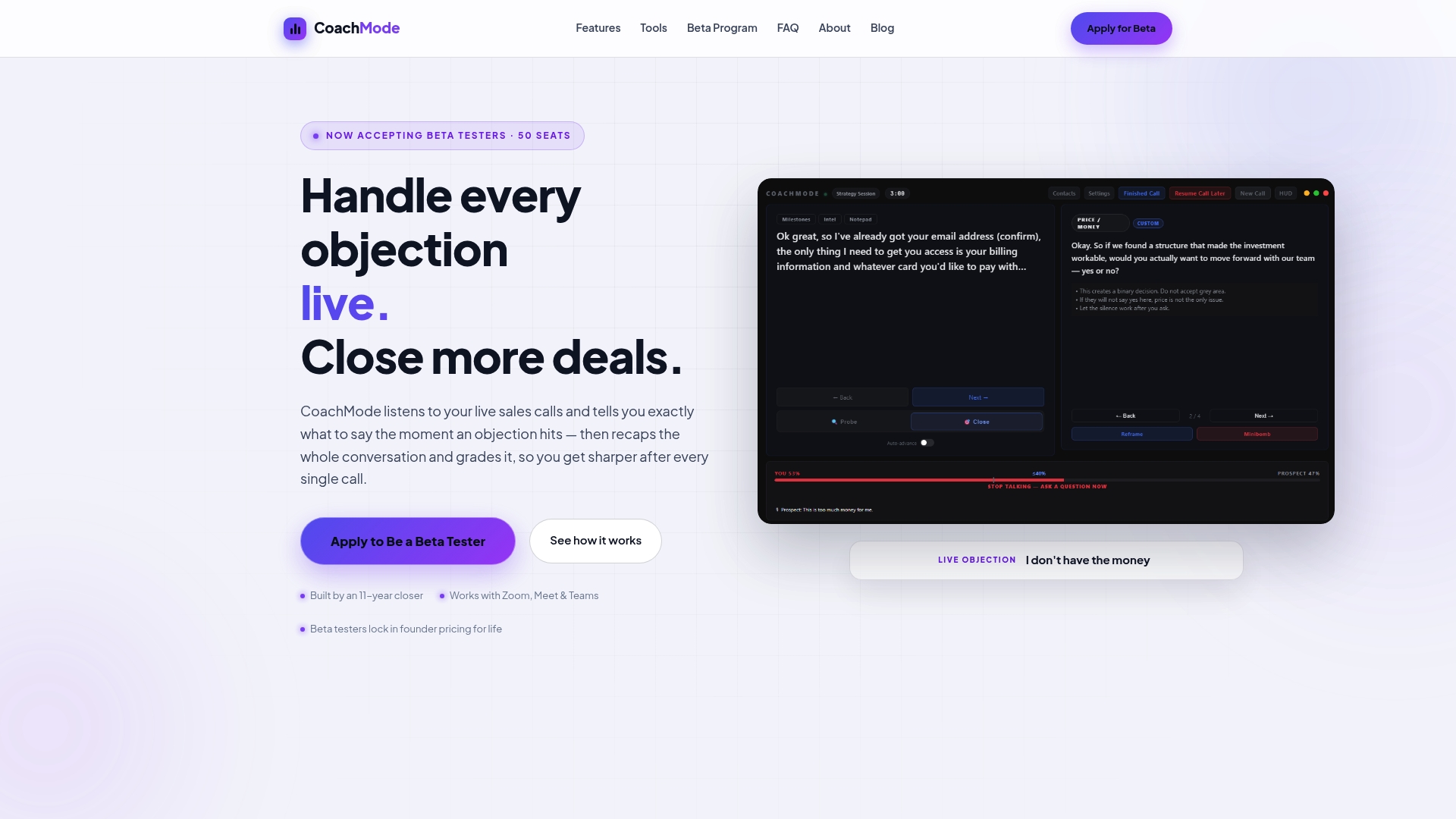
Sales managers and high-ticket closers running the 25-minute structure above get the most out of it, since the tool reinforces the exact discipline this playbook asks for: three tailored features, a clear ask, and objections handled without dead air. If you want to see how it works on your own call structure, start with AI sales coaching for live sales calls and try it on your next demo. For teams building out objection responses ahead of time, the sales objection library is a useful companion for rehearsal between calls.
Sources
- How to Run a B2B Sales Demo That Converts — Allston Labs
- First sales demo: the 25 minute structure that closes in 2026 | Causo Hub
- Sales demos: stop the feature tour, start closing — Ziel Lab
- How to Build a Product Demo Presentation That Closes Deals | SlidesMate
- Demo-to-close event playbook — Rework resources
FAQ
What Does “Demo” Mean in Sales?
A sales demo is a live or recorded walkthrough of a product tailored to a specific buyer’s stated problems, distinct from a generic product tour aimed at no one in particular.
How Is Demoing Used in Sales?
Demoing is used to prove a product solves the buyer’s named pains, usually after discovery has confirmed budget, timeline, and decision ownership, and it typically ends with an explicit ask for the next commitment.
How Much Does a Sales Coach Cost?
Sales coaching costs vary widely by format, from live-call AI coaching tools billed as monthly SaaS subscriptions to human coaching engagements billed per session or retainer, so the right comparison depends on whether you need in-the-moment call support or periodic strategy review.
Who Are the Top Sales Coaches?
Rather than a fixed ranking, the strongest results tend to come from combining human sales coaching for strategy and skill development with real-time, in-call tools like CoachMode that catch objections and mistakes as they happen, not after a call is already lost.
What Is a Good Demo-to-Close Rate?
Demo-to-close rates in the 20 to 30% range are typical for SMB-focused SaaS, while disciplined teams running structured, timeboxed demos with explicit asks can reach 50 to 65%.