The best discovery call framework runs on three moves: diagnose, qualify, lock a next step, and fit it inside a tightly time-boxed call instead of a meandering hour. Get the structure right and you’ll spend most of the call listening, not pitching. Here’s the checklist to run on your very next call, plus the full question bank, scripts, and scorecard behind it.
Run this before you hang up:
- Open and frame the agenda in under two minutes, then get verbal permission to ask pointed questions.
- Diagnose with three anchor questions: current state, desired state, and what’s blocking the move between them.
- End with a committed next step that has an owner, a date, and a deliverable attached to it.
A 30-minute call typically gives you about 15 minutes for actual discovery, with the rest split between opening, context, and next steps. Compress the frame for transactional deals under a few thousand dollars. Expand it for enterprise deals with multiple stakeholders, where you may need two calls just to map the buying committee.
Key Takeaways
A structured discovery call framework works because it forces diagnosis before prescription, uses time-boxing to protect the questioning phase, and ends every call with a dated commitment instead of a vague follow-up.
| Point | Details |
|---|---|
| Diagnose before you pitch | Spend the bulk of a 30-minute call on situation, problem, and impact questions before showing any solution. |
| Use anchor questions, not scripts | A handful of sharp questions per category outperform long checklists that make reps sound robotic. |
| Qualify out fast | Log a clear reason code when a deal fails your criteria instead of letting it linger in the pipeline. |
| Lock four fields before hanging up | Owner, action, deliverable, and date turn discovery into a scheduled next step, not a hope. |
| Score every call | CoachMode’s post-call scorecard tracks talk ratio and qualification capture so managers coach on data, not guesswork. |
Table of Contents
- What Is a Discovery Call Framework and Why It Matters
- How to Prepare Before a Discovery Call
- How to Open the Call and Set the Agenda
- Diagnostic Frameworks That Actually Uncover Root Cause
- Question Bank and Sample Scripts for Discovery Calls
- How to Qualify In or Qualify Out With Clear Rules
- Prescribing Next Steps Without Losing Momentum
- Common Discovery Call Mistakes and Quick Fixes
- How to Measure and Improve Discovery Call Performance
- How Real-Time Coaching Sharpens Discovery Execution
- Handling and Overcoming Common Objections During Discovery
- Building Deeper Rapport and Trust Quickly
- Managing Different Buyer Personas During Discovery
- How CoachMode Supports This Framework in Real Time
- Sources
What Is a Discovery Call Framework and Why It Matters
A discovery call is a diagnostic conversation, not a sales pitch with a question or two bolted on front. Its job is to surface real business pain, quantify its impact, and figure out how the prospect actually makes buying decisions, all before anyone talks price or product. Salesforce’s own breakdown of discovery calls frames it the same way: an early-stage conversation meant to determine fit and decide whether the deal deserves a scoped proposal or demo at all.
That framing matters because it changes what “winning” a discovery call looks like. You’re not trying to impress anyone with your product’s feature list. You’re trying to answer five questions:
- Does this prospect actually have the problem you solve?
- Is the pain urgent enough to justify change this quarter?
- Who else needs to sign off, and what’s their process?
- What does success look like to them, in their own words?
- Have you earned permission to move to a next step?
The most common mistake reps make is demoing too early, often within the first ten minutes, because they’re excited or nervous and want to show value fast. It backfires. When you pitch before you’ve diagnosed the problem, you’re guessing at what matters to the buyer instead of using their own words to build the case. Discovery methodology built on the SPIN framework makes this explicit: reps who resist the urge to prescribe a fix and instead dig into root cause and scale of impact consistently close at higher rates than reps who jump to solutions.
Pro Tip: If you catch yourself starting a sentence with “So what we do is…” before minute fifteen, stop. That’s a pitch reflex, not discovery.
How to Prepare Before a Discovery Call
Preparation is where most reps quietly lose the deal before the call even starts, and building a healthcare SaaS go-to-market strategy helps you understand your regulated or healthcare buyers better. Walking in without research means you spend the first ten minutes asking questions a Google search or a CRM note would’ve answered.
Run this checklist the night before or morning of:
- Confirm the prospect matches your ideal customer profile on size, industry, and use case.
- Scan public signals: recent funding, leadership changes, job postings that hint at growth pains, or a competitor’s recent move in their space.
- Read every CRM note left by SDRs or marketing, including form-fill answers and email replies.
- Draft two or three technical or process questions specific to their stack or workflow that only they can answer.
- Write down your single most important qualification question, the one you’d ask if you only got one shot.
Send a one-paragraph agenda 24 hours ahead. It should name the timebox (“30 minutes”), list two or three topics you want to cover, and state the outcome you’re hoping for (“leave with a clear picture of whether this is worth a deeper technical conversation”). This does double duty: it sets expectations and it gives the prospect a chance to loop in a stakeholder if one’s missing.
Call length should track deal complexity:
- Transactional deals (self-serve or low-touch): 15 to 20 minutes, tight and direct.
- Mid-market deals: 30 minutes, the standard frame most playbooks default to.
- Enterprise deals: 45 minutes or a two-call sequence, since you’re often mapping a buying committee, not one decision-maker.
How to Open the Call and Set the Agenda
The first two minutes decide whether the rest of the call feels collaborative or interrogative. Your opener needs to do three things fast: confirm time, state the mutual purpose, and get explicit permission to ask direct questions.
For an inbound prospect who requested the call, try something like: “Thanks for grabbing time. I saw you requested info on [specific thing] — before I show you anything, I want to understand what’s driving that so I don’t waste your half hour. Sound fair?”
For an outbound prospect who’s colder, lead differently: “I know I reached out, so let me be direct about why. I’ve been working with a few teams in [industry] hitting [specific pain], and I wanted to see if that’s on your radar too. If it’s not a fit, I’ll tell you that in fifteen minutes flat.”
Both openers end the same way: with a line that earns permission. Something like, “Mind if I ask a few pointed questions first, so anything I show you actually lands?” Nobody says no to that, and it sets you up to control pacing without sounding scripted.
- Confirm the agenda out loud, even if you sent it in advance.
- State the timebox again (“we’ve got 30 minutes”).
- Ask the permission question before your first diagnostic question.
Reps who rush the opener unconsciously signal that the call is about them, not the prospect’s problem.*
Diagnostic Frameworks That Actually Uncover Root Cause
Every strong discovery call framework borrows from a handful of proven diagnostic models. You don’t need to memorize all of them. You need to know which one to reach for and in what order.
SPIN (Situation, Problem, Implication, Need-payoff) is the foundation most others build on. Huthwaite’s original SPIN methodology found that top performers spend disproportionate time on implication and need-payoff questions, the ones that make a problem feel urgent and let the buyer state the value of fixing it in their own words.
SP3V compresses that into situation, problem, and three flavors of value (personal, business, and vision) to keep reps from getting lost in a long question list.
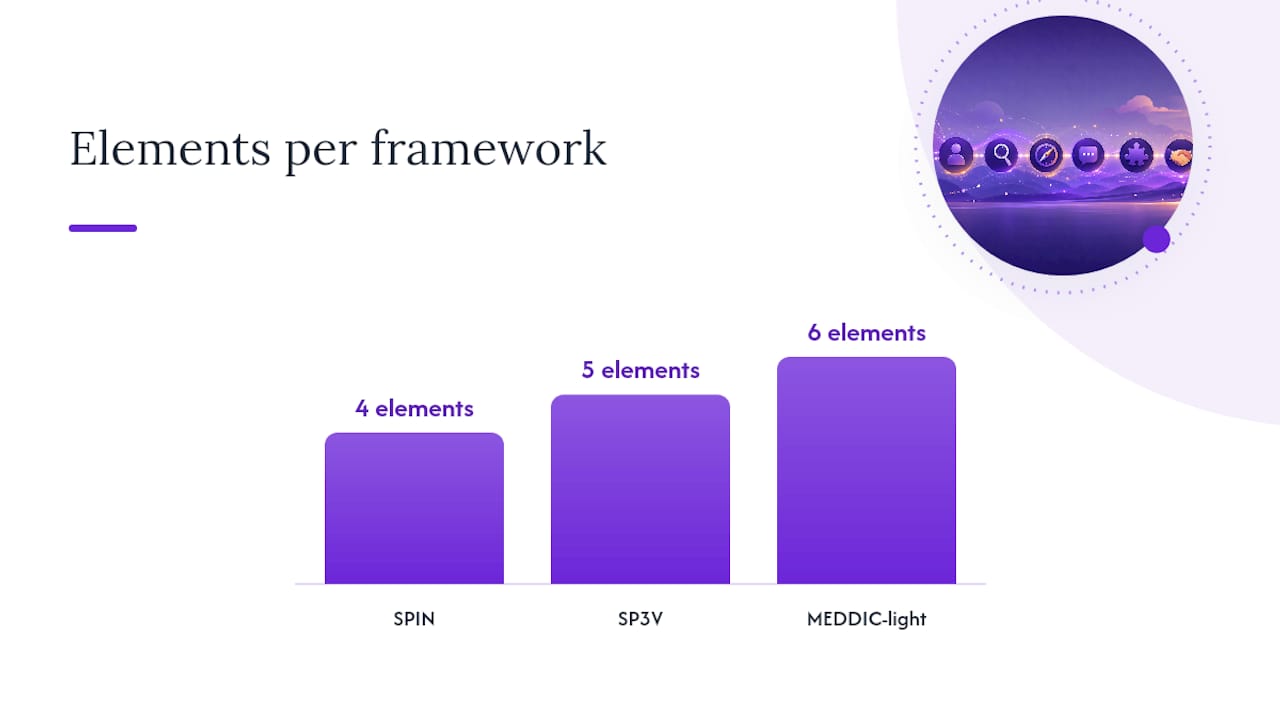
MEDDIC-light borrows the qualification backbone of full MEDDIC (metrics, economic buyer, decision criteria, decision process, identify pain, champion) without demanding you nail every letter in one call. Use it as a mental checklist, not a script.
Current-state versus future-state is the simplest lens: what does today look like, what should it look like, and what’s the gap costing them.
A workable sequence for a 30-minute call looks like this:
- Situation (3 to 5 minutes): confirm what you already know, don’t re-ask it wholesale.
- Problem (5 to 7 minutes): what’s broken, and how do they know it’s broken.
- Implication (5 to 7 minutes): what does this cost in time, money, or risk if it stays unsolved.
- Need-payoff or future-state (3 to 5 minutes): what does solved look like, and who benefits.
- Qualification checkpoint (remaining time): confirm timeline, budget range, and decision process.
The follow-up probe is where reps either extract quantified impact or settle for vague complaints. If a prospect says “onboarding takes too long,” don’t move on. Ask “too long compared to what, and what does that delay cost you when a new hire doesn’t ramp for six extra weeks?” That’s the difference between a surface answer and one you can build a business case around.
Question Bank and Sample Scripts for Discovery Calls
A good question bank isn’t a hundred questions. It’s a short list of sharp anchor questions organized by what you’re trying to learn, plus enough judgment to know which three or four actually apply on a given call. Playbooks built around anchor questions rather than long checklists tend to convert better, because reps who memorize a script sound like they’re reading one.
Situation questions:
- Walk me through how your team handles [process] today.
- Who’s involved when this comes up, and how often?
Problem questions:
- What’s not working about the current approach?
- How long has this been a problem, and what changed recently?
Impact questions:
- What does this cost you in time, revenue, or risk each month?
- If nothing changes in six months, what happens?
Exploration questions:
- What have you already tried, and why didn’t it stick?
- What would need to be true for this to become a priority this quarter?
Budget and timing questions:
- Is there budget allocated for solving this, or would it need to be created?
- What’s driving the timeline, if there is one?
Buying process questions:
- Who else needs to weigh in before a decision gets made?
- What does your evaluation process typically look like?
Three scripts worth having ready:
Advance script (moving to a demo): “Based on what you’ve shared, this looks like a strong fit for [specific capability]. I’d like to show you exactly how we’d solve [their stated problem]. Can we grab 30 minutes next week with [decision maker] in the room?”
Disqualification script (qualifying out politely): “Honestly, based on what you’ve described, I don’t think we’re the right fit right now, mainly because [specific reason]. I don’t want to waste your time chasing something that won’t solve your actual problem.”
Next-step close script: “Let’s lock this in now rather than play calendar tag. I’ll send an invite for Thursday at 2pm, and I’ll loop in [name] since you mentioned they’d need to weigh in. Does that work?”
You can find a downloadable version of this exact question sequence with follow-up probes mapped to each category, useful for adapting questions on the fly when talk-time is tight.
How to Qualify In or Qualify Out With Clear Rules
Qualification isn’t a gut feeling. It’s a checklist, and the discipline to walk away when a deal fails it. A five-stage qualification structure that includes an explicit qualification checkpoint produces more reliable outcomes than reps who “just get a feel” for fit.
Here’s what should be true before a deal advances:
- Quantifiable pain: the prospect can put a number on the cost of the problem, even a rough one.
- Timeline: there’s a stated reason this needs solving in a specific window, not “someday.”
- Budget: either allocated funds exist or there’s a credible path to creating them.
- Decision owner: you know who signs, and they’re either on the call or reachable.
- Aligned success metrics: you and the prospect agree on what “solved” looks like.
Red flags that should slow or stop a deal:
- No timeline beyond “we’re just looking around.”
- Budget conversations get deflected every time you raise them.
- Nobody can name who else is involved in the decision.
- The stated problem doesn’t map to anything your product actually fixes.
When a deal fails the checklist, log it. Use a CRM field for “qualified out” with reason codes like “no budget authority,” “no timeline,” or “poor product fit,” so your pipeline reporting reflects reality instead of hopeful guessing. Qualifying out fast isn’t a loss. It’s time you get back for a deal that’ll actually close.
Prescribing Next Steps Without Losing Momentum
Discovery only pays off if it ends in a locked commitment. The prescription phase is where you convert everything you learned into a specific, dated next step, not a vague “I’ll follow up.”
Lock four fields before you hang up:
- Owner — who’s responsible for the next action, you or them.
- Action — what specifically happens (demo, technical call, proposal review).
- Deliverable — what gets produced or shown.
- Date — a real calendar date, not “sometime next week.”
A wrap script that works: “So to confirm, it sounds like [restate their core problem] is costing you [impact they mentioned]. I’m going to put together [specific deliverable] and walk you through it on [date]. I’ll also send a quick recap of what we covered so you can loop in anyone who wasn’t here. Does that match what you heard?”
Post-call, within the hour:
- Send a recap email restating the problem, impact, and agreed next step.
- Update CRM fields for qualification status and next action.
- Calendar-block your own prep time for the next call, don’t just rely on a reminder.
Common Discovery Call Mistakes and Quick Fixes
Most discovery calls don’t fail because of a bad question. They fail because of a bad habit repeated every call.
Demoing too early. Fix: physically keep your screen share closed until you’ve completed at least the problem and impact questions.

Losing agenda control. Fix: restate the timebox out loud at the halfway mark (“we’ve got about 15 minutes left, I want to make sure we get to next steps”).
Never quantifying impact. Fix: whenever a prospect states a problem, follow with “what does that cost you” before moving to the next topic.
Skipping the decision process. Fix: build “who else is involved” into your standard closing questions, every single call, no exceptions.
A useful weekly exercise: record yourself on two calls, then count how many minutes you talked versus listened. Reps converting at the top consistently land closer to a 70/30 buyer-to-seller talk ratio. If your ratio is flipped, that’s your practice target for the week.
Pro Tip: Count silence as a win, not a failure. A three-second pause after a good implication question usually means the prospect is actually thinking, not stalling.
How to Measure and Improve Discovery Call Performance
You can’t coach what you don’t measure. A simple scorecard beats a gut-feel review every time, and it gives managers something concrete to work from instead of “that call sounded fine.”
Track these fields on every call:
- Advance rate: percentage of discovery calls that move to a next scoped step.
- Next-meeting-set rate: percentage that leave with a locked calendar invite before hanging up.
- Decision-criteria capture rate: percentage of calls where you documented who decides and how.
- Talk ratio: minutes the prospect spoke versus minutes you spoke.
Review cadence matters as much as the metrics themselves. Run weekly call reviews on a small sample, calibrate the scorecard monthly across the team so everyone’s grading the same way, and revisit the framework itself quarterly since deal types and buyer behavior shift.
Discovery calls with disciplined structure and a hard next-step close land advancement rates ranging roughly from 30% to 80%, depending on rep discipline and deal type. That’s a wide enough gap between undisciplined and structured calls to justify the scorecard exercise on its own. A call scorecard template gives you a starting point instead of building one from scratch.
How Real-Time Coaching Sharpens Discovery Execution
Live coaching changes what happens inside the call, not just what gets reviewed after. When a rep freezes on an unexpected objection mid-discovery, the instinct is often to pivot straight to pitching just to fill the silence. That’s exactly the moment real-time support earns its keep.
Where live coaching shows up in practice:
- Surfacing the right follow-up probe the instant a prospect gives a vague answer, instead of the rep improvising under pressure.
- Feeding a calm, specific objection response mid-sentence so the rep doesn’t lose the thread of discovery to handle a pushback.
- Keeping talk-ratio visible in real time so reps notice they’re over-talking before the call ends, not after.
Post-call scoring closes the loop. A shared canvas or artifact captured during the call itself turns notes into something a manager can actually review against the scorecard, rather than relying on a rep’s memory of how the call went.
Pro Tip: Use live coaching insights as a starting point for weekly manager reviews, not a replacement for them. The scorecard tells you what happened; the manager conversation is where the rep actually learns why.
Handling and Overcoming Common Objections During Discovery
Objections during discovery are different from objections during a close. They usually signal confusion or skepticism, not a final no, and treating them that way changes how you respond.
The most common one: “We’re already using something for this.” Don’t argue that your product is better. Ask what’s not working about the current tool. That question alone usually surfaces the actual gap you’re there to fill.
Another frequent one: “I don’t think we have budget for this right now.” Resist the urge to discount or promise flexible terms on the spot. Instead, separate the impact conversation from the budget conversation: “Let’s set budget aside for a second, if this problem got solved, what would that be worth to you?” Budget objections raised before impact is established are often reflexive, not final.
“I need to check with my team” is really a signal you haven’t identified the full decision process yet. Ask directly: “Who else typically weighs in on decisions like this, and what do they usually care about?” That question does double duty, it surfaces the buying committee and reframes the objection as useful information rather than a stall.
The through-line across all of these: treat the objection as a data point about where the prospect’s thinking actually is, not an obstacle to argue past. Reps who get defensive when they hear pushback usually lose the rest of the discovery conversation, because the prospect shifts into guard mode. A structured transition between discovery and next steps helps prevent objections from derailing the call entirely.
Building Deeper Rapport and Trust Quickly
Rapport on a discovery call isn’t small talk about the weather. It’s built through specificity, showing the prospect you did your homework and that you’re listening to their actual words, not a generic script.
Reference something concrete from your research in the first two minutes: a recent product launch, a leadership change, a specific challenge common to their industry. Generic rapport (“How’s your week going?”) signals you didn’t prepare. Specific rapport (“I saw you just expanded into a new region, that usually creates onboarding headaches, is that showing up for you?”) signals you actually thought about their business.
Mirror their language back to them during the call. If a prospect says “our team is drowning in manual work,” use that exact phrase later rather than translating it into your own terminology. It tells them you were actually listening, not just waiting for your turn to talk.
Silence builds trust too, in a way most reps underestimate. When a prospect pauses after a tough question, resist filling that gap. Let them finish their own thought. Interrupting a thinking pause, even to be helpful, often reads as impatience.

Finally, admit when something isn’t a fit. Counterintuitively, telling a prospect early that you might not be the right solution builds more trust than overselling would. It signals you’re not just chasing a commission, and prospects notice the difference immediately.
Managing Different Buyer Personas During Discovery
Not every prospect responds to the same diagnostic style, and reading the room in the first few minutes saves you from forcing the wrong approach.
The analytical buyer wants data and specifics fast. They’ll get impatient with open-ended questions like “tell me about your challenges.” Lead with sharper, quantifiable questions: “What’s your current cost per unit on this process?” Give them room to dig into numbers rather than rushing them toward a vision statement.
The relationship-driven buyer needs rapport before substance. Spend an extra minute or two on context before diving into problem questions, and expect them to want to understand who you are and who you’ve helped before they open up about their own pain.
The skeptical or guarded buyer, often burned by a past vendor, tests you before they trust you. Acknowledge that directly: “I get the sense you’ve been through a rough vendor experience before, want to tell me what happened?” That question alone often unlocks the real objection sitting underneath their guardedness.
The decisive executive buyer wants the call compressed. Lead with the sharpest impact question you have and skip the extended context-setting. They’ll respect you more for moving fast than for following a script.
The common thread: your framework’s structure stays the same, situation, problem, impact, qualification, but the pacing and tone flex to match who’s on the call. Rigid script-following regardless of persona is one of the fastest ways to lose a prospect’s attention early.
A Sales Coach’s Take on What Actually Moves the Needle
Three things separate reps who master discovery from reps who just go through the motions. First, they treat silence as a tool, not a gap to fill. Second, they write down the prospect’s exact words and use them later, word for word. Third, they qualify out faster than feels comfortable, because a fast no protects the pipeline more than a slow maybe. One rep I watched change nothing but her closing question, adding “who else needs to weigh in” to every call, and her next-meeting-set rate jumped within a month simply because she stopped losing deals to invisible stakeholders.
How CoachMode Supports This Framework in Real Time
Running this framework perfectly in your head while also listening, probing, and taking notes is a lot to hold at once, especially on a call where an unexpected objection throws off your pacing. That’s the exact gap CoachMode was built to close.
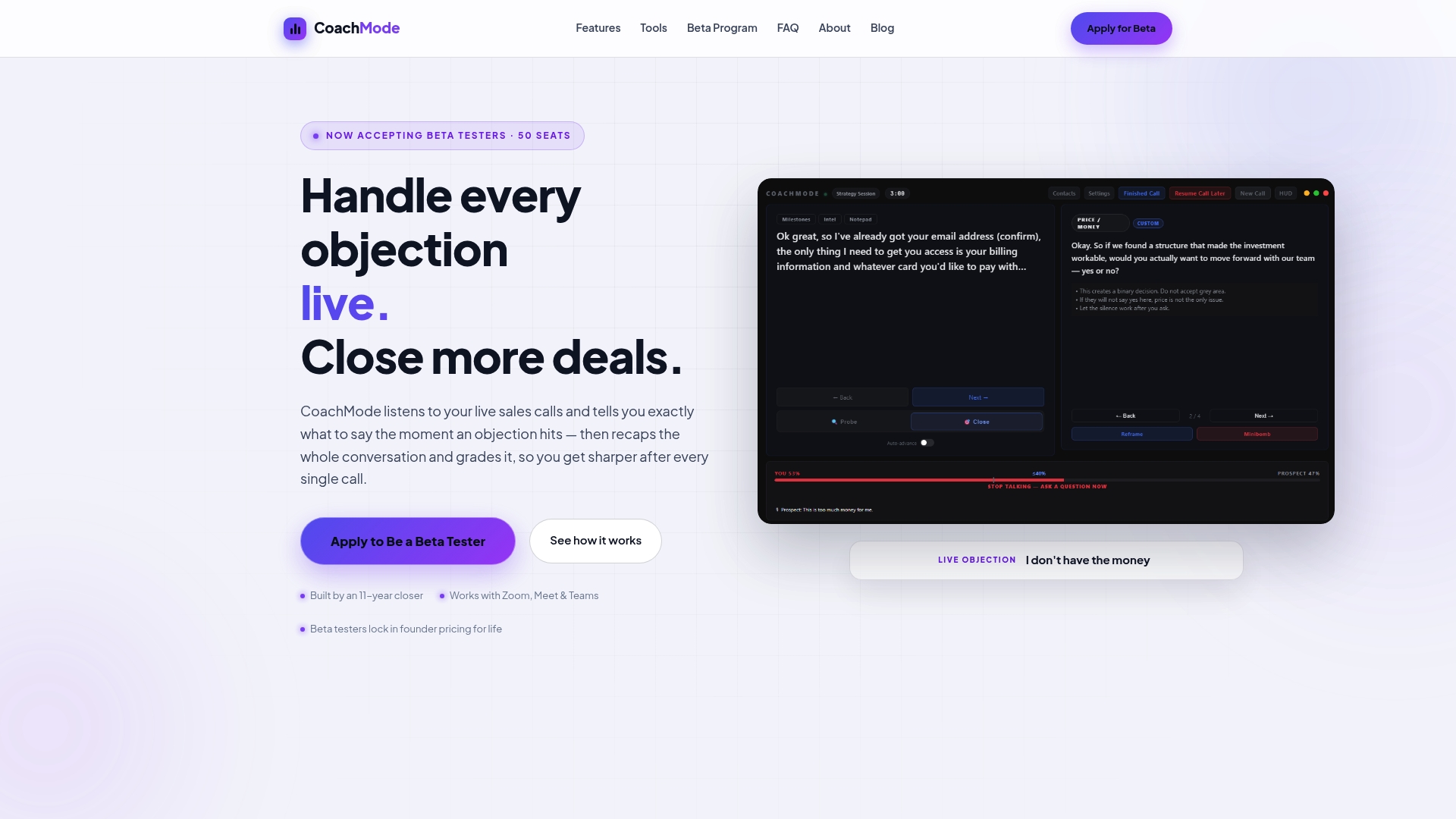
CoachMode listens alongside you on Zoom, Google Meet, or Teams and surfaces live prompts tied to the framework above: if a prospect raises an objection mid-discovery, it delivers the wording to handle it without derailing your diagnostic flow. When you’re deep in implication questions and need a sharper follow-up, it nudges the next probe instead of leaving you to improvise. And every call feeds into a post-call scorecard, the same kind of scoring outlined earlier, so you can track talk ratio, qualification capture, and advance rate over time instead of guessing at what went well.
Three direct mappings: a live objection prompt keeps you inside discovery instead of pivoting to a pitch; the post-call recap gives you a shareable artifact instead of scattered notes; the scorecard turns one good call into a repeatable coaching habit. If you’re running high-ticket discovery calls and want that support live, not just in a post-call review, CoachMode for high-ticket closers is built specifically for that.
Sources
- What is a Discovery Call? Questions & Sample Script
- Discovery call architecture — the 30-minute frame and the advancement rate — Allston Labs
- Discovery Call Framework That Actually Closes Deals — Alex Berman
- Discovery Call Agenda Template: 30-Min Playbook for 2026
FAQ
How long should a discovery call last?
Most mid-market discovery calls run 30 minutes, with about 15 minutes reserved for the core diagnostic questions. Transactional deals can run shorter; enterprise deals with multiple stakeholders often need 45 minutes or a second call.
What’s the difference between a discovery call and a sales call?
A discovery call is diagnostic, focused on surfacing pain, impact, and decision criteria before any pitch happens. A broader sales call can include demos, pricing discussions, or negotiation, stages that come after discovery confirms fit.
What questions should I never skip in a discovery call?
Always ask who else is involved in the decision and what the timeline pressure actually is. Skipping the decision-process question is one of the most common reasons deals stall after a seemingly great call.
How do I know when to qualify a prospect out?
Watch for the absence of a real timeline, no identifiable budget path, no named decision owner, or a stated problem that doesn’t map to what you actually solve. Any two of these together are a strong signal to qualify out rather than keep chasing.
Can AI tools help during a live discovery call?
Yes. Tools like CoachMode listen in real time and surface objection responses and follow-up prompts, helping reps stay in diagnostic mode instead of freezing or defaulting to a pitch under pressure.