Send your post call follow up promptly after the call, ideally before you leave your desk, and never later than the same business day. Its only job is to do three things: recap what was agreed, add one piece of value, and name a single next step with an owner and a date attached. Everything else is decoration.
TL;DR:
- Sending the first follow-up within two hours of the call significantly increases open and reply rates compared to waiting until the next day.
- A high-performing follow-up includes a clear subject line referencing the call, a one-line proof of attention, a brief recap, an added value, and a specific next step.
- Tailoring subject lines to the conversation type, such as call reference, promised resource, or decision cue, improves email open rates.
- Tracking next-step coverage and adherence provides a more accurate view of pipeline health than simple open or reply metrics.
- Using live prompts during calls and structured follow-up templates can improve consistency and clarity in setting specific next steps.
Table of Contents
- Why Post-Call Follow-Up Matters More Than Reps Think
- When to Send Your First Follow-Up (and What Comes After)
- What Goes Into a Follow-Up That Actually Gets a Reply
- Subject Lines That Get Opened, Not Ignored
- Ready-to-Use Templates for the Six Calls You Have Every Week
- Writing Follow-Ups the Buyer Can Forward Without Editing
- The Follow-Up Mistakes Quietly Killing Your Reply Rate
- How Live Coaching Improves the Follow-Up Before You Even Write It
- How to Actually Measure Whether Your Follow-Ups Are Working
- Tools That Take the Manual Work Out of Follow-Up
- Tone That Builds Trust Without Sounding Like a Script
- Legal Considerations You Can’t Skip in Follow-Up Emails
- A Sales Leader’s Micro-Playbook for Follow-Up Discipline
- Another Option: Faster Follow-Ups With Live In-Call Prompts
- Sources
Why Post-Call Follow-Up Matters More Than Reps Think
Most reps treat the follow-up email as paperwork. It’s not. It’s the document your buyer forwards to their VP, their procurement team, or the colleague who missed the call. If that document is vague, the deal stalls in someone else’s inbox, where you have zero visibility.
A follow-up that captures the conversation clearly becomes what one analysis calls a shared record buyers can forward internally without needing to loop you back in to explain what happened. That’s the entire value proposition of a good follow-up: it lets your champion sell on your behalf while you’re not in the room.
There’s a pipeline hygiene angle too. Deals with a documented owner, date, and deliverable behave differently than deals that just have a vague “will circle back” note. Tracking next-step coverage and adherence as real metrics, not afterthoughts, is one of the more reliable ways to spot which opportunities are actually alive.
What follow-up actually accomplishes:
- Converts a verbal agreement into a written record the buyer can act on without you
- Gives internal stakeholders who weren’t on the call a fast way to get up to speed
- Forces clarity on what “next step” really means, which surfaces soft commitments before they cost you a week
- Signals professionalism at the exact moment the buyer is deciding if you’re worth their time
None of that is administrative. It’s selling, just done asynchronously.
When to Send Your First Follow-Up (and What Comes After)
Timing isn’t a nice-to-have. The first follow-up within two hours of the call consistently gets higher open and reply rates than a message sent the next morning, mostly because the conversation is still fresh in the buyer’s head. Wait until tomorrow and you’re competing with their inbox backlog and whatever fire started after you hung up.
Here’s a cadence that works for most B2B sales cycles when the prospect goes quiet:
- Same day (within 2 hours): Recap, value add, next step. This is non-negotiable.
- Day 2: Send the resource you promised on the call, even a small one, tied back to something they said.
- Day 5: A short check-in that references the specific business problem discussed, not a generic “just following up.”
- Day 10: The breakup email. State plainly that you’ll close the loop unless you hear back, and give them an easy out.
That cadence is a default, not a formula to follow blindly. A hot deal with budget confirmed and a decision date set deserves faster touches, sometimes daily, especially in the week before that date. A long-cycle enterprise evaluation with six stakeholders can stretch the cadence to weekly without losing momentum, because the internal process is genuinely slower than your patience.
The mistake reps make is applying one cadence to every deal stage. A discovery call and a signed-verbal-yes call need completely different follow-up speeds, even though the two-hour rule for the first touch applies to both equally.
What Goes Into a Follow-Up That Actually Gets a Reply
A follow-up that works has five parts, and skipping any one of them is why most go unanswered. The structure that consistently performs is a specific subject line, a one-line opener, a short recap, one value add, and a single next step.
- Subject line: Reference the call itself, not a generic label.
- Opener: One sentence that proves you were actually listening. “Enjoyed hearing about the rollout timeline for your Chicago team” beats “Thanks for your time today.”
- Recap: Two to three sentences, written in the prospect’s own words where possible, not sales jargon.
- Value add: One resource, data point, or answer to something they asked and you didn’t have ready on the call.
- Next step: One clear ask, with a named owner and a specific date. Not “let me know your thoughts.”
Keep the whole thing under roughly 150 words. Longer messages with multiple asks consistently underperform shorter ones with a single, specific CTA, largely because a buyer skimming on their phone will act on one clear ask and ignore three vague ones.
Pro Tip: Write the next step as a sentence the prospect could copy into their own calendar invite. If it’s not that specific, it’s not specific enough.
Subject Lines That Get Opened, Not Ignored
Skip “Following up” and “Touching base.” Those phrases tell the reader nothing and get buried instantly. Specific subject lines tied to the actual conversation outperform generic ones, especially since most buyers are reading on a phone where anything past 50 characters gets cut off.
Three formulas cover almost every post-call scenario:
- Call reference: “Recap: pricing discussion for [Company]” or “Notes from our call today”
- Promised resource: “The ROI breakdown I mentioned” or “Case study you asked about”
- Decision cue: “Quick question before Thursday’s meeting” or “One thing before you decide”
Each formula maps to a different moment in the sales cycle. Use the call reference right after every call as your default. Save the promised resource line for the Day 2 touch when you’re delivering on something specific. The decision cue works best late in the cycle, when there’s an actual deadline the subject line can point to.
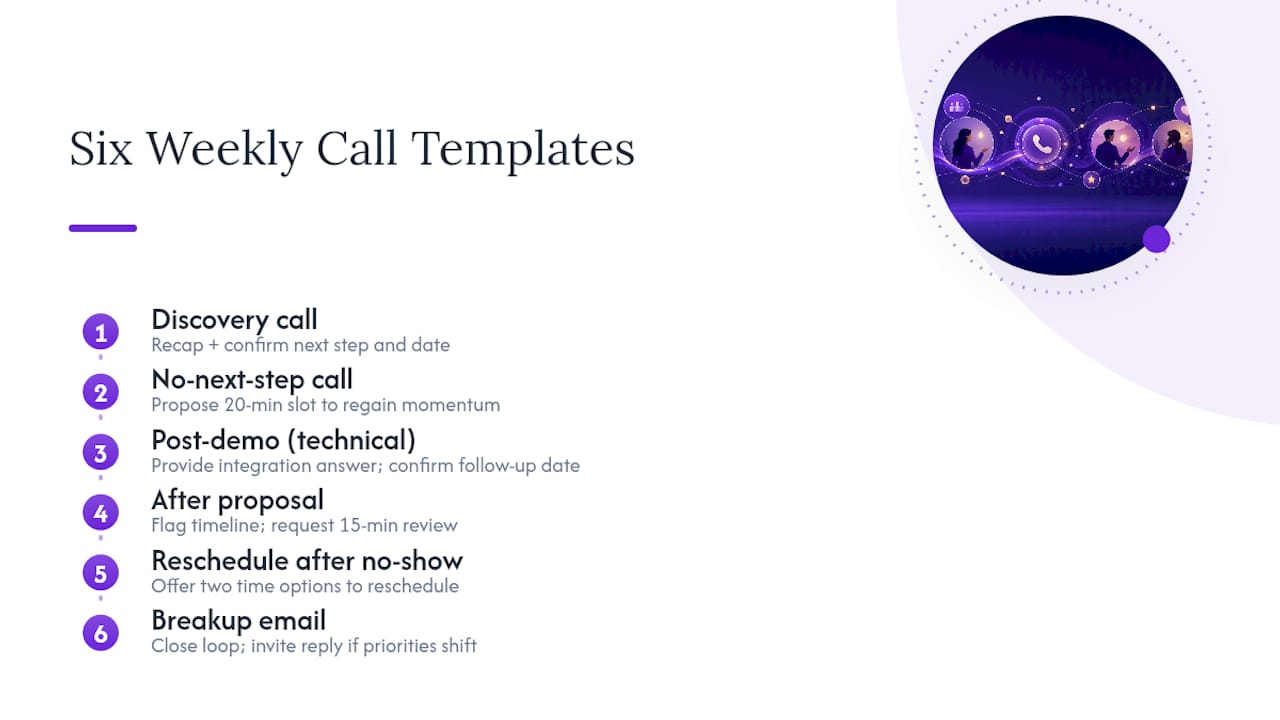
Ready-to-Use Templates for the Six Calls You Have Every Week
Copy these, swap in your own details, and keep the CTA intact. That’s the one line you should never soften.
1. Discovery call with a clear next step agreed
Subject: Recap + next step for [Company]
“Thanks for walking me through [specific challenge]. Sounds like the priority is [X] before [timeframe]. I’ll send the pricing breakdown by Wednesday. Can you confirm [stakeholder] joins our next call on [date]?”
2. Call that ended without a defined next step
Subject: One thing before we lose momentum
“Great conversation on [topic]. I want to make sure we don’t lose the thread. Does a 20-minute call on [specific date/time] work to walk through [next logical step]?”
3. Post-demo, answering a technical question you couldn’t on the call
Subject: The integration answer you asked about
“Confirmed with our engineering team: [specific answer]. Given that, does [date] still work for the follow-up demo with your IT lead?”
4. After sending a proposal
Subject: Proposal for [Company], quick check
“Sent the proposal over. Before you review, one flag: section 3 covers the timeline concern you raised. Can we grab 15 minutes on [date] to walk through any questions?”
5. Reschedule after a no-show
Subject: Missed you, easy to reschedule
“No worries if today didn’t work out. Want to grab [two time options] instead? Happy to work around your calendar.”
6. Breakup email after no response
Subject: Closing the loop on [Company]
“Haven’t heard back, so I’ll assume the timing isn’t right. If priorities shift, reply anytime and I’ll pick this back up. Wishing you luck with [specific initiative they mentioned].”
A few personalization notes across all six: when you know there’s a second stakeholder, name them directly (“Would it help to loop in your ops lead before Thursday?”) rather than leaving the multithreading to chance. And if you’re handing a deal to a colleague, forward the same recap internally first. It saves the next person from re-asking questions the buyer already answered once.
Writing Follow-Ups the Buyer Can Forward Without Editing
The best follow-ups do double duty: they read like a personal note to the person on the call, and they work as a standalone summary for someone who wasn’t. That means mirroring the prospect’s own language for their problem, not translating it into your product’s terminology, and naming the timeline they gave you rather than a vague one you assumed.
- Use the exact phrase they used for their problem, not your product’s jargon for it.
- Name specific stakeholders and dates they mentioned, even minor ones.
- Ask directly for a named person to be looped in, and say why: “Would it help to bring [name] in, since they’ll own the rollout?”
- Keep a short account memory note (industry, pain point, timeline, key names) so your next call doesn’t restart from zero.
That last point matters more than it sounds. A structured memory layer prevents the buyer from feeling like they’re re-explaining their business every time you talk, which is one of the fastest ways to lose trust in a multi-call cycle.
Pro Tip: Before your next call with the same prospect, reread your last follow-up out loud. If you can’t remember the details without it, neither can they.
The Follow-Up Mistakes Quietly Killing Your Reply Rate
Most low reply rates trace back to four repeatable errors, each with a fast fix.
- Generic subject line. “Following up” gets ignored. Fix: reference the call or a specific resource by name.
- Vague ask. “Let me know your thoughts” gives the buyer nothing to act on. Fix: a single yes/no question or a calendared time with a named owner.
- Delayed send. Waiting until the next morning kills momentum. Fix: send within two hours, no exceptions for busy days.
- Bloated recap. A five-paragraph summary reads like a chore. Fix: two to three sentences plus one value add, nothing more.
Audit your last ten follow-ups against this list. If three or more have a vague ask or a delayed send, that’s your reply rate problem, not your pitch.
How Live Coaching Improves the Follow-Up Before You Even Write It
The best post-call follow-up starts during the call, not after it. If the next step gets fuzzy in the moment, no amount of email polish fixes it afterward.
Getcoachmode listens to the live conversation and prompts reps in real time, which helps them lock down a specific next step, an owner, and a date while the buyer is still on the line instead of guessing at it later from memory. That’s the same framing effect Sandler’s research points to: reps who set up the ask early in the call get stronger, more specific commitments at the end of it.
- Live prompts nudge reps toward asking for a concrete next step before the call ends, not after.
- Post-call scorecards flag where next-step language was weak, so reps improve over successive calls.
- A quick workflow: capture the owner and date live, send the recap within two hours, and check the scorecard before your next touch to see what to tighten.
That scorecard becomes an audit trail. Instead of guessing why a rep’s deals stall, a manager can see exactly where the next-step language went soft.
How to Actually Measure Whether Your Follow-Ups Are Working
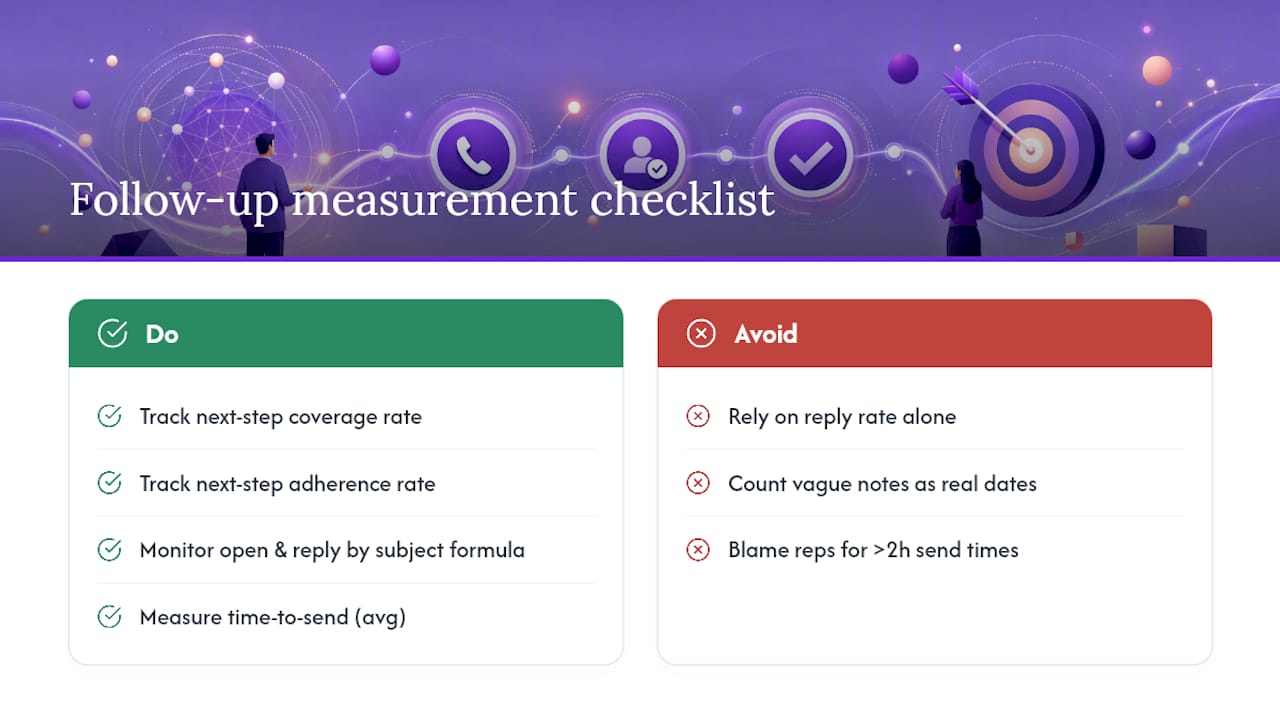
Reply rate is the metric everyone watches and the one that tells you the least on its own. A better system tracks two things: whether a next step exists, and whether it got done.
Next-step coverage rate is the share of open opportunities with a valid owner, date, and deliverable attached. Pull your pipeline report this week and count how many deals have a real date versus a note that just says “follow up next week.” Most sales teams find that number is lower than they’d guess.
Next-step adherence rate is the share of those commitments completed on time. This is the metric that separates reps who write good follow-ups from reps who write good-sounding follow-ups that nobody, including the rep, actually executes on. Tracking both figures together gives a far more honest read on pipeline health than open rates alone.
Beyond those two, watch open rate and reply rate by subject-line formula, since that tells you which of the three formulas (call reference, promised resource, decision cue) performs best with your specific buyer base. Track time-to-send as its own metric too. If your average first-touch send time creeps past two hours, that’s usually a workflow problem, not a motivation problem, and it’s worth fixing at the CRM automation level before you blame the rep.
Run this audit monthly, not quarterly. Follow-up habits erode fast when nobody’s watching.
Tools That Take the Manual Work Out of Follow-Up
You don’t need a stack of ten tools. You need three functions covered: capture, send, and track.
Call recording and transcription tools log what was actually said, which matters because memory is unreliable an hour after a call, let alone a week. CRM automation (most major CRMs support this natively) can trigger a follow-up reminder the moment a call ends, closing the gap between “I meant to send that” and “I forgot.”
Templates saved directly in your email client or CRM cut send time from ten minutes to two, which matters when the two-hour clock is running. And a scorecard or coaching layer, whether that’s a manager reviewing calls manually or a system like Getcoachmode generating one automatically, tells you which reps are consistently vague on next steps before it shows up as a pipeline problem three weeks later.
The mistake teams make is buying the tool before fixing the process. Automation speeds up a good follow-up habit. It doesn’t create one from nothing. Get the timing rule and the template right first, then automate the parts that are pure repetition.
Tone That Builds Trust Without Sounding Like a Script
Professional doesn’t mean stiff, and warm doesn’t mean informal. The tone that works in a post-call follow-up sits closer to how you’d actually talk to a colleague you respect: direct, specific, no filler.
Avoid two extremes. The first is overly formal language that sounds like a legal notice: “Per our conversation, please find attached.” Nobody talks like that, and buyers notice the shift from how you sounded on the call to how you sound in writing. The second is over-familiarity before you’ve earned it: exclamation points, forced enthusiasm, or jokes that didn’t land on the actual call.
Match the register the buyer used with you. If they were casual and quick on the call, mirror that in the email. If they were formal and precise, tighten your language to match. The goal is consistency between how you sounded live and how you sound in writing, since a mismatch is one of the fastest ways to make a follow-up feel like a form letter instead of a person.
One more thing: cut the hedging. “I just wanted to check in and see if maybe you had a chance to look at this” buries a simple question under four qualifiers. Ask it straight: “Did you get a chance to review the proposal?” Directness reads as confidence, not aggression, when the rest of the message is genuinely helpful.
Legal Considerations You Can’t Skip in Follow-Up Emails
Post-call follow-ups sent to a prospect you just spoke with are generally treated as transactional or relationship-based communication, not cold marketing, but that distinction only holds if you’re following up on an actual conversation and not adding people to a recurring newsletter without consent.
In the United States, the CAN-SPAM Act requires that any commercial email include your physical address, an accurate subject line, and a working way to opt out of future messages. A single one-to-one follow-up tied to a real call rarely triggers the heavier requirements built for bulk marketing sends, but the moment you add that contact to an automated nurture sequence, those rules apply in full, including a working unsubscribe mechanism.
If your prospect is in the EU or UK, GDPR governs how you store and use their contact information, not just how you email them. That means documenting a lawful basis for holding their data (legitimate interest from an actual sales conversation typically qualifies) and honoring any request to be removed from your records promptly. This isn’t a substitute for legal advice specific to your business, but the practical rule holds up well: keep follow-ups tied to real conversations, make opting out easy, and don’t let a one-off recap quietly become a marketing list.
A Sales Leader’s Micro-Playbook for Follow-Up Discipline
Managers don’t need a new framework. They need three checks, run weekly. First, pull the next-step coverage rate across the team’s pipeline and flag any deal missing an owner or date. Second, take three of the weakest next-step lines you find and rewrite them live with the rep, out loud, so they hear the difference between vague and specific.
Third, fold adherence rate into your pipeline reviews the same way you’d review forecast numbers. A rep who writes strong recaps but never checks whether the promised date got hit is optimizing for the wrong thing. Track both, coach the gap, and the follow-up habit sticks because it’s measured, not just encouraged.
— Ryan
Another Option: Faster Follow-Ups With Live In-Call Prompts
Templates and timing rules fix the writing half of the problem. They don’t fix what happens when the next step gets fuzzy mid-call and you’re left guessing what to put in the recap. Getcoachmode listens during the live conversation and surfaces the right prompt at the moment an objection or a soft commitment shows up, so the next step gets locked down in real time instead of reconstructed from memory afterward.
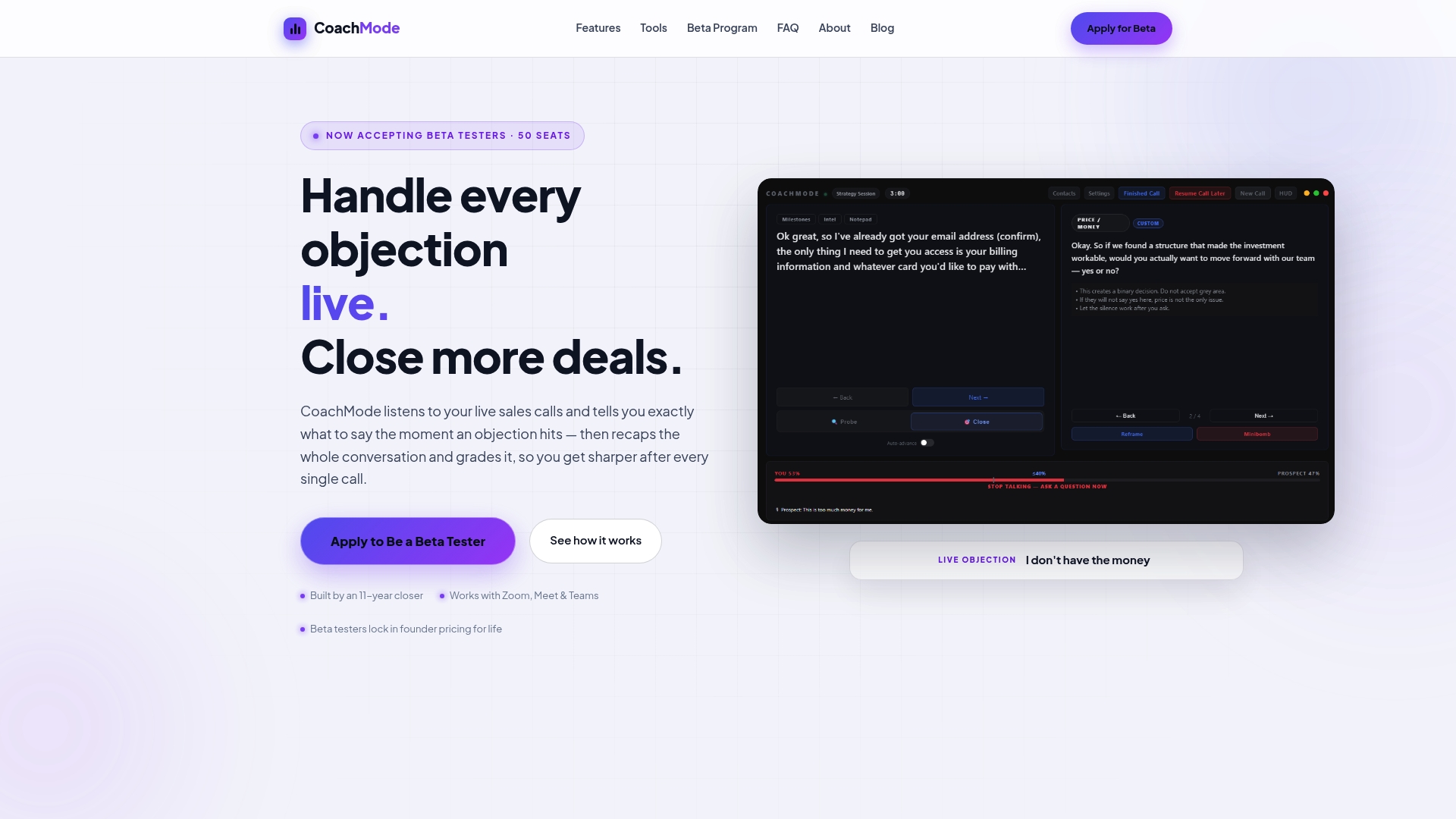
It’s built for teams handling high-touch or high-ticket sales, where one weak recap can cost a week of pipeline momentum, not a quick transactional call where speed beats precision. Every call also generates a scorecard, so managers can see exactly where next-step language went soft across the team, not just guess at it in a pipeline review. If your team’s coverage rate on next steps is lower than it should be, start with the AI Sales Coaching page and see what a live-prompted call actually sounds like.
Sources
- Sales follow-up email guidance | HubSpot
- How to ensure every call ends with next steps | Sandler
- Otter
- Sales next steps playbook | Salesmotion
- How to write an effective follow-up email after a sales call | Grammarly