The right move when a prospect says “your price is too high” is to ask a diagnostic question, not to offer a discount. Try “Compared to what?” or “Help me understand what’s driving that.” Discounting reflexively treats a symptom instead of the actual problem, and it trains buyers to negotiate against your list price every time. What follows is the framework for diagnosing what’s really going on, plus the scripts, timing rules, and practice drills that turn that diagnosis into a closed deal.
TL;DR:
- Understanding the true cause of a price objection requires diagnosing whether it stems from anchor, value gap, authority, or timing issues.
- Using diagnostic questions early in the conversation prevents automatic discounts that may leave money on the table or reduce margins.
- Response templates should be matched to the specific root cause and include openers, value reframes, scope reduction, and payment structure scripts.
- Building value and quantifying outcomes before discussing price helps avoid anchoring prospects to initial numbers and improves deal closure.
- Consistent practice, real-time coaching, and micro-skills like diagnostic framing significantly increase confidence and effectiveness in handling price objections.
Table of Contents
- What Causes Pricing Objection Responses to Fail Before They Start?
- Ready-to-Use Response Templates for Every Objection Type
- When Should You Bring Up Price in a B2B Sales Call?
- How to Protect Pricing Integrity Without Losing the Deal
- Scripts and Call Language That Hold Up Under Pressure
- How to Practice Pricing Objection Responses Until They’re Instinct
- Why Field-Tested Scripts Beat Generic Advice
- What One Coaching Habit Taught Me About Price
- Try Live Pricing Objection Coaching on Your Next Call
- Sources
What Causes Pricing Objection Responses to Fail Before They Start?
Most reps hear “it’s too expensive” and jump straight to a number. That’s the mistake. HubSpot’s analysis of price objections shows that “too high” almost always masks one of four distinct problems, and each one needs a completely different response. Discount for the wrong reason and you either leave money on the table or lose the deal anyway.
Here’s what’s actually happening behind that objection, and how to spot which one you’re dealing with:
- Anchor. The buyer has a number in their head, usually from a competitor’s quote or last year’s budget, and your price doesn’t match it. Signal: they mention a specific figure or say “we were expecting something closer to X.” Next step: reposition around what that number actually buys elsewhere.
- Value gap. They believe the price, they just don’t see enough return to justify it. Signal: vague pushback like “it just feels like a lot” with no comparison point offered. Next step: quantify the outcome in their own terms, not yours.
- Authority. The person on the call can’t approve the spend, or someone upstream will veto it. Signal: “I’d need to run this by finance” or unusual hesitation about a number they haven’t really evaluated. Next step: identify the real decision-maker and navigate the buying committee directly, since Gartner’s research on B2B buying confirms most deals move through multiple stakeholders on a non-linear timeline.
- Timing. The budget genuinely isn’t available this quarter, or there’s a fiscal-year constraint. Signal: specific mentions of budget cycles, renewal dates, or “ask me again in Q2.” Next step: phase the start date or structure payment terms around their calendar instead of walking away.
Pro Tip: Ask one diagnostic question before you say anything else. Silence after the question is doing the work. If you fill it, you never find out which of the four you’re actually dealing with.
Getting this categorization right is the entire game. AmpUp’s analysis of price objection handling found that reps who map their response to the actual root cause close at meaningfully higher rates than reps who default to a percentage-off reflex.
Ready-to-Use Response Templates for Every Objection Type
Scripts only work when they’re matched to the right diagnosis. Below are templates grouped by category. Adapt the wording to your product and your prospect’s language, don’t recite them verbatim.
Diagnostic openers (use these first, before anything else):
- “Compared to what, exactly? I want to make sure I’m solving the right comparison.”
- “What number did you have in mind, and how did you land on it?” This pattern-interrupt question, recommended by The Revenue Coaches, shifts the conversation from a flat rejection into a negotiation you can actually navigate.
- “Is this about the price itself, or about timing on the budget?”
ROI and value reframes (once you’ve confirmed it’s a value gap):
- “If this saves your team 10 hours a week, what does that hour cost you today? Let’s run the math together.”
- “What does it cost you to keep doing this the current way for another two quarters?” Framing the choice around cost of inaction rather than cost of adoption works because buyer-experience research from 6sense shows that clear ROI data shortens deal cycles and directly reduces price pushback.
- “Walk me through what a 5% improvement in [their metric] is worth to your business this year.”
Scope-reduction scripts (start smaller instead of cutting price):
- “What if we started with just [core module] to prove the model, then expanded once you see results?”
- “Let’s scope this to your highest-priority team first. You get the same outcome, just a smaller footprint to start.”
Pilot and payment-term scripts:
- “We can run a 60-day pilot at a reduced commitment. Full price applies if you continue past that window.”
- “If cash flow is the real constraint, we can split this across two invoices tied to your fiscal quarters instead of lowering the total.”
Use diagnostic openers within the first 10 seconds of hearing the objection. Save ROI reframes for value-gap situations specifically, and reserve pilots and payment terms for timing or authority objections where the buyer wants in but can’t move yet. Templates for handling price objections and isolating the real objection walk through fuller versions of these exchanges if you want to build a personal script library.
When Should You Bring Up Price in a B2B Sales Call?
Price introduced too early gets anchored to nothing. If a prospect hears a number before they understand what it buys, that number becomes the only thing they remember, and every objection afterward traces back to that first impression. The fix isn’t complicated: build value first, quantify the outcome, and only then attach a price to it.
A few rules of thumb keep this disciplined:
- Don’t quote price until the prospect has stated, in their own words, what the problem is costing them.
- Ask discovery questions that surface budget reality before you get there: “How is this typically funded?” or “Who else weighs in on a purchase like this?”
- If a prospect asks for pricing in the first five minutes, answer with a range tied to outcomes rather than a bare figure; see the pricing & packages options for a helpful example of structuring price information this way. “Most teams like yours see this priced between X and Y, depending on scope. Let’s figure out where you’d land.”
Genuine timing constraints look different from a polite exit. A real constraint comes with specifics: a fiscal quarter, a budget freeze, a named approval date. A polite exit sounds vague and unfalsifiable, “let me think about it” with no follow-up detail offered. When you hit a real constraint, propose a calendar hold or a phased start instead of disappearing for three months. When you suspect a polite exit, go back to the diagnostic question you should have asked already: “Compared to what?” often surfaces the real objection hiding behind the stall.
How to Protect Pricing Integrity Without Losing the Deal
Discounting on request teaches every future buyer that your list price is a starting offer, not a real number. That erodes margin across your entire pipeline, not just on this one deal.
The alternative is trading value for commitment instead of trading price for commitment. Non-price concessions that preserve your positioning include:
- Additional user seats or licenses at the same price point.
- Implementation credits or expedited onboarding.
- Extra training sessions or a dedicated success contact for the first 90 days.
- A phased scope that delivers core value now with an expansion path later.
Pro Tip: Never offer a concession without asking for something back. “I can include onboarding at no cost if we can get this signed by Friday” reframes the exchange as a trade, not a giveaway.
A simple two-line script captures this: “I can’t move on price, that’s set for a reason. But if you can commit this week, I’ll include [training/credits/extra seats] at no additional cost.” That single sentence rewards speed and commitment instead of rewarding the act of asking for less.
Scripts and Call Language That Hold Up Under Pressure
Templates matter less than the delivery. Here are three short exchanges that show how this actually sounds on a live call:
Exchange 1: Prospect: “Your price is way higher than what we budgeted.” Rep: “Compared to what, exactly?” Prospect: “We got a quote from another vendor for half this.” Rep: “Got it. What’s included in that quote?” This usually reveals the competitor is quoting a stripped-down version, turning an anchor objection into a feature comparison.
Exchange 2: Prospect: “I like it, but I need to think about the cost.” Rep: silence for three full seconds, then, “What specifically about the cost is giving you pause?” That pause, often called the ledge, resists the urge to fill dead air with a justification the prospect didn’t ask for.
Exchange 3: Prospect: “Can you just come down 10%?” Rep: “I can’t move on price, but I can adjust the scope or the timeline. Which matters more to you right now?” This isolates price from the rest of the deal instead of negotiating everything at once.
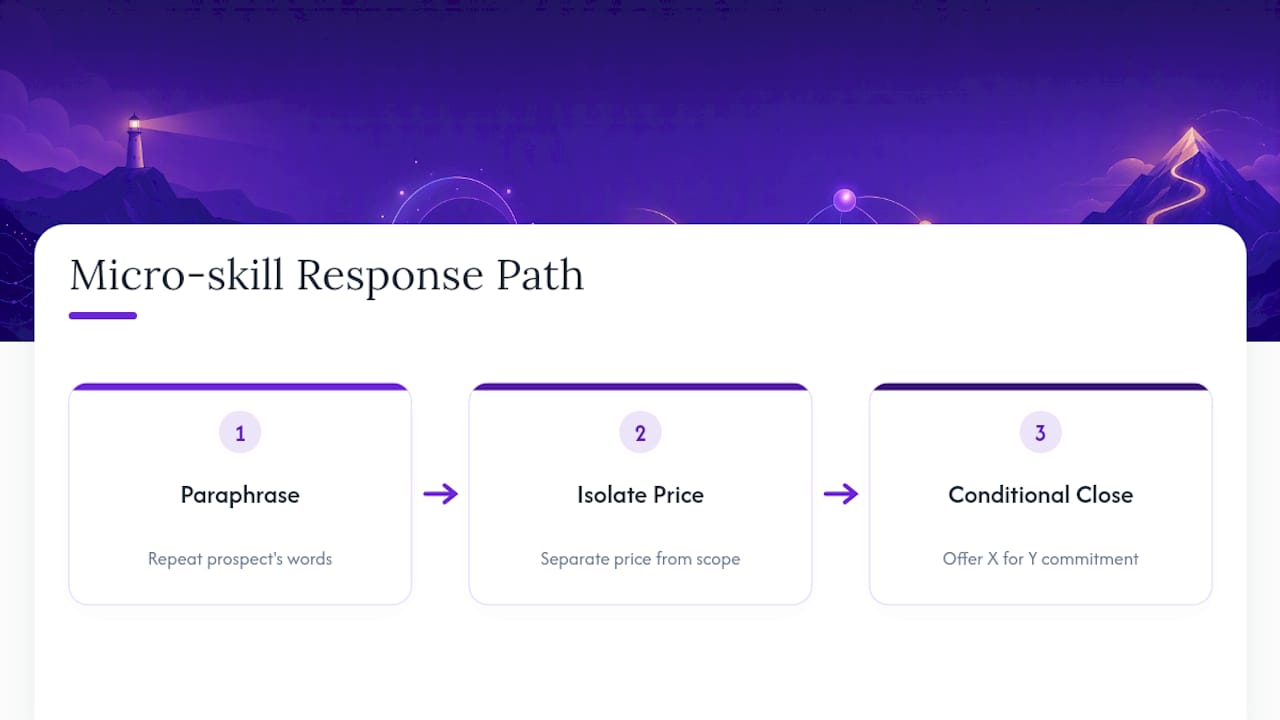
Three micro-skills make these exchanges land: paraphrase what you heard before responding, isolate price as a single variable rather than letting it bleed into scope and timeline, and use conditional closes (“If I can do X, can you commit to Y by Friday?”) instead of open-ended concessions.
How to Practice Pricing Objection Responses Until They’re Instinct
Reading a script is not the same as being able to say it cold, under pressure, while a prospect is staring at you over Zoom. Build the muscle with a structured drill.
- Pair up reps for a 10 to 15 minute roleplay. One plays the prospect and picks one of the four root causes (anchor, value gap, authority, timing) without telling their partner which one.
- The rep playing the seller has to diagnose the category out loud within the first two exchanges, then deliver the matching script from memory, not from a document.
- Score the roleplay on three items: did they diagnose correctly, did they reframe around value or timing appropriately, and did they use a non-price lever instead of defaulting to a discount.
- After a live call, run a five-minute coaching micro-session immediately while the call is fresh: what was the actual objection, what did the rep say, and what would the ideal response have sounded like.
Reps who drill this weekly stop sounding rehearsed and start sounding confident, which is the entire point.
Why Field-Tested Scripts Beat Generic Advice
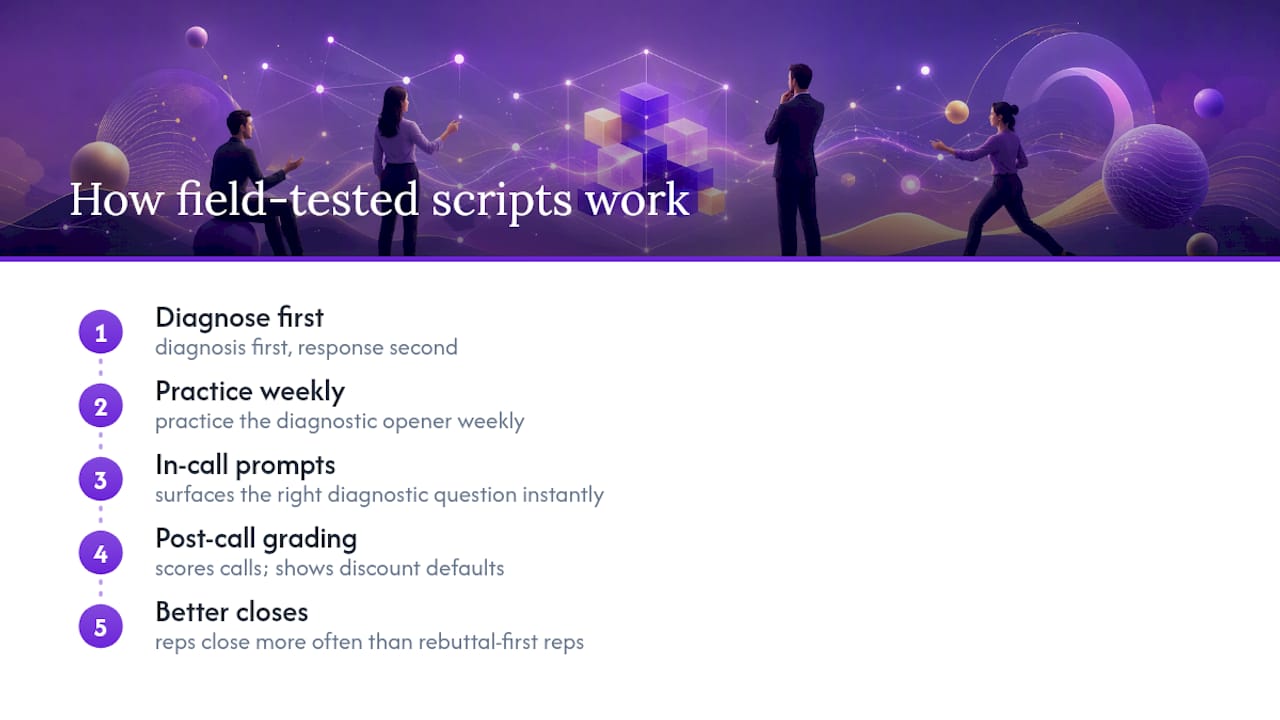
Objection-handling advice is everywhere, but most of it treats “too expensive” as one problem instead of four. The reason field-tested scripts and structured coaching outperform generic tips is straightforward: they’re built around diagnosis first, response second, exactly the sequence HubSpot’s guidance on adapting rather than reciting scripts recommends.
Sales managers running these drills consistently report the same pattern: reps who practice the diagnostic opener weekly close more often than reps who go straight to a rebuttal. That’s not because the words themselves are magic. It’s because rehearsal removes hesitation, and hesitation is what makes a discount feel like the safe move in the moment.
Getcoachmode’s real-time coaching platform was built around this exact gap. It listens during live calls and surfaces the right diagnostic question or reframe the instant a pricing objection comes up, then scores the call afterward so reps see precisely where they defaulted to a discount instead of a diagnosis. That combination of in-call prompting and post-call grading is what turns a script from something a rep read once into something they actually use.
What One Coaching Habit Taught Me About Price
The reps who struggle most with pricing pushback aren’t the ones with weak scripts. They’re the ones who skip the diagnostic question because it feels awkward to pause and ask instead of just answering. I’ve watched this play out across enough call reviews to trust the pattern: the moment a rep starts answering “too expensive” with a number instead of a question, the deal usually gets worse, not better.
The habit that fixes this is small and boring: before every single call where price might come up, say the diagnostic opener out loud once, alone, before the prospect ever says a word. It sounds trivial. It works because it moves the question from “something I should remember” to “something I’ve already said today.” Do that on your very next live call and watch how differently the objection unfolds.
— Ryan
Try Live Pricing Objection Coaching on Your Next Call
Reading templates helps you understand the framework. Having the right words surface in real time, while a prospect is actually pushing back on price, is a different skill entirely, and it’s the one that decides whether the deal closes. Getcoachmode listens to your live calls on Zoom, Google Meet, or Teams, and delivers the exact diagnostic question or reframe the moment a pricing objection lands, so you’re never scrambling for what to say next.
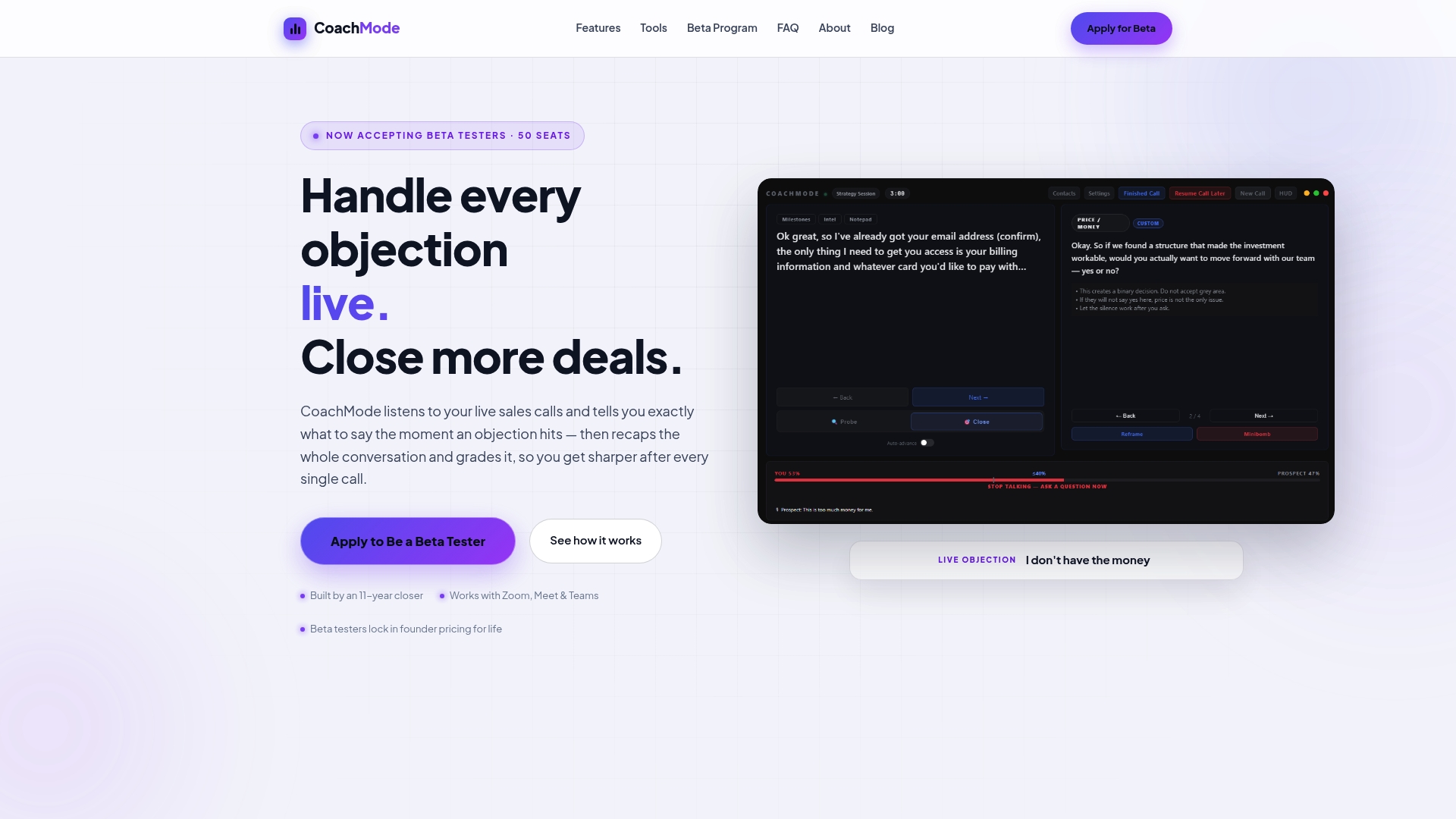
High-ticket closers and sales managers get the most out of it because pricing objections show up constantly in longer sales cycles with multiple stakeholders, exactly where a wrong response costs the most. The platform also grades every call afterward against categories like diagnosis and value reframing, so managers can run coaching sessions based on real data instead of guesswork about what happened on the call. Try the sales objection response generator to see how it turns a pricing pushback into a ready-to-use reply, or start a trial of real-time AI sales coaching and let it run alongside your next live call.
Sources
For deeper frameworks and additional examples beyond this guide, these sources are worth your time:
- 14 responses to the sales objection, “Your price is too high” — HubSpot
- How to Handle ‘Can You Lower the Price?’ Without Losing the Deal — The Revenue Coaches
- B2B buying journey — Gartner
- 2024 buyer experience report — 6sense