Sales call coaching is the recurring, one-on-one practice of diagnosing a rep’s specific call behaviors and drilling the fix until it shows up on the next live call. Done right, it changes what a rep says and does on calls, which is what moves pipeline metrics, not a slide deck or a motivational Monday huddle.
Do three things this week:
- Put a recurring 30-minute 1:1 on the calendar, same time every week, non-negotiable.
- Pull one recorded call per rep and score it before you meet.
- Pick a single observable behavior to fix (not five) and name how you’ll check it next week.
Reps who get roughly three hours of coaching a month, about 30 minutes a week per rep, hit quota more consistently than reps who get sporadic feedback or none. That’s the whole business case in one line.
Key Takeaways
Sales call coaching works when a manager isolates one observable behavior per rep, models and practices it in a fixed weekly cadence, and checks for change within a week, not a quarter.
| Point | Details |
|---|---|
| Protect the cadence | Keep a fixed 30-minute weekly 1:1 and never let pipeline review replace it. |
| Coach one behavior | Pick a single observable skill gap per session instead of a full call teardown. |
| Score consistently | Use a five-part rubric (discovery, qualification, objections, close, talk-to-listen) on every call. |
| Solve the observation gap | Use call intelligence or real-time AI to make more calls coachable than a manager can review alone. |
| Pilot real-time coaching | Getcoachmode’s real-time AI coach feeds reps objection responses live and grades calls after, useful for teams stalling at the objection stage. |
Table of Contents
- What Sales Call Coaching Actually Means
- Which Coaching Method Fits Which Situation
- The Five-Step Coaching Loop That Actually Works
- Coaching Cold Calls: Openers, Scripts, and Resilience
- Building a Call Scorecard That Actually Predicts Results
- Solving the Observation Problem With Call Intelligence
- Copy These Templates: Agenda, Roleplay, and Call Checklist
- Why Coaching Programs Quietly Fail
- Your 30/60/90-Day Rollout Plan
- What Changed When We Stopped Winging It
- Give Reps a Voice in Their Ear, Not Just Notes After the Call
- Frequently Asked Questions
- Sources
What Sales Call Coaching Actually Means
Sales call coaching is developmental, not evaluative. Training teaches a new skill from scratch. A performance review scores what already happened against a quota. Coaching sits between the two: it takes one specific behavior on one specific call and helps the rep change it before the next call happens. Get this distinction wrong and you’ll spend your 1:1s reviewing pipeline stages instead of fixing how a rep opens a discovery call.
The business outcomes are concrete:
- Shorter ramp time for new reps, because they’re correcting habits in week three instead of month three.
- Higher close rates, driven by better objection handling and stronger discovery questions.
- Better retention, since reps who feel coached stick around longer than reps who feel judged.
- More confidence on calls, which shows up as a calmer talk-to-listen ratio and fewer rambling pitches.
The manager’s job is to protect three things: a fixed weekly cadence, a hard line between coaching and pipeline review, and a single skill focus per session. Blur any of those and the program drifts into a status meeting.
Which Coaching Method Fits Which Situation
Not every coaching moment calls for the same tool. Live coaching, post-call review, roleplay, and deal coaching each solve a different problem, and most managers need all four in rotation.
- Live on-call coaching: whispering guidance or feeding a rep language mid-call. Best for new reps on high-stakes calls or when a deal is about to slip. Limitation: you can only shadow so many calls a week before it eats your whole calendar.
- Post-call review: listening to a recording and scoring it against a rubric. Works for any rep, any experience level, and scales better than live shadowing. Limitation: the feedback arrives after the moment has passed, so the rep has to remember the fix for next time.
- Roleplay: simulating a specific scenario, usually an objection or a tricky opener, in a safe setting. Best for building muscle memory before a rep faces it live. Limitation: roleplay energy never perfectly matches a real prospect pushing back.
- Deal coaching: reviewing a specific opportunity’s strategy and stakeholders rather than a single call. Best for veteran reps stuck on a complex, multi-threaded deal. Limitation: it’s slower and doesn’t build general call skills.
| Method | Best for | Main limitation |
|---|---|---|
| Live on-call | New reps, high-stakes calls | Doesn’t scale past a few reps |
| Post-call review | Any rep, any skill gap | Feedback lands after the moment |
| Roleplay | Building resilience before it’s needed | Never fully mimics real pushback |
| Deal coaching | Complex, multi-threaded opportunities | Doesn’t build repeatable call skills |
New reps generally need more live coaching and roleplay early, then shift toward post-call review and deal coaching as they mature. Before any session, ask yourself: is this about a skill (roleplay or post-call) or a specific deal (deal coaching)? That question alone will point you to the right method most of the time.
The Five-Step Coaching Loop That Actually Works
A coaching program lives or dies on whether it’s repeatable. Five steps, run weekly, every rep:
- Observe. Pull the call recording or notes from the week. You can’t diagnose what you haven’t watched.
- Diagnose. Identify the single behavior holding this rep back right now, not everything wrong with the call.
- Model. Show, don’t just tell. Say the exact words you’d use, or play a clip of a rep who nailed the same moment.
- Practice. Have the rep say it back, out loud, in the room. Reading a tip doesn’t build the muscle.
- Inspect. Check next week whether the behavior actually showed up on a real call.
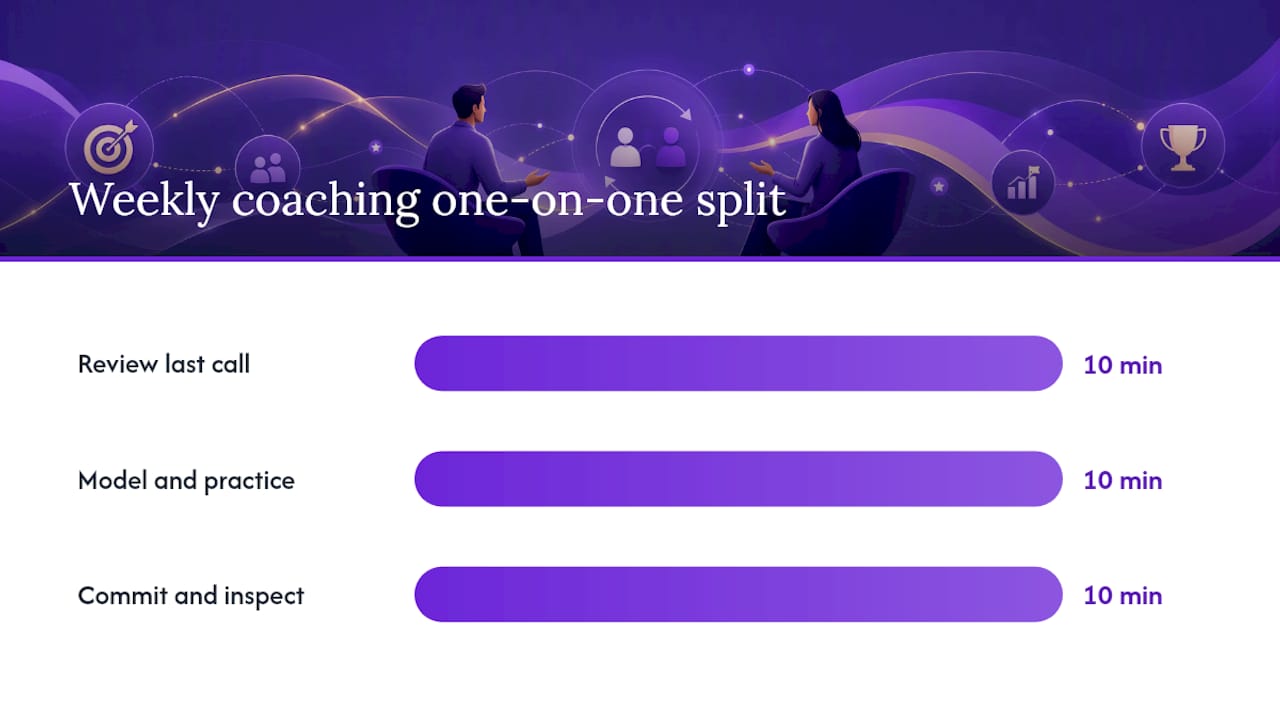
This maps cleanly onto a 30-minute weekly 1:1: 10 minutes reviewing last week’s call and naming the one behavior, 10 minutes modeling and practicing the fix, 10 minutes committing to what gets checked next session. Richardson’s research on developmental feedback points to the same root cause behind most failed coaching programs: managers let pipeline review creep into the session, and the developmental focus disappears.
A scoped goal looks like this: “This week, ask three open discovery questions before pitching on every call. I’ll pull two calls Friday and check.”
Pro Tip: Write the goal down in the exact words you’ll use to check it next week. “Improve discovery” is not measurable. “Ask three open questions before the pitch” is.
Coaching Cold Calls: Openers, Scripts, and Resilience
Cold calling breaks coaching frameworks that work fine for warm demos, because the rep gets rejected in the first ten seconds and has to reset for the next dial immediately. Coach for resilience as much as for phrasing.
Three openers worth drilling in roleplay:
- Direct pattern interrupt: “I’ll be quick, this is a cold call, do you have 20 seconds?” Works because it disarms the instinct to hang up.
- Reason-why opener: “The reason I’m calling is [specific trigger event].” Works when you have real intel, not a generic industry line.
- Permission-based opener: “Is now a terrible time, or do you have a minute?” Works for reps who struggle with pushy energy.
Run roleplay with a twist: have the “prospect” actually hang up, object hard, or go silent, not play along. Reps who only practice against a cooperative partner freeze the first time a real prospect snaps at them.
Metrics that matter for cold outreach:
- Connect rate (dials that reach a live person).
- Talk-to-listen ratio on the call itself.
- Meetings booked per 100 dials.
Track these weekly per rep, not just in aggregate. A rep with a great connect rate but zero meetings booked has a different problem than one who can’t get anyone on the phone. Getcoachmode’s guide on handling sales objections on live calls breaks down phrasing for the pushback that follows most cold-call openers.
Building a Call Scorecard That Actually Predicts Results
You can’t coach what you don’t measure, and vague feedback like “be more confident” doesn’t give a rep anything to practice. A workable scorecard rates five competencies on every call: discovery, qualification, objection handling, close, and talk-to-listen ratio.
- Discovery: did the rep ask open questions and uncover a real business problem, or did they pitch too early?
- Qualification: did the rep confirm budget, timeline, and decision process, or assume it?
- Objection handling: did the rep acknowledge the objection and respond with a specific answer, or get defensive?
- Close: did the rep ask for a clear next step, or let the call end vague?
- Talk-to-listen ratio: a rep talking more than roughly 60% of the call is usually pitching instead of listening; the strongest discovery calls tend to run closer to even.
Getcoachmode’s sales call scorecard is built around these five categories and works as a starting template you can adapt.
The fix isn’t “talk less” in the abstract, it’s “ask two questions before you say anything about the product.” That’s the one-week goal, and it’s checkable against next Friday’s call.
Solving the Observation Problem With Call Intelligence
Most coaching programs fail quietly for a boring reason: managers can’t listen to enough calls to know what’s actually happening. A manager with eight reps making 30 calls a week can maybe review a handful. Everything else is a black box.
Call intelligence tools close that gap by recording and transcribing every call, then flagging the ones that need attention, so 100% of calls become coachable instead of the 5% a manager happened to catch. Post-call analytics are strong for building a library of top-performing calls and spotting patterns across a team. Real-time AI coaching goes a step further: it listens live and surfaces the right response while the rep is still on the call.

The practical difference shows up in a live demo when a prospect throws out a hard price objection. Post-call analytics will tell you, a day later, that the rep fumbled it. Real-time coaching tells the rep what to say while the prospect is still on the line, which is the difference between losing the deal and saving it.
For call-intelligence scaling, automate the metrics you already track by hand: talk-to-listen, filler words, sentiment shifts, and objection frequency. Configure alerts for calls where sentiment drops sharply or an objection goes unanswered, and build your weekly 1:1 around the two or three flagged moments rather than a full transcript. Getcoachmode’s AI sales coach is built around this real-time model rather than next-day review.
Pro Tip: Don’t let AI replace the coaching conversation. Use it to find the moment worth discussing, then have the human conversation about why it happened.
Copy These Templates: Agenda, Roleplay, and Call Checklist
30-minute 1:1 agenda:
- Minutes 0 to 10: rep shares the call they thought went worst this week; manager scores it together against the scorecard.
- Minutes 10 to 20: manager models the fix out loud, rep practices it back twice.
- Minutes 20 to 30: rep commits to the one behavior they’ll apply, manager notes how it’ll be checked.
Roleplay script snippet (discovery drill):
- Manager plays a prospect who gives one-word answers.
- Rep has to ask three follow-up questions before mentioning the product at all.
- Manager breaks character and gives feedback on which question actually opened the prospect up.
7-step call checklist for scoring and teaching structure:
- Opening and rapport
- Agenda-setting
- Discovery questions
- Qualification
- Pitch tied to what was uncovered
- Objection handling
- Clear next step or close
Print this checklist and score against it live during roleplay, not just after real calls.
Why Coaching Programs Quietly Fail
Most coaching programs don’t collapse dramatically, they just erode. Watch for these patterns:
- Coaching sessions turn into pipeline review meetings.
- Goals stay vague (“sell better”) instead of one observable behavior.
- The weekly cadence gets bumped for “more urgent” meetings two weeks running.
Red flags that mean it’s time to reset: three missed sessions in a row, or no measurable behavior change after two straight weeks of the same goal. If you see either, stop, pick one narrower behavior, and rebuild the cadence before adding anything new.
Your 30/60/90-Day Rollout Plan
- Days 1 to 30: manager schedules recurring 1:1s, builds the scorecard, and reviews one call per rep weekly. Deliverable: every rep has had at least three coaching sessions. KPI: cadence adherence, not revenue yet.
- Days 31 to 60: enablement builds a call library of strong examples; manager starts tracking talk-to-listen and objection-handling scores weekly. KPI: measurable behavior shift on at least one scored competency per rep.
- Days 61 to 90: operations layers in call intelligence tooling if manual review can’t keep pace. KPI: close rate and ramp time for coached reps versus baseline.
Budget roughly 30 minutes per rep per week from the manager, plus prep time to score the call beforehand. Once a manager has more than eight or nine reps, manual review time usually justifies bringing in tooling.
What Changed When We Stopped Winging It
The biggest shift wasn’t a new script, it was separating coaching from pipeline review entirely. Reps stopped bracing for a grilling and started actually bringing their worst calls to the session, which is where the real learning happens.
A few things surprised me. Reps wanted more roleplay than expected, not less, once they trusted it wasn’t a test. And the managers who struggled most weren’t bad coaches, they just couldn’t resist fixing five things instead of one.
Dos: protect the cadence like a client meeting, name one behavior per session, and check it the following week without fail. Don’ts: never let “how’s your pipeline looking” open a coaching call, and never let a good rep skip coaching just because their numbers look fine this month.
Scaling across teams comes down to one checklist: same scorecard everywhere, same cadence everywhere, and a shared call library so a manager on team B can point to a great call from team A.
Give Reps a Voice in Their Ear, Not Just Notes After the Call
Post-call scorecards and weekly 1:1s fix behavior over weeks. They don’t help a rep who’s frozen mid-call, staring down a price objection they didn’t see coming. That’s the gap real-time coaching closes.
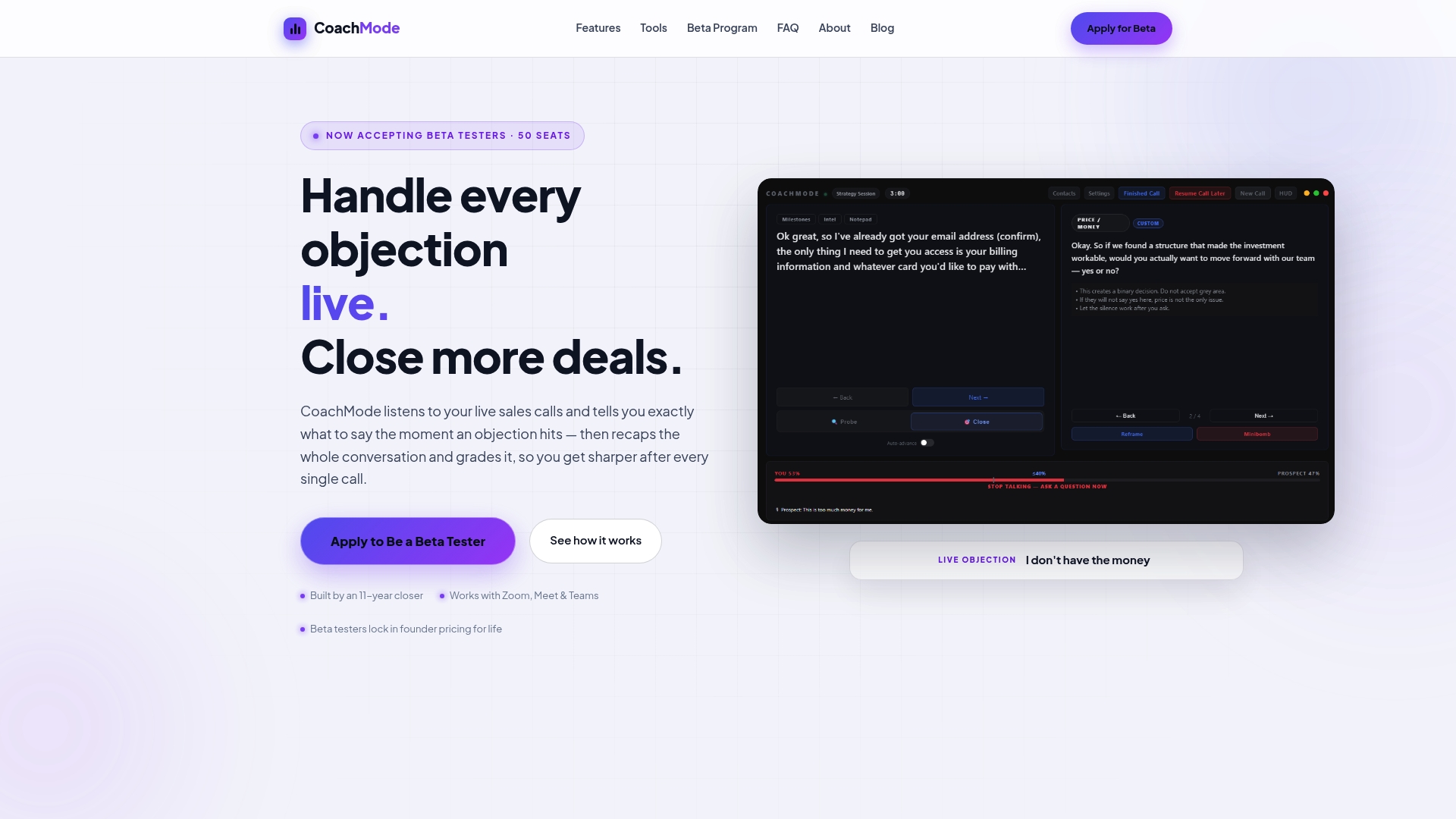
Getcoachmode’s real-time AI sales coach listens to live calls on Zoom, Google Meet, or Teams and feeds reps the right words the moment an objection lands, then hands the manager a graded recap afterward so coaching has real data behind it instead of a manager’s memory of how the call “felt.” For high-ticket closers, that live assist during the price conversation or the stall is often the difference between a rep going quiet and a rep staying in control of the call.
If you’re piloting it, keep the group small: two or three reps who are coachable but currently losing deals at the objection stage, run it for two to three weeks, and track close rate on objection-heavy calls against your usual baseline. Start with CoachMode’s live sales call coaching to see how the live-assist setup works before rolling it out to the full team.
Frequently Asked Questions
How often should a manager coach each rep?
Roughly once a week for 30 minutes is the baseline that correlates with better quota attainment. Less frequent coaching tends to lose momentum between sessions.
What’s the difference between sales call coaching and sales training?
Training builds a new skill from scratch, often in a group setting. Coaching is one-on-one and developmental, focused on fixing one specific behavior a rep already has partial command of.
What should a manager score on every call?
Discovery quality, qualification rigor, objection handling, the close, and the talk-to-listen ratio. Those five categories cover most of what separates a strong call from a weak one.
Does real-time AI coaching replace a manager’s coaching sessions?
No. It handles the in-the-moment response during a live call, but the weekly 1:1 where a rep practices and internalizes the behavior still needs a human coach running it.
How do I coach cold calls differently from warm ones?
Focus more on resilience and opener phrasing, since cold-call rejection happens in the first few seconds. Roleplay with a partner who actually pushes back or hangs up, not one who cooperates.
Sources
- Evaluative vs. Developmental Feedback — Richardson
- Sales Call Coaching: A Manager’s Guide | Sendspark
- Sales coaching guide: using call intelligence to improve performance | Coldread