A meeting doesn’t count as handed off until the AE has a completed, structured CRM record in hand. That’s the whole rule. Not a Slack message, not a calendar invite with “great fit, talk soon” in the notes. A five-field handoff record, filed before the AE’s scheduling link ever gets sent to the prospect.
Make it mechanical: five required CRM fields plus routing through the AE’s own scheduling link. No completed fields, no handoff. No handoff, no meeting on the books.
Here’s what changes when you enforce it:
- Show rates climb because the AE actually knows who’s walking into the call
- AEs stop burning the first ten minutes re-asking discovery questions the SDR already covered
- Meeting-to-opportunity conversion improves because “qualified” stops being a matter of opinion
Everything below explains how to build that gate and keep it honest.
TL;DR:
- Enforcing a completed five-field CRM handoff record before scheduling links go out significantly improves show rates and meeting quality.
- Teams should adopt a clear qualification framework and route prospects automatically by territory and segment to avoid misaligned handoffs.
- Requiring explicit AE acceptance with structured reasons and enforcing response SLAs helps prevent unconfirmed meetings and rework.
- Automating gatekeeping, routing, and SLA reminders ensures consistency, accuracy, and timely follow-up in the handoff process.
- Weekly metrics and call coaching, especially with AI support, improve handoff quality, from objection handling to pipeline conversion.
Table of Contents
- What Counts as a Real SDR to AE Handoff?
- Why SDR to AE Handoffs Break Down as Teams Grow
- How to Standardize the Handoff: Qualification, Routing, Package, Ownership, SLA
- The Five-Field Handoff Checklist You Can Paste Into Your CRM
- What Automation Should Actually Enforce
- Measuring Handoff Quality: Metrics, QA, and Cadence
- Rolling Out the New Handoff Process in 30 to 60 Days
- Key Takeaways
- Sources
What Counts as a Real SDR to AE Handoff?
A handoff is the transfer of a qualified meeting plus the structured context an AE needs to run it without starting over. Not a meeting invite. Not a lead assignment. A package.
For a handoff to be valid, four things need to be true:
- The prospect has accepted the calendar invite, not just received it
- ICP fit has been confirmed against your qualification criteria, not assumed from firmographic data alone
- A next step has been agreed with the prospect, in their own words if possible
- The handoff record in the CRM is complete, not partially filled and marked “good enough”
Skip any of those four and you get a false positive. Teams that mark meetings “handed off” when they’re really just booked build their pipeline forecast on sand. The SalesHive framework for handoff processes exists precisely because “qualified meeting” without a shared definition becomes whatever the SDR needs it to be that week.
Why SDR to AE Handoffs Break Down as Teams Grow
The handoff usually works fine with five reps in one room. It falls apart at twenty, across time zones, with SDRs and AEs who’ve never had lunch together.
The failure modes repeat across almost every scaling sales org:
- Misaligned incentives. SDRs get paid on meetings booked; AEs get paid on deals closed. Nobody owns the quality of the handoff itself.
- Missing context. Notes get typed in a rush between calls, so the AE opens the meeting blind and re-runs discovery the SDR already did.
- Routing gaps. Meetings land on the wrong AE’s calendar, or on nobody’s calendar, because territory and segment rules live in someone’s head instead of the CRM.
- Slow AE response. A meeting sits unconfirmed for days with no escalation path when the assigned AE goes dark.
- No QA loop. Nobody scores handoffs, so bad habits calcify instead of getting corrected.
Pulse RevOps frames this as a definitional problem at its root: SDRs and AEs are often working from two different mental models of what “qualified” means, and no amount of process fixes that until the definition gets written down and both sides sign off on it.
How to Standardize the Handoff: Qualification, Routing, Package, Ownership, SLA
Fixing this isn’t about hiring more SDRs or lecturing AEs about responsiveness. It’s five specific mechanical changes.
Adopt one qualification framework, and make its inputs CRM fields, not tribal knowledge. Whether you run MEDDIC, BANT, or a homegrown scorecard, the point is that “qualified” becomes a checkbox everyone can see, not a judgment call buried in someone’s notes.
Route deterministically. Territory, then segment, then owner, then priority, in that order, every time. Send the prospect an AE-specific scheduling link rather than a generic company calendar, so the meeting lands on the correct person’s calendar automatically instead of getting reassigned manually after the fact.
Require the five-field handoff package before that scheduling link goes out:
- A one-line company overview and ICP fit statement
- The prospect’s pain, ideally in their own words
- Objections raised and exactly how the SDR handled them
- The agreed next step and a rough agenda
- The prospect’s current tech stack, where relevant
Make AE acceptance an explicit action, not a default. The AE reviews the record and accepts or rejects it within a defined SLA window, and every rejection carries a structured reason. Pulse RevOps notes this accept/reject step is often the fastest way to teach an SDR team what “complete” actually looks like, because vague feedback never sticks the way a logged rejection reason does.
Enforce SLAs in both directions. SDRs owe a complete package; AEs owe a response inside a set window, with an escalation path when that window gets missed.
Pro Tip: Treat the handoff record like a required field in a form, not a courtesy. If your CRM lets an SDR book a meeting without filling in all five fields, the gate doesn’t exist. Enforce it structurally, not through good intentions.
The Five-Field Handoff Checklist You Can Paste Into Your CRM
Here’s the template. Five fields, one line each, no exceptions.
- Company overview and ICP fit — “42-person fintech, matches our mid-market ICP on headcount and funding stage.”
- Prospect’s stated pain — “Current onboarding takes six weeks; they lose 15% of new signups before activation.”
- Objections and how they were handled — “Worried about implementation time; SDR walked through the 10-day rollout case study.”
- Agreed next step — “AE to walk through integration options and pricing tiers on the call.”
- Relevant tech stack — “HubSpot, Segment, no existing sales engagement tool.”
The gating rule stays simple: no scheduling link goes out until all five fields are filled. The AE then logs accept or reject inside the SLA window, and every rejection needs a specific reason (“missing objection context,” “ICP fit unclear”) rather than a vague “not ready.” Structured rejection reasons are what actually teach an SDR team where they’re losing quality, week over week.
What Automation Should Actually Enforce
Process documents don’t stop a rushed SDR from skipping a field at 4:45 PM on a Friday. Automation does.

Your CRM workflow engine should physically block the AE scheduling link from generating until all five handoff fields are populated. That’s required-field gating, and it’s the single highest-leverage automation in this whole system.
Beyond that, three more behaviors matter:
- Deterministic routing that assigns meetings by territory and segment automatically, removing manual reassignment
- SLA timers with alerts that notify a manager the moment an AE misses the response window, rather than waiting for someone to notice
- AE notification flows across CRM and Slack or email, plus an auto-generated prep task the moment a handoff is accepted
Tool categories worth knowing: scheduler and routing layers like Chili Piper, CRM platforms like HubSpot or Salesforce running the workflow logic, and call transcription tools that attach a recording or transcript snippet directly to the handoff record so the AE walks in having actually heard the discovery call. Prospecting Manual’s breakdown of this workflow is worth reading if you’re rebuilding the process from scratch.
Measuring Handoff Quality: Metrics, QA, and Cadence
Five numbers tell you almost everything about handoff health, and you should be looking at them weekly, not quarterly.
- Handoff acceptance rate — the share of SDR-submitted handoffs an AE accepts without rejection
- AE SLA compliance — how often the AE responds inside the agreed window
- Meeting-to-opportunity conversion — the metric that actually reflects revenue impact
- Rejection reasons — tracked by category, not just counted
- Accepted-to-won rate — whether accepted handoffs are actually closing
Pair that with a lightweight QA rubric scored on three things: were all fields present, was discovery genuinely thorough, and were objections handled well. Run a weekly 30-minute huddle reviewing one strong handoff and one weak one, the format SalesHive recommends for keeping the standard concrete instead of theoretical, plus a monthly trend review to catch slow decay before it shows up in closed revenue.
| Metric | What It Tells You |
|---|---|
| Handoff acceptance rate | How consistently SDRs meet the quality bar |
| SLA compliance | Whether AEs are responding on time |
| Meeting to opportunity rate | Whether “qualified” is translating to real pipeline |
Rolling Out the New Handoff Process in 30 to 60 Days
You don’t need a quarter-long change management project. You need three phases.
- Audit (week one). Pull 30 recent handoffs and answer three questions for each: were all five fields present, did the AE respond inside a reasonable window, and did the meeting convert to an opportunity?
- Pilot (week two). Pick one SDR and AE pair. Enforce the five-field gate and a defined AE SLA for one week straight. Measure conversion against the prior baseline.
- Scale (weeks three through eight). Roll out the CRM automation, train the full team on the new fields, publish the KPIs somewhere visible, and start the weekly huddle.
Pro Tip: Run the pilot with your best AE, not your busiest one. You want clean data on whether the process works before you introduce the variable of an overloaded calendar.
How real-time coaching closes the skill gap the process alone can’t fix
A perfect handoff template still depends on the SDR handling objections well enough to fill field three honestly. In-call AI coaching helps here by surfacing the right phrasing in the moment, so the SDR’s objection notes reflect what actually worked, not a guess written after the call ended.
Post-call scoring turns every discovery call into a teachable example. Instead of a manager reviewing handoffs from memory, the weekly huddle can pull an actual transcript and score, side by side.
Why measuring accepted meetings, not booked ones, changes behavior
Booked meetings reward volume. Accepted meetings reward quality, which is the number that should drive comp conversations. Teams that shift the scoreboard this way usually see SDR behavior change within a month, not a quarter, because the incentive finally points at the outcome that matters.
— Ryan
CoachMode fits directly into this handoff workflow
The handoff record depends on an SDR capturing objections accurately and a manager scoring calls without spending hours listening to recordings. CoachMode’s real-time AI sales coaching listens live and surfaces the right response during the call itself, which means the “objections and how they were handled” field in your handoff record reflects what genuinely happened rather than a rushed recap.
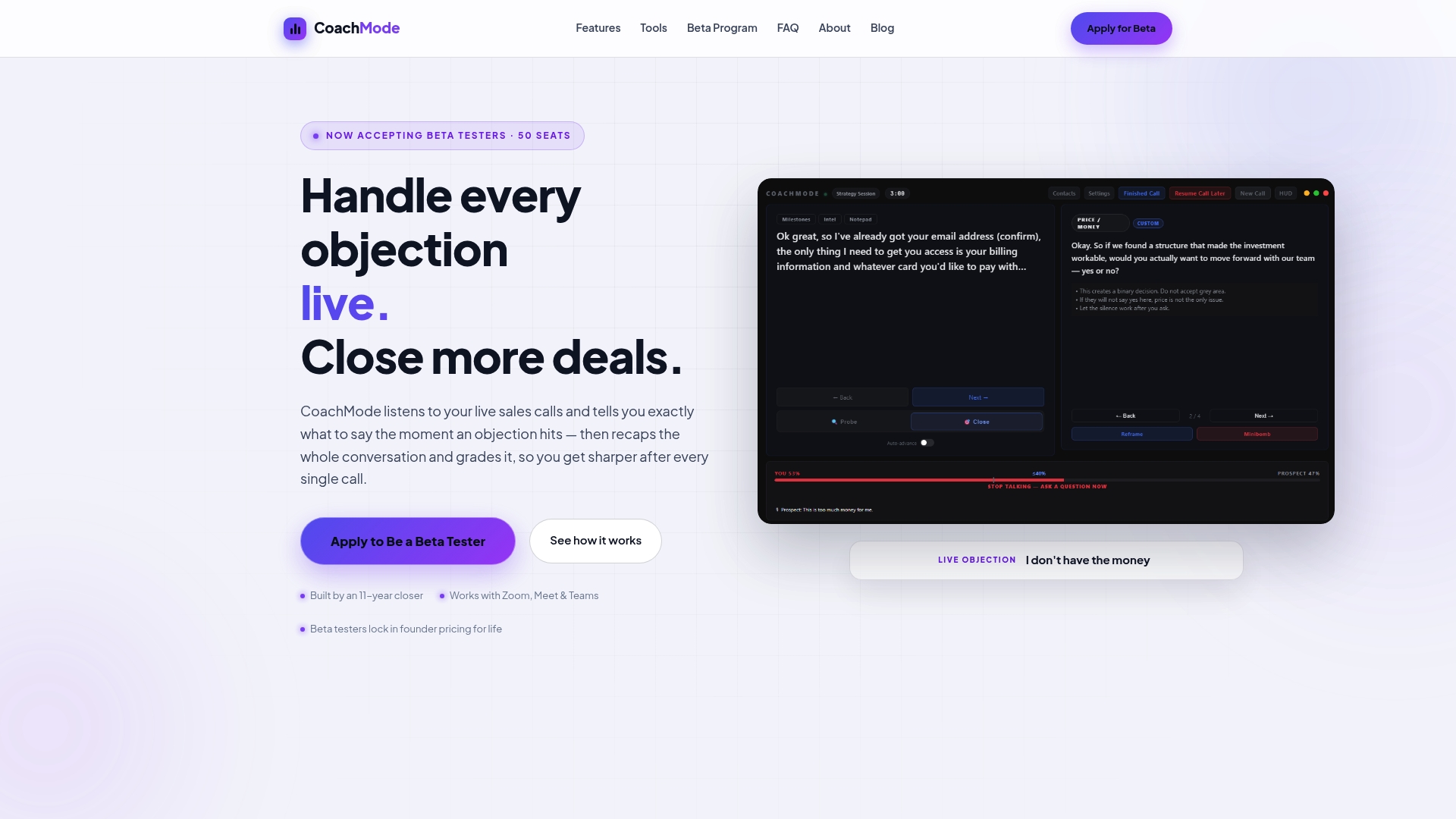
Two practical uses matter most here. First, in-call support during discovery keeps SDRs calm and specific when a prospect pushes back, so the notes they hand off are sharper. Second, the post-call scorecard can attach directly to the handoff record, giving the AE and the manager a transcript and a score before the weekly huddle even starts. If your handoff process is solid but your call quality is the weak link, start with a walkthrough of how the scoring system works.
Key Takeaways
The most effective SDR to AE handoff treats the CRM record as a gate: no complete five-field package, no scheduling link, no meeting on the books.
| Point | Details |
|---|---|
| Gate the handoff | Require five CRM fields complete before the AE scheduling link goes out. |
| Route deterministically | Assign by territory, then segment, then owner, then priority, automatically. |
| Enforce two-sided SLAs | SDRs owe a complete package; AEs owe a timed response with escalation. |
| Measure weekly | Track acceptance rate, SLA compliance, and meeting-to-opportunity conversion every week. |
| Close the skill gap with coaching | CoachMode’s real-time coaching and post-call scoring sharpen the objection notes that feed the handoff record. |
Sources
- SDR to AE Handoff: Best Practices for High-Conversion Sales | Default
- SDR-to-AE Handoff: Pass Meetings That Actually Convert | SalesHive
- SDR to AE Meeting Handoff: Process, Checklist & Tools | Prospecting Manual
- Fixing the SDR-to-AE Handoff Where Pipeline Dies | Pulse RevOps