A script is word-for-word phrasing you read or recite exactly as written. A talk track is a modular framework of hooks, proof points, and objection pivots that reps adapt live, based on what the buyer actually says. Use scripts for short, repeatable moments like cold openers and voicemails. Use talk tracks for discovery, demos, and objection handling, where the conversation never runs the same way twice.
TL;DR:
- Talk tracks are modular, adaptable frameworks built from real call transcripts, enabling reps to respond naturally and flexibly during conversations.
- Scripts are rigid, word-for-word phrases suitable only for voicemails, openers, or compliance needs, but tend to sound rehearsed in longer interactions.
- Using a hybrid approach—scripts for initial moments and talk tracks for deeper engagement—optimizes consistency and conversational authenticity.
- Internalizing modules through live coaching and call analysis improves talk ratio, objection handling, and the ability to adapt based on buyer responses.
- AI-driven coaching tools help reinforce talk track modules in real time, ensuring reps recall key response strategies during live calls.
Table of Contents
- What Is a Talk Track? Definition and Core Components
- What Is a Sales Script and When Does It Work Best?
- Talk Track vs Script: A Side-by-Side Comparison
- When to Use a Script vs a Talk Track
- Talk Track Examples and Templates You Can Use Today
- Converting a Script Into a Talk Track: A Manager’s Playbook
- The Trade-offs: Pros and Cons of Each Approach
- Why Coaching Beats Handing Reps a Document
- How CoachMode Turns Talk Tracks Into Live Coaching
- Sources
What Is a Talk Track? Definition and Core Components
A talk track is a flexible communication framework built from proven pieces, not a document meant to be read line by line. Instead of dictating exact sentences, it gives reps a set of modular blocks they can rearrange depending on how a prospect responds. Think of it as a musician’s set of chord progressions rather than sheet music locked to one performance.
The strongest talk tracks come directly from real calls, not from a manager’s imagination of what should work. Transcribing and analyzing top-performer calls surfaces the openers, pivots, and objection responses that actually close deals, and those transcripts become the raw material for every module below.
A well-built talk track usually includes:
- The hook: an opener that quickly earns the prospect’s initial attention.
- Value pillars: a few core benefit statements the rep can lead with depending on the buyer’s interests.
- Proof points: specific numbers, client outcomes, or comparisons that back the value pillars.
- Discovery prompts: open questions that help uncover pain points, budget, and timeline without sounding like an interrogation.
- Objection pivots: short, reusable responses to common objections.
Reps memorize the intent of each module, not the exact wording. That distinction is what lets a talk track survive contact with an unpredictable human being on the other end of the line, something a memorized paragraph rarely does once the prospect interrupts.
What Is a Sales Script and When Does It Work Best?
A sales script is the opposite instinct: exact phrasing, written in advance, delivered close to verbatim. It removes guesswork from the moments where guesswork is genuinely dangerous, which is a real strength when used correctly and a real liability when it isn’t.
Scripts earn their keep in a handful of situations, such as cold call openers where the initial seconds decide whether the prospect stays on the line.
- Voicemails, which are one-directional and have zero chance to adapt anyway.
- Compliance-heavy disclosures, in finance, healthcare, or insurance, where exact wording is a legal requirement.
- New-hire onboarding, where a rep with zero reps under their belt needs a safety net before they’ve earned the confidence to improvise.
The trouble starts when teams stretch a script past those moments and into discovery calls, demos, or objection handling. A memorized paragraph delivered during a live back-and-forth tends to sound exactly like what it is: recited. Buyers pick up on that flatness fast, and it kills the sense that the rep is actually listening. Scripts also age poorly. A rigid script written six months ago rarely reflects this quarter’s buyer language, competitive landscape, or pricing objections, while a modular talk track can absorb those shifts one block at a time.
Talk Track vs Script: A Side-by-Side Comparison
Here’s the practical breakdown across the dimensions that actually affect how a call goes:
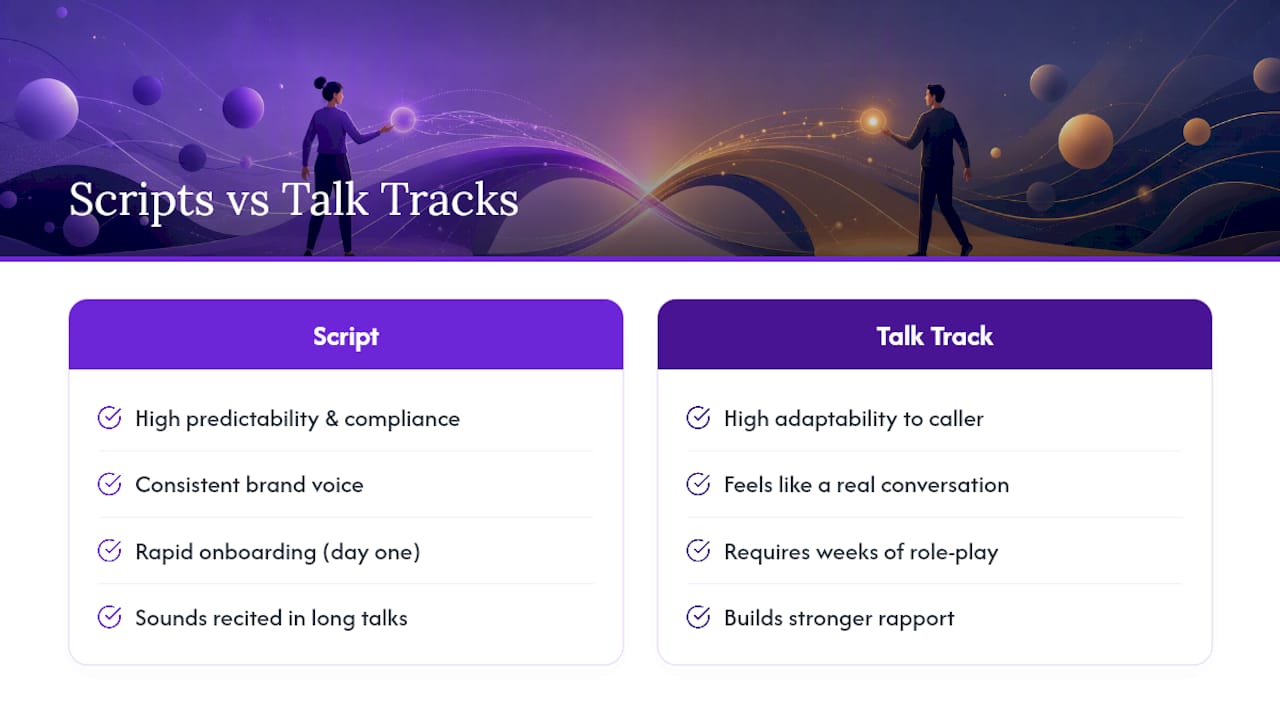
- Format: scripts are word-for-word text; talk tracks are modular frameworks with fill-in components.
- Flexibility: scripts are rigid and break under interruption; talk tracks bend around whatever the buyer says.
- Best use cases: scripts fit openers, voicemails, and compliance; talk tracks fit discovery, demos, and objections.
- Ramp time: scripts are faster to hand a brand-new rep, but slower to update; talk tracks take longer to internalize but adapt instantly once learned.
- Buyer experience: scripts can read as canned; talk tracks tend to feel like an actual conversation, because they are one.
Picture the same objection handled two ways. Scripted: “I understand price is a concern. Compared to what?” One sounds rehearsed. The other sounds like someone actually paying attention to what the prospect just said.
The gap is bigger than most managers assume. Top-performing reps deviate from scripted language more than average performers do, yet they do it inside a consistent framework rather than freestyling. That’s the whole argument for talk tracks in one data point: structure without word-for-word recitation is what separates your best closers from everyone else on the team.
When to Use a Script vs a Talk Track
Match the approach to the moment, not to habit. Here’s a practical breakdown by call stage:
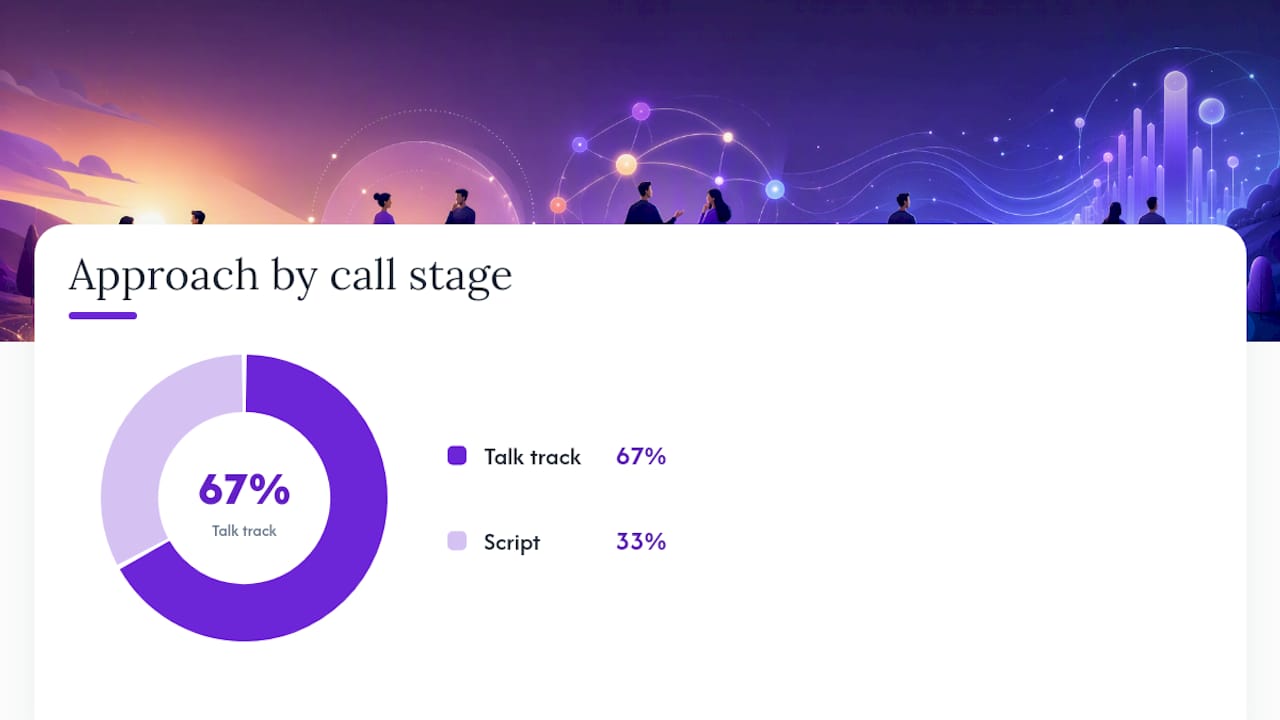
- Cold call opener (first 10 to 20 seconds): script. You have almost no information about the prospect yet, and consistency matters more than adaptability.
- Voicemail: script. There’s no back-and-forth to adapt to.
- Discovery: talk track. Every answer the buyer gives should change your next question.
- Demo: talk track. You’re reacting to what the prospect reacts to, in real time.
- Pricing conversation: talk track, built around a small set of proof points and framing options.
- Objection handling: talk track, always. A scripted objection response is the fastest way to sound like a chatbot.
The hybrid pattern most experienced teams land on: script the first 10 to 20 seconds of a cold call for consistency, then hand control to the talk track the moment the prospect responds. That’s the exact point where a rigid script would start working against you.
Managers tracking adoption should watch talk ratio, objection resolution rate, and how often reps deviate from old scripted language in a good way. Frequent updates matter too. Feeding fresh buying signals into your messaging keeps talk tracks aligned with what buyers are actually asking about this quarter, not last year.
Pro Tip: Record your top three closers for one week and transcribe every call. You’ll find the same four or five phrases reused across their best deals, and those phrases are your next talk-track modules, not the ones a manager guesses at from a whiteboard.
Talk Track Examples and Templates You Can Use Today
Two 15 to 20 second cold-call openers you can adapt directly:
- “Hey [Name], this is [Rep] from [Company]. I know this is out of the blue, but I’ll be quick: we help [role] teams fix [specific pain] in about [timeframe]. Worth 20 seconds to see if it’s relevant?”
- “[Name], quick one. I noticed [specific trigger, like a job posting or funding round]. That usually means [pain point] is on your radar. Fair guess?”
Three talk-track modules, each with placeholders you fill in per call:
- Hook module: “The reason I reached out is [trigger]. Most teams in [industry] tell us [pain point] is the thing keeping them up at night. Sound familiar?”
- Value pillar module: “What we do differently is [specific mechanism], which usually means [outcome] within [timeframe].”
- Objection pivot module: “That’s fair. When [buyer] told us the same thing, what changed their mind was [specific proof point]. Can I share that?”
To internalize these, run a 10-minute role-play drill twice a week: one rep plays the buyer and throws out three random objections, the other responds using only modules, no scripted lines. Grade the response on whether it sounded like a real answer or a recited one. CoachMode’s free sales tools include templates you can drop these modules into directly.
Converting a Script Into a Talk Track: A Manager’s Playbook
Turning a stale script into a working talk track is a four-step process, not a rewrite you finish in an afternoon.
- Transcribe your top performers’ calls. Pull the last 10 to 15 calls from your best closers and look for repeated phrasing around openers, pivots, and closes. This is where the actual modular blocks come from, not from a script someone wrote in isolation.
- Rewrite each block into one or two sentences with guardrails. A module should communicate intent, not exact wording. Give reps the boundary (“always mention the timeframe”) without dictating the sentence.
- Drill it through role-play and live coaching. Role-play combined with AI simulation cuts down the number of hours a manager has to spend shadowing calls, while still producing reps who sound natural under pressure.
- Grade every call and adjust. Post-call scoring against talk ratio, objection resolution, and module usage tells you which blocks are actually landing and which need a rewrite.
Watch three metrics as you roll this out: talk ratio (reps should be talking less than buyers in discovery), conversion rate at each stage, and how often objections get resolved on the first attempt versus requiring a follow-up call. If talk ratio doesn’t move within a month, the modules probably need trimming, not the reps.
The Trade-offs: Pros and Cons of Each Approach
Scripts give you predictability. Every rep says roughly the same thing, which matters enormously for compliance, brand consistency, and getting a brand-new hire on the phone without embarrassing anyone. The downside shows up fast in longer conversations: word-for-word delivery sounds recited, kills rapport, and can’t adapt when a buyer says something the script writer never anticipated.
Talk tracks give you adaptability. Reps respond to what’s actually happening on the call instead of what a document predicted would happen, and that tends to produce conversations that feel like conversations. The trade-off is ramp time. A new rep can read a script on day one; internalizing a talk track’s modules well enough to sound natural takes weeks of role-play and live feedback, not a single training session.
The honest answer for most teams is both, applied to different moments. Scripts for the 10 seconds where consistency and legal accuracy matter most. Talk tracks for the 10 minutes after that, where the buyer’s actual words should be steering the conversation. Teams that pick one approach for every stage of the call are usually the ones stuck explaining why their close rate hasn’t moved despite a “better” script.
Why Coaching Beats Handing Reps a Document
Most sales teams treat script quality as a writing problem. It isn’t. You can hand a rep the best-written talk track in the world, and if they never practice it under pressure, it evaporates the moment a real buyer pushes back. The gap between a good document and a good call is repetition with feedback, not better prose.
That’s the case for building coaching into the workflow itself rather than treating it as a separate training event. Live objection handling that surfaces the right module in the moment a buyer raises a concern does something a static PDF never can: it catches the rep exactly when they need it, not two days later in a debrief nobody remembers clearly. Post-call grading turns every real conversation into a data point about which modules are working and which ones need to be cut.
Teams that pair transcript-based talk tracks with structured practice internalize the framework faster than teams that just distribute a document and hope. The difference shows up in talk ratio and objection resolution within a few weeks, not a few quarters.
— Ryan
How CoachMode Turns Talk Tracks Into Live Coaching
Everything covered above, modular blocks, objection pivots, and role-play repetition, still depends on a rep remembering the right module at the exact second a buyer objects. That’s the part most training programs never solve. CoachMode listens to the live call and surfaces the specific response or next step in real time, so the talk track you built from top-performer transcripts actually shows up on the call instead of getting forgotten under pressure.
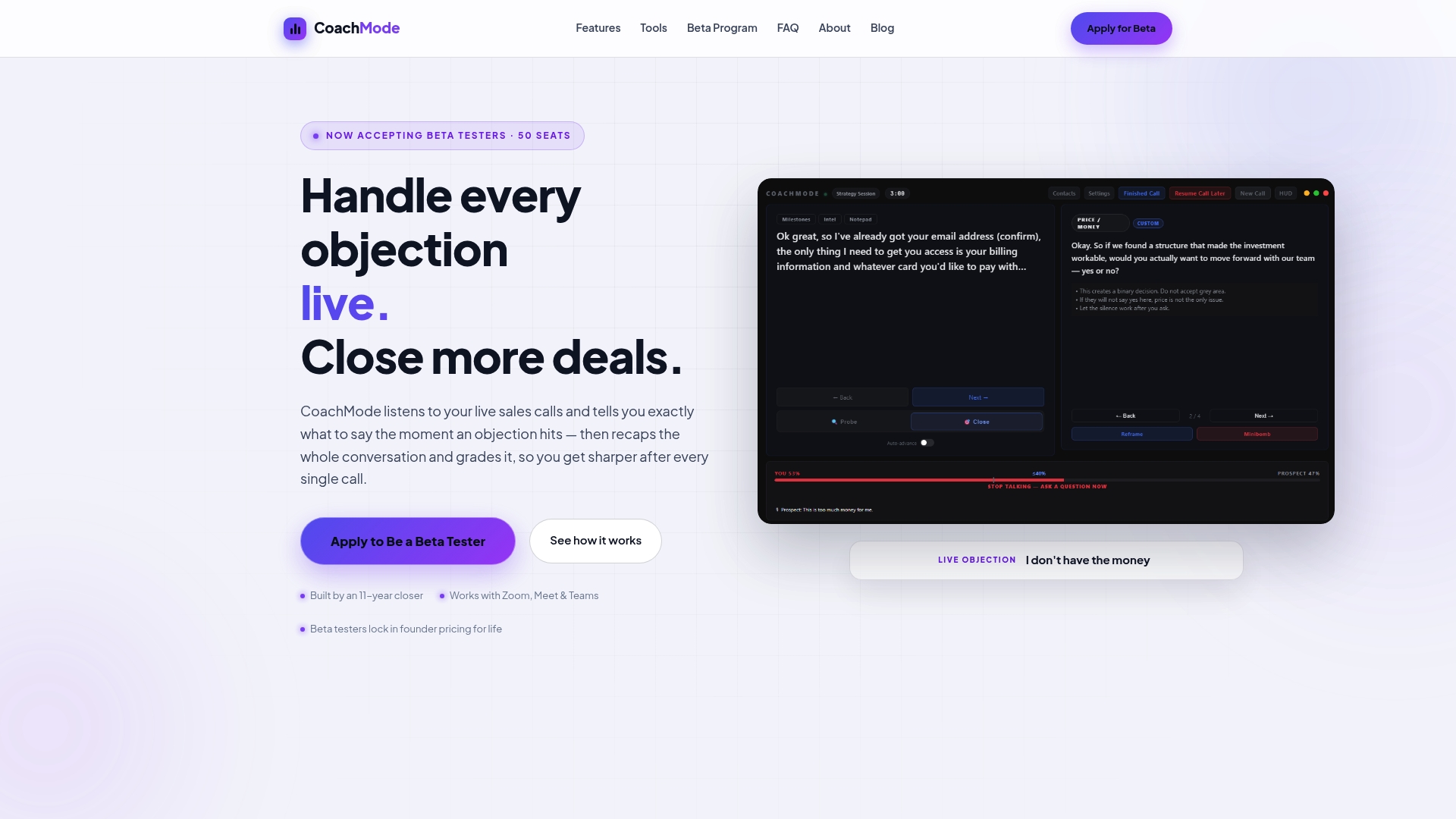
Every call also gets graded afterward against talk ratio, objection resolution, and module usage, giving managers the exact data needed to refine talk tracks instead of guessing which parts are working. If you want to see how this fits into a real call, start with CoachMode’s AI sales coaching and try it on your next live conversation.
Sources
A few sources shaped the recommendations in this piece and are worth a closer read:
- How to use top-performer calls to build talk tracks — Zendesk
- SDR talk tracks that sound natural & book meetings — QUOTA Training