Sales call scoring is a short, behavior-focused rubric that gives managers consistent, repeatable evidence for coaching instead of gut feelings. It works because it forces reviewers to grade what actually happened on a call, not how confident the rep sounded. Done well, it turns coaching from a once-a-quarter guess into a weekly habit tied directly to pipeline movement, whether you build it by hand or run it through AI at scale.
TL;DR:
- Regularly scoring multiple calls per rep improves pattern detection and links specific behaviors directly to faster pipeline progress.
- Building a scorecard with 3 to 8 clear, yes/no criteria weighted by predictive value yields more reliable coaching than broad, qualitative assessments.
- AI call scoring reliably handles compliance checks but needs human backup to interpret tone, empathy, and rapport indicators.
- Starting with one call type and a short, calibrated scorecard foster trust and prevent team defensiveness during implementation.
- Focusing coaching on one or two low-scoring, high-impact behaviors per session enhances the likelihood of lasting behavior change.
Table of Contents
- What Does Sales Call Scoring Actually Measure?
- Why Scoring Calls Actually Moves the Needle
- How Do You Build a Sales Call Scorecard From Scratch?
- Can AI Score Sales Calls Accurately?
- How Should You Roll Out Scoring Without Breaking Trust?
- Turning Scores Into Coaching That Actually Changes Behavior
- Legal and Ethical Considerations in Recording and Scoring Calls
- What Surprises Teams Once They Start Scoring Calls
- How CoachMode Turns Scoring Into Real-Time Coaching
- Sources
What Does Sales Call Scoring Actually Measure?
A sales call scorecard isn’t a personality test. It grades specific, observable behaviors that happened in a specific call, which is why two managers grading the same recording should land on nearly the same number.
Most effective scorecards group behaviors into five categories, a structure Agogee has laid out clearly for consistent grading:
- Discovery depth: Did the rep ask open-ended questions and dig past the first answer?
- Buyer participation: What percentage of the call did the prospect talk, and did they ask questions back?
- Qualification and methodology: Did the rep confirm budget, timeline, and decision process using whatever framework the team runs (MEDDIC, BANT, or a custom version)?
- Objection handling: Did the rep acknowledge the objection before responding, and did they check if it actually landed?
- Commitment to next steps: Did the call end with a specific, calendared action, or a vague “I’ll follow up”?
The weight you put on each category shifts by call stage. A discovery call should score heavily on questions asked; a closing call should score heavily on next-step clarity and objection handling.
Why Scoring Calls Actually Moves the Needle
Managers who sit in on calls occasionally tend to grade on vibes. One rep sounds confident and gets a pass; another stumbles over one phrase and gets marked down, even if their discovery was sharper. A structured scorecard removes most of that bias by anchoring every review to the same list of behaviors.
The bigger win is scale. Reviewing three or four calls a quarter tells you almost nothing about a rep’s real pattern. GradeMyClose recommends grading multiple calls per rep each week specifically because single-call impressions are unreliable.
Why it matters: teams that score consistently start seeing direct links between specific criteria and outcomes, like faster rep ramp time or higher next-step booking rates, that a single sampled call would never reveal.
- Reduces subjective bias between reviewers
- Surfaces patterns across dozens of calls instead of one
- Connects specific behaviors to measurable pipeline results
How Do You Build a Sales Call Scorecard From Scratch?
Building a workable scorecard is less about design theory and more about restraint. The biggest mistake managers make is cramming in twenty criteria because everything feels important. It isn’t. Here’s a process that produces something reps will actually respect:
- Pick 3 to 8 observable criteria per call stage. More than that, and reviewers start rushing through the list without really evaluating each item.
- Convert vague items into yes/no or count-based checks. Instead of “good discovery,” ask “Did the rep ask at least three open-ended questions?” That single change is what separates a defensible scorecard from an opinion sheet.
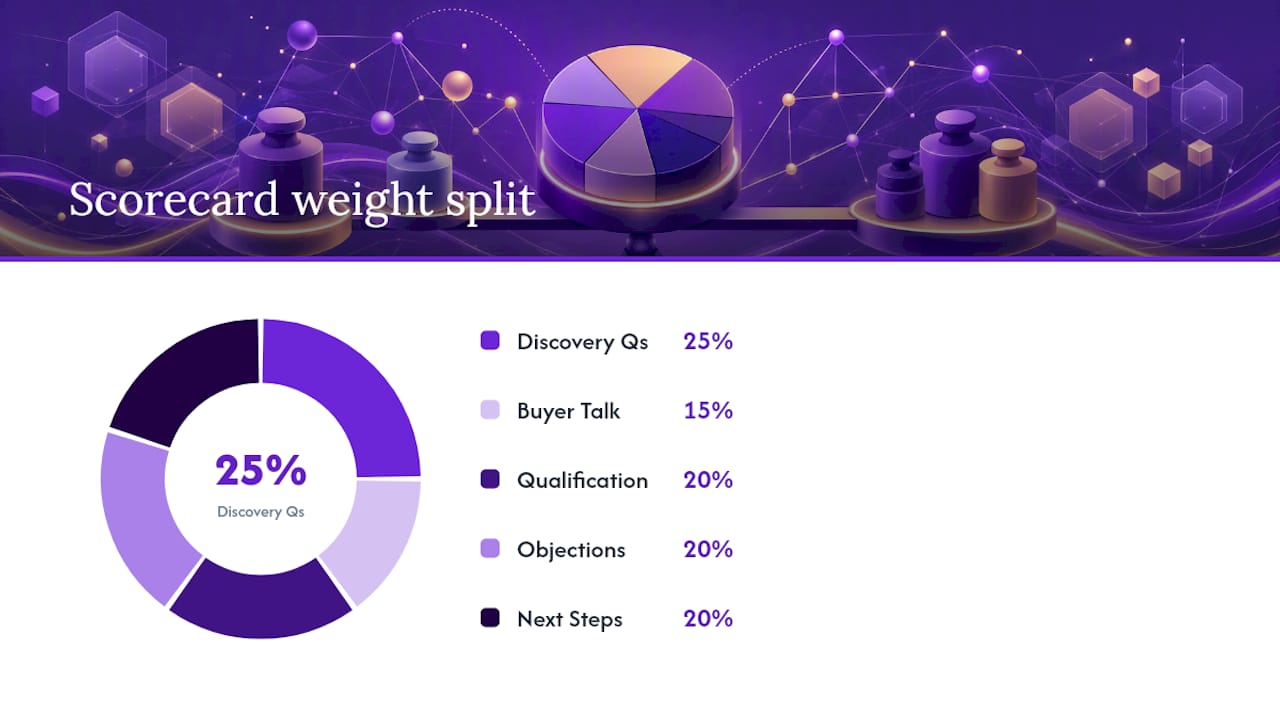
- Weight criteria by predictive value, not by feel. A sample model: discovery questions (25%), buyer talk ratio (15%), qualification completeness (20%), objection handling (20%), next-step clarity (20%). Weighted scorecards built around a handful of high-impact behaviors consistently outperform flat, all-criteria-equal checklists for coaching focus.
- Set a pass threshold. Many teams use 70 to 80 percent as a baseline “call met standard” cutoff, then adjust once they see a few weeks of real scores.
- Decide your review cadence. Weekly for new reps, biweekly for ramped ones, is a reasonable starting split.
- Run monthly calibration. Have every manager score the same recorded call, then compare and reconcile before scores go back into 1:1s.
A sales call scorecard template gives you a starting structure, but the weighting model only gets accurate once you’ve run it against 15 or 20 real calls and seen which criteria actually predicted deals moving forward.
Pro Tip: Write every scorecard item as a question a stranger could answer just from the transcript, with no context about the deal. If it requires guessing intent, rewrite it.
Can AI Score Sales Calls Accurately?
AI call scoring works by running a transcript against your scorecard questions and returning an aggregated score you can drill into item by item. Aircall describes this flow as transcription feeding into scorecard evaluation, with every question getting an individually reviewable answer rather than one opaque grade.
Where AI is genuinely strong: binary, compliance-style checks. Did the rep mention pricing? Did they ask about budget? Did they confirm a next meeting? Those questions have clear yes/no answers in a transcript, and AI handles them reliably at 100% call volume, something no manager has time to do manually.
Where it gets shakier: tone, empathy, and rapport. These require reading between the lines, and AI still needs a human backstop for anything genuinely subjective.
The shift this creates: instead of coaching off a handful of sampled calls, managers get every call flagged and trended, catching a skill gap in week one instead of month three.
Guardrails worth keeping:
- Spot-check a sample of AI-graded calls against your own read each month.
- Route subjective items (tone, confidence, rapport) to human review by default.
- Tune scorecard questions to focus on transcript-visible evidence rather than intent or feeling, since vague questions produce unreliable automated answers.
How Should You Roll Out Scoring Without Breaking Trust?
Rolling scoring out to an entire team at once is how you get defensiveness instead of buy-in. Start small.
- Pilot with one team and one call type. Discovery calls are usually the easiest starting point since the criteria are the most objective.
- Refine weights and thresholds for two to three weeks before expanding to other call types or teams.
- Hold a manager calibration session monthly. Everyone scores the same recorded call independently, then compares numbers and argues out the differences. This single ritual prevents score drift better than any written rubric alone.
- Set operational norms: how many calls get scored per rep per week, a time box per review (ten minutes, not thirty), and a rule that scored calls get referenced in every 1:1.
- Confirm recording consent and access permissions before a single call gets scored, not after.
Skip the pilot and you’ll spend months arguing about whether the scorecard itself is broken, when the real problem is that nobody calibrated it first.
Turning Scores Into Coaching That Actually Changes Behavior
A scorecard that sits in a dashboard changes nothing. The value shows up when scores drive specific 1:1 conversations.
Start by picking coaching priorities from the highest-weighted, lowest-scoring criteria, not whatever felt notable on the last call you happened to catch. A repeatable routine works better than ad hoc feedback: listen to the clip together, timestamp the exact moment the behavior broke down, model what the stronger version sounds like, have the rep practice it live, then track whether it shows up on the next scored call.
Pro Tip: Never coach more than one or two criteria per session. Reps can’t fix five behaviors at once, and trying to guarantees none of them stick.
Track these KPIs to prove the program is working:
- Conversion rate by call stage, not just overall close rate
- Next-step booking rate immediately after the call
- Rep ramp time compared to reps hired before scoring started
- Criterion-level improvement over a rolling 30 or 60 days
Comparing a cohort that got scorecard-driven coaching against one that didn’t, or running a simple A/B test on coaching approach, is the cleanest way to show leadership the program pays for itself.
Legal and Ethical Considerations in Recording and Scoring Calls
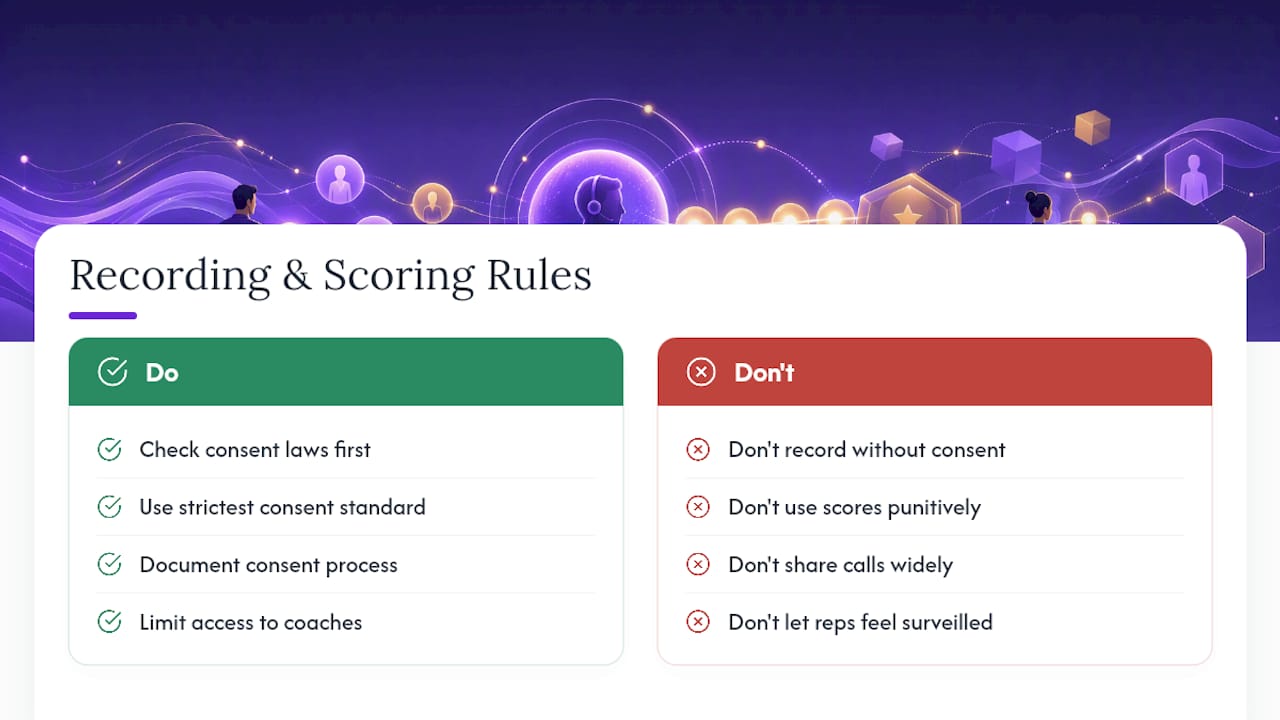
Before you score a single call, you need to know whether you’re legally allowed to record it. Consent rules vary significantly depending on where your reps and prospects are located. Some jurisdictions only require one party (usually your own rep) to consent to a recording; others require every participant on the call to agree before it’s legal to record at all. Since a sales team frequently calls across state and national lines, the safest approach is a documented consent process that meets the strictest standard among the jurisdictions you operate in, not just your own. Check with legal counsel to confirm the specific rules that apply to your call volume and geography.
Beyond legality, there’s an ethical layer that scorecards can quietly violate if you’re not careful. Recording and scoring exist to develop reps, not to build a paper trail for punitive action. Teams that use scores primarily to justify firing decisions tend to see reps start gaming the criteria (hitting the checklist items without actually improving the conversation) rather than genuinely getting better.
Access matters too. Not everyone in the company needs to hear every call. Limit access to managers directly coaching that rep, and be transparent with your team about who can see scored calls and why. Reps who understand the system exists to help them tend to engage with feedback instead of dreading it. Reps who suspect it’s surveillance tend to shut down, and the scores stop reflecting anything real.
What Surprises Teams Once They Start Scoring Calls
Most teams expect resistance and get it, but not always where they predicted. The bigger surprise is usually data that contradicts a manager’s own instincts about who the strong performers are. A rep everyone assumed was “naturally good” often scores poorly on discovery once it’s measured instead of felt.
The two mistakes I see most: building a 20-item scorecard nobody can score consistently, and skipping calibration entirely, which lets each manager’s version of the rubric drift apart within weeks. Ignoring whether reps actually change behavior after a low score is the third, quieter failure. Expect real traction within 60 to 90 days if you keep the scorecard short and calibrate monthly.
— Ryan
How CoachMode Turns Scoring Into Real-Time Coaching
Some sales coaching tools focus on scorecards that tell you what went wrong after the call, when it’s too late to fix that specific conversation. CoachMode’s real-time AI sales coaching listens during the live call and surfaces objection responses and next-step prompts while the rep is still on the line, then rolls straight into a post-call score so managers get both the moment-by-moment help and the aggregated data in one system.
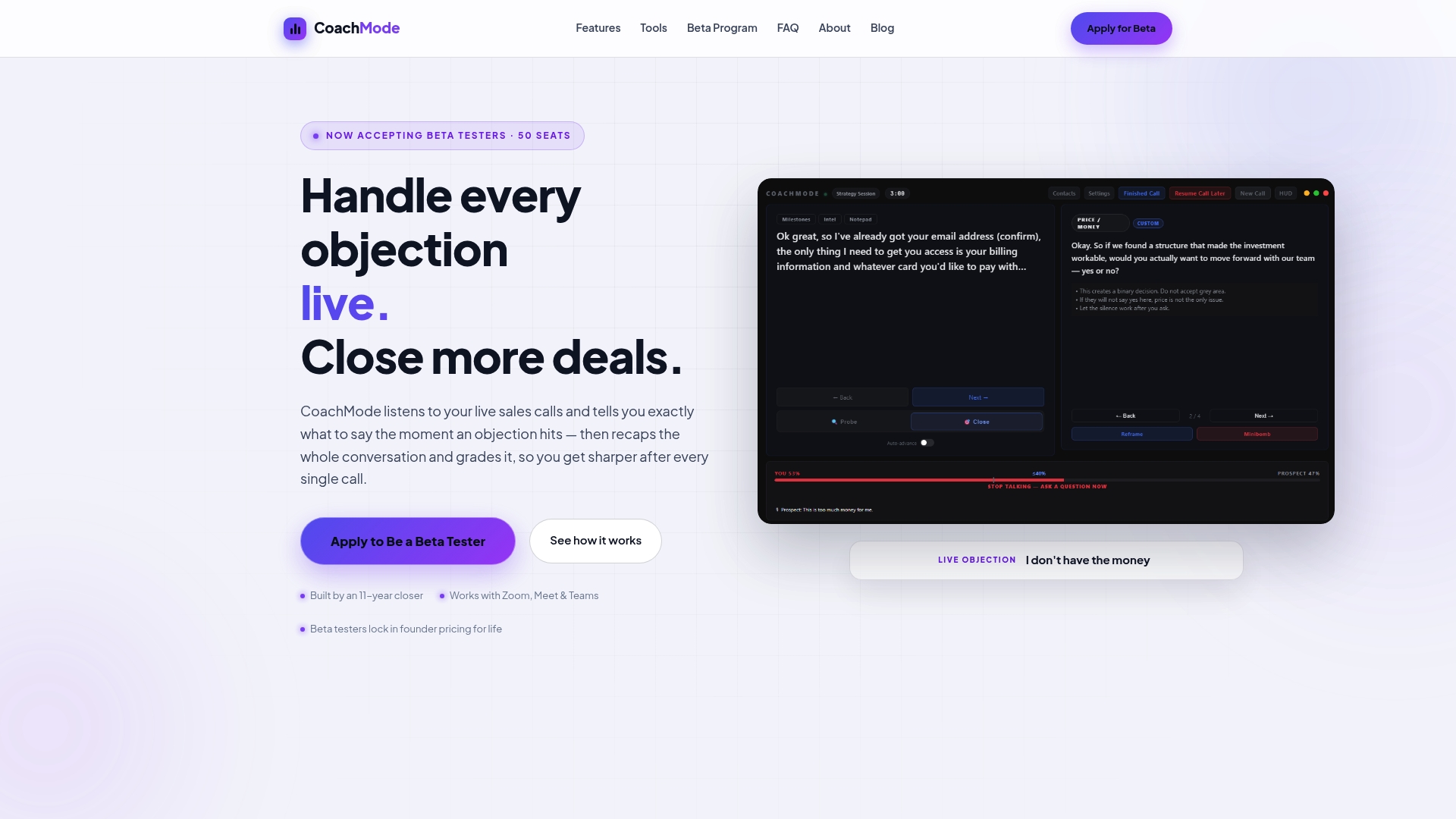
A demo walks through how it connects to Zoom, Google Meet, and Teams, what a sample post-call report looks like, and how scorecard criteria map to the live prompts reps see mid-call. If you’re building your rubric from scratch, the free sales call scorecard resource gives you a structured starting point before you ever touch software. From there, request a demo of the AI sales coach to see how live prompting and post-call grading work together on an actual call recording from your team.