Discovery questions are the specific prompts a rep uses to uncover a prospect’s problems, priorities, budget, and decision process before pitching a solution. Nail nine of them live and handle the rest asynchronously, and a 30-minute call generates real qualification data instead of a friendly chat that goes nowhere.
Copy these into your next call:
- “What prompted you to look into this now?”
- “Walk me through how this problem affects your team day to day.”
- “What happens if this stays unsolved for another two quarters?”
- “Who else touches this decision besides you?”
- “What’s budgeted for solving this, if anything?”
- “What would make this a clear win for you personally?”
- “What’s your timeline for having something in place?”
- “What have you tried already, and why didn’t it stick?”
- “If we’re a fit, what does the next step look like on your end?”
Gong’s analysis of roughly 519,000 recorded calls found win rates peak when reps ask 11 to 15 questions per call, not more, not fewer. In the first 60 seconds, state the agenda in one sentence, confirm time, then ask the first question above before you say anything about your product.
Key Takeaways
Discovery calls win or lose based on asking roughly 11 to 15 well-sequenced questions, prioritizing impact and stakeholder mapping over factual checklist items.
| Point | Details |
|---|---|
| Question count matters | Aim for 11 to 15 questions per call, with the bulk of live time on impact and stakeholder items. |
| Sequence, don’t scatter | Move from situation to problem to implication to next steps, not budget first. |
| Push facts to async | Send factual questions in a pre-call form to free live time for higher-value questions. |
| Disqualify with a script | Use a prepared disqualify line to preserve goodwill and leave the door open. |
| Coach in real time | Getcoachmode surfaces the next question and grades talk ratio and qualification signals after each call. |
Table of Contents
- What Are Sales Discovery Questions, and When Do You Use Them?
- Why Better Discovery Questions Change Your Win Rate
- How Do You Structure Effective Discovery Questions?
- What Categories of Discovery Questions Should You Ask?
- The Complete Discovery Question Bank by Call Stage
- How to Run a Discovery Call Step by Step
- Qualifying vs. Disqualifying: When to Walk Away
- A Copy-Ready 30-Minute Discovery Script
- Why Real-Time Coaching Improves Discovery Outcomes
- What We Coach Reps to Do Differently
- Let CoachMode Handle the Discovery Questions You Forget Mid-Call
- Frequently Asked Questions
- Sources
What Are Sales Discovery Questions, and When Do You Use Them?
A discovery call is a structured conversation, usually 20 to 30 minutes, where a rep qualifies a prospect by uncovering their problem, its business impact, who else is involved in buying, and roughly when they need a solution. The goal isn’t rapport for its own sake. It’s collecting enough signal to decide whether this deal deserves your next two weeks or a polite exit.
Run a discovery call when a prospect has responded to outbound, booked a meeting from inbound interest, or been referred with some context already established. Skip straight to a demo when the prospect has already articulated their problem in detail during a previous touch and just wants to see the product work. Route to nurture when someone downloaded a resource but hasn’t shown buying intent. Confusing these three paths wastes everyone’s time.
When to run full discovery:
- First meaningful conversation with a new contact
- Inbound lead with vague or unstated need
- Referral where the referrer didn’t brief you on specifics
- Renewal or expansion conversation where priorities may have shifted
When to skip to a demo:
- Prospect already named their problem and asked to “see it in action”
- Technical evaluator who’s been briefed by a champion internally
- Prospect explicitly requests a shorter, feature-focused call
A typical 30-minute discovery call breaks down to roughly two minutes of framing, 20 to 22 minutes of questions and listening, and five to six minutes for next steps. That window fits nine to twelve live questions comfortably if you’re actually listening to answers instead of rushing to the next item on your list. Sendspark’s research on B2B discovery calls found top-performing reps ask 12 to 15 thoughtful questions, while low performers ask fewer than six and close deals far less often.
Why Better Discovery Questions Change Your Win Rate
Question quality isn’t a soft skill you can skip if you’re naturally charming. It’s the single biggest lever separating reps who hit quota from reps who don’t.
The data on this is specific. Gong’s call analysis shows win rates climb as question count rises toward the 11 to 15 range, then flatten or decline past that point. Ask too few questions and you’re pitching blind. Ask too many and the call feels like an interrogation, which makes prospects guarded instead of candid.
What better discovery buys you:
- Faster sales cycles because you stop chasing deals that were never going to close, and you spend saved time on deals that will
- Fewer false positives in your pipeline, since vague answers to impact and timeline questions get flagged early instead of discovered in week six
- Better deal prioritization for managers, who can compare real qualification data across reps instead of gut-feel forecasts
- Stronger next-step commitment, because a prospect who’s answered specific questions about their own pain is more invested in solving it
If you manage a team, track these three metrics weekly: questions asked per call, talk ratio (rep talk time versus prospect talk time), and qualified deals per rep as a share of total discovery calls run using the best sales compensation software for SDR/BDR teams. A rep with a 70/30 talk ratio in their own favor is pitching, not discovering, no matter how many questions appear in their script. Sendspark’s data on the gap between top and bottom performers makes the same point from a different angle: the reps asking fewer than six questions aren’t failing because they lack charisma. They’re failing because they never collect the information that makes a strong pitch possible.
How Do You Structure Effective Discovery Questions?
Good discovery questions share three traits: they’re open-ended, they test a hypothesis rather than fish for information blindly, and they invite a specific, checkable answer instead of a vague one.
Do this:
- Ask “What’s the impact of this problem on your quarterly numbers?” instead of “Is this a big problem?”
- Frame questions around a hypothesis: “Most teams your size struggle with X. Is that true for you, or is it something else?”
- Let silence sit after a question. The best answers usually come after an uncomfortable pause, not immediately.
Don’t do this:
- Avoid leading questions like “Wouldn’t it help to have this solved faster?”, which just invites a polite yes
- Don’t stack two questions in one breath. Pick one, get the answer, then move to the next.
- Don’t ask a closed question (“Do you have a budget?”) when an open one (“How is budget typically allocated for something like this?”) gets you more usable information
Sequencing matters as much as wording. Pitchbase’s SPIN-style framework moves from situation questions (establishing facts) to problem questions (surfacing pain) to implication questions (quantifying what the pain costs) to need-payoff questions (getting the prospect to state the value of solving it themselves). Skip straight to implication questions before you’ve established the situation, and prospects feel ambushed. Stay in situation questions too long, and you never get to the part that actually motivates a purchase decision.
Pro Tip: Reserve roughly a third of your live question budget for implication and priority questions. If you’re asking nine live questions, three or four should dig into cost, urgency, or consequence. Factual questions are easy to answer async through a pre-call form. Impact questions require a live conversation because the prospect has to think out loud to get to the real number.

What Categories of Discovery Questions Should You Ask?
Every strong discovery call moves through a set of question categories in roughly this order, each serving a distinct purpose.
- Opener: Confirms context and sets a collaborative tone. Successful answers sound specific (“we’re evaluating three vendors”); a red flag is vagueness (“just looking around”).
- Current state: Establishes what’s happening today so you have a baseline to compare against. Ask this early, in the first third of the call.
- Problem/pain: Surfaces what’s actually broken. Listen for emotional language, not just factual description. If a prospect can’t name a specific pain, they may not be ready to buy.
- Impact: Quantifies the cost of the problem in time, money, or risk. This is where deals get won or lost. A strong answer includes a number or a consequence; a weak one stays abstract.
- Goals/future state: Reveals what success looks like from the prospect’s own mouth, which becomes your value proposition later in the call.
- Decision process/stakeholders: Maps who else needs to say yes. Missing this category is the single most common reason deals stall in month two.
- Budget/timing: Confirms whether resources and urgency actually exist. Ask this in the back half of the call, after you’ve built enough rapport that it doesn’t feel transactional.
- Next steps: Confirms mutual commitment to a specific action with a date attached, not a vague “I’ll follow up.”
Ask opener and current-state questions early in the call, pain and impact in the middle portion, and decision process, budget, and next steps later. Reversing this order, such as asking about budget before establishing pain, may make a prospect defensive.
The Complete Discovery Question Bank by Call Stage
This bank gives you more questions than you’ll use live in any single call. The idea is to pick nine to twelve for the live conversation and push the rest into an async pre-call form or a follow-up email, based on Gong’s finding that the 11 to 15 question range is where win rates peak.
1. Pre-call async questions (send before the call)
- “What’s the main challenge you’re hoping to solve?” — Send in your booking confirmation email. What to listen for: specificity in the written response tells you whether the prospect has thought this through or is just curious.
- “How many people on your team would use a solution like this?” — Gets you a rough deal-size signal before you spend live time on it.
- “What’s your target timeline for making a decision?” — Sets expectations for pacing without burning a live question.
2. Opening questions (minutes 0 to 3)
- “Before we dive in, can you tell me what led you to book this call?” Follow-up: “Was there a specific event, or has this been building for a while?” Listen for whether the trigger is urgent (a deadline, a failed vendor) or exploratory.
- “What would make this 30 minutes useful for you?” This hands the prospect some control and often surfaces their real priority faster than a scripted agenda would.
3. Current state questions (minutes 3 to 8)
- “Walk me through how you handle this today.” Follow-up: “Who’s involved in that process?” A strong answer is detailed and names specific tools or steps. A vague answer (“we kind of just wing it”) signals low process maturity, which is either a green flag (easy to improve) or a red flag (no urgency to change).
- “What tools or workarounds are you using right now?” Listen for frustration in tone, not just content. Frustration predicts urgency better than facts do.
4. Problem and pain questions (minutes 8 to 13)
- “What’s the most frustrating part of the current process?” Follow-up: “How often does that come up?” A one-off annoyance rarely justifies a purchase. A weekly or daily pain point usually does.
- “What have you already tried to fix this?” This question does double duty: it surfaces past failed solutions (so you know what not to pitch) and reveals how seriously they’ve pursued a fix.
5. Implication and impact questions (minutes 13 to 18)
- “What does this problem cost you in time, money, or missed opportunities?” Follow-up: “Can you put a rough number on that?” A specific figure, even an estimate, is a strong buying signal. A shrug is a red flag worth probing gently before moving on.
- “If this isn’t solved in the next two quarters, what happens?” This is the single highest-leverage question in the bank because it forces the prospect to articulate urgency in their own words rather than accepting yours.
- “How is this affecting the rest of your team or other departments?” Uncovers stakeholders you haven’t identified yet and widens the deal’s real footprint.
6. Goals and future state questions (minutes 18 to 21)
- “What would ‘solved’ look like six months from now?” Follow-up: “How would you measure that?” Vague answers here (“things would just be better”) suggest the prospect hasn’t defined success, which makes closing harder later.
- “What’s the ideal outcome for you personally in this project?” Surfaces the individual’s stake, which often differs from the company’s stated goal and matters just as much for closing.
7. Decision process and stakeholder questions (minutes 21 to 24)
- “Who else would be involved in evaluating a solution like this?” Follow-up: “What does each of them care most about?” This maps your champion, your economic buyer, and any technical gatekeepers before you’re surprised by them in week four.
- “How has your team made similar decisions before?” Reveals whether procurement, legal, or committee approval will slow things down.
8. Budget and timing questions (minutes 24 to 26)
- “Is there budget allocated for this already, or would it need to be approved?” Follow-up: “What’s that approval process typically look like?” A prospect who’s vague on both counts likely isn’t ready to buy this quarter, regardless of how much pain they described earlier.
- “What’s driving your timeline, if anything?” Listen for an external deadline (contract renewal, fiscal year end) versus a soft preference, since the former predicts actual movement far better than the latter.
9. Closing and next-step questions (minutes 26 to 30)
- “Based on what we’ve covered, does this feel like something worth solving now?” A direct temperature check that surfaces objections before you leave the call.
- “What would you need to see from us to move forward?” Follow-up: “Who else needs to be in that next conversation?” This locks a concrete next step with a name and, ideally, a date attached.
How to Run a Discovery Call Step by Step
Preparation determines whether your live questions land or fall flat. Spend ten minutes before every call checking the prospect’s company size, recent news, and anything captured in your pre-call async form.
- Research (10 minutes before the call). Check company size, industry, and any pre-call form responses. Note one specific detail to reference in your opener.
- Set the agenda (minute 0 to 2). State the time box, confirm what the prospect wants to get out of the call, and get a verbal yes before moving on.
- Run current state and pain questions (minutes 2 to 13). Use the question bank above; adjust wording based on the async answers you already have.
- Run implication and future state questions (minutes 13 to 21). This is where most of your qualification signal comes from, so resist the urge to rush here.
- Cover decision process, budget, and timing (minutes 21 to 26). Ask directly rather than dancing around it. Prospects respect directness more than reps assume.
- Confirm next steps (minutes 26 to 30). Get a specific date and name attached to the next action before you hang up.
Post-call recap checklist (fill out within 15 minutes of the call ending):
- Qualification status: qualified, disqualified, or needs more information
- Pain summary in the prospect’s own words
- Named stakeholders and their roles
- Budget and timeline signal, even if rough
- Agreed next step with date
A tool like CoachMode’s post-call scorecard can automate this recap by tracking question count and talk ratio directly from the call recording, which saves the five minutes most reps skip when they’re rushing to the next meeting.
Qualifying vs. Disqualifying: When to Walk Away
Discovery questions exist to protect your time as much as to build a case for your product. A confident disqualification, done well, preserves goodwill and sometimes generates a referral even when the deal doesn’t happen.
Map your questions to a qualification framework so nothing falls through the cracks. Salesforce’s POWERFUL framework covers Problem, Opportunity cost, Wants, Executive influence, Resources, Fear of failure, Unequivocal trust, and Little things, which lines up neatly with the pain, impact, stakeholder, and budget questions in the bank above. If you’re using BANT (Budget, Authority, Need, Timeline) or MEDDIC (Metrics, Economic buyer, Decision criteria, Decision process, Identify pain, Champion), the same live questions map across frameworks with minor rewording.
Disqualify scripts that preserve the relationship:
- “Based on what you’ve shared, it sounds like the timing isn’t quite right yet. Would it make sense for me to check back in a quarter?”
- “It sounds like your current setup is actually handling this well enough for now. I’d rather not push something you don’t need. Can I send you a resource for when priorities shift?”
CRM note template for qualification signals:
- Pain identified: yes/no, brief description
- Impact quantified: yes/no, rough figure if given
- Budget confirmed: yes/no/unclear
- Decision process mapped: names and roles
- Disposition: qualified / disqualified / nurture, with one-line reason
A Copy-Ready 30-Minute Discovery Script
Use this as a starting skeleton, not a rigid script to read verbatim.
Minutes 0 to 2, opener: “Thanks for making time today. I want to spend the next 25 minutes understanding what’s going on with [problem area] so I can tell you honestly whether we’re a fit. Then we’ll leave five minutes for next steps. Sound good?”
Minutes 2 to 13, current state and pain: “Walk me through how you handle this today.” Then follow the thread with implication questions from the bank above.
Minutes 13 to 21, impact and future state: “If this isn’t solved in the next couple quarters, what happens?” followed by “What would success look like six months out?”
Minutes 21 to 26, process and budget: “Who else would need to weigh in on a decision like this?” followed by “Is there budget set aside already, or would that need approval?”
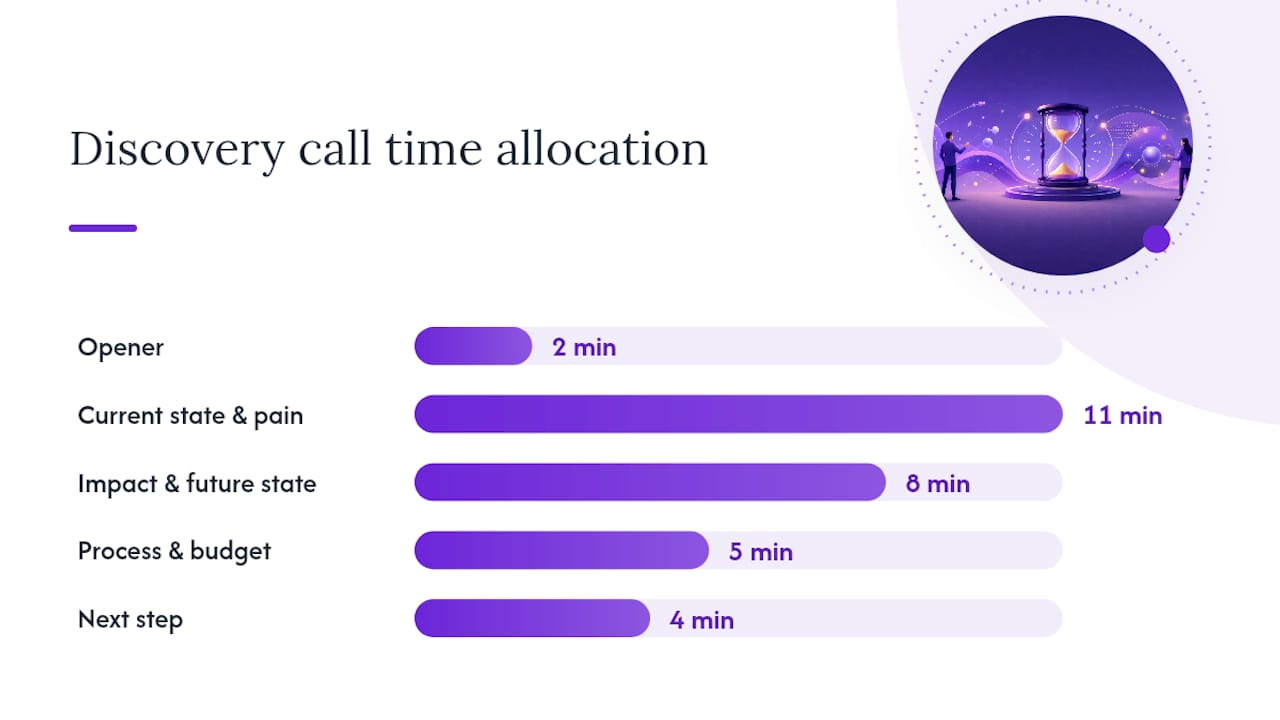
Minutes 26 to 30, next step: “Based on everything we’ve covered, it sounds like [restate pain and impact]. Does that feel accurate? What would you want to see from us next?”
Two follow-up email templates:
- Qualified next step: “Great talking today. To recap, you’re dealing with [pain] costing roughly [impact], and you’re looking to have something in place by [timeline]. Next step: [specific action] by [date].”
- Disqualified but nurture: “Appreciate you walking me through your situation today. It sounds like the timing isn’t quite right, and I don’t want to push something you don’t need yet. I’ll check back in [timeframe], and in the meantime, here’s [resource].”
A strong execution names a specific number when discussing impact (“this costs us about 15 hours a week”) and confirms a dated next step. A weak execution ends with “I’ll follow up soon” and no attached action, which is why so many discovery calls generate activity in the CRM but no actual movement.
Why Real-Time Coaching Improves Discovery Outcomes
Gartner projects that by 2030, 75% of B2B buyers will prefer sales experiences that prioritize human interaction over AI. That finding argues for keeping discovery human-led, not automated. It also argues for coaching that supports the rep in real time rather than replacing the conversation entirely.
The practical integration point is timing. Real-time prompts work best surfacing a forgotten implication question or flagging a missed follow-up, not scripting every word a rep says. Stay silent during a prospect’s answer. Surface a nudge only in the gap after they finish talking.
Pro Tip: Push every factual question you can into an async pre-call form. That alone can free up two or three of your nine live questions for the impact and stakeholder questions that actually move a deal forward.
What We Coach Reps to Do Differently
Start asking implication questions earlier than feels comfortable. Most reps save “what happens if this doesn’t get solved” for the end of the call, when it should come right after the prospect names the pain. Stop treating discovery as a checklist to complete in order. Continue trusting silence. It’s the most underused tool in a rep’s kit.
One rep on a team we worked with cut her live question count from nineteen to ten and restructured the back half around implication and stakeholder mapping. Her qualified-deal rate rose within a month, not because she asked fewer questions, but because the questions she kept were the ones that actually predicted whether a deal would close.
Let CoachMode Handle the Discovery Questions You Forget Mid-Call
Every rep has had this moment: the prospect just said something important, and the right follow-up question doesn’t surface until the call is already over. CoachMode listens to the live conversation and surfaces the next question or objection response in real time, so the implication or stakeholder question you’d normally forget shows up exactly when you need it.
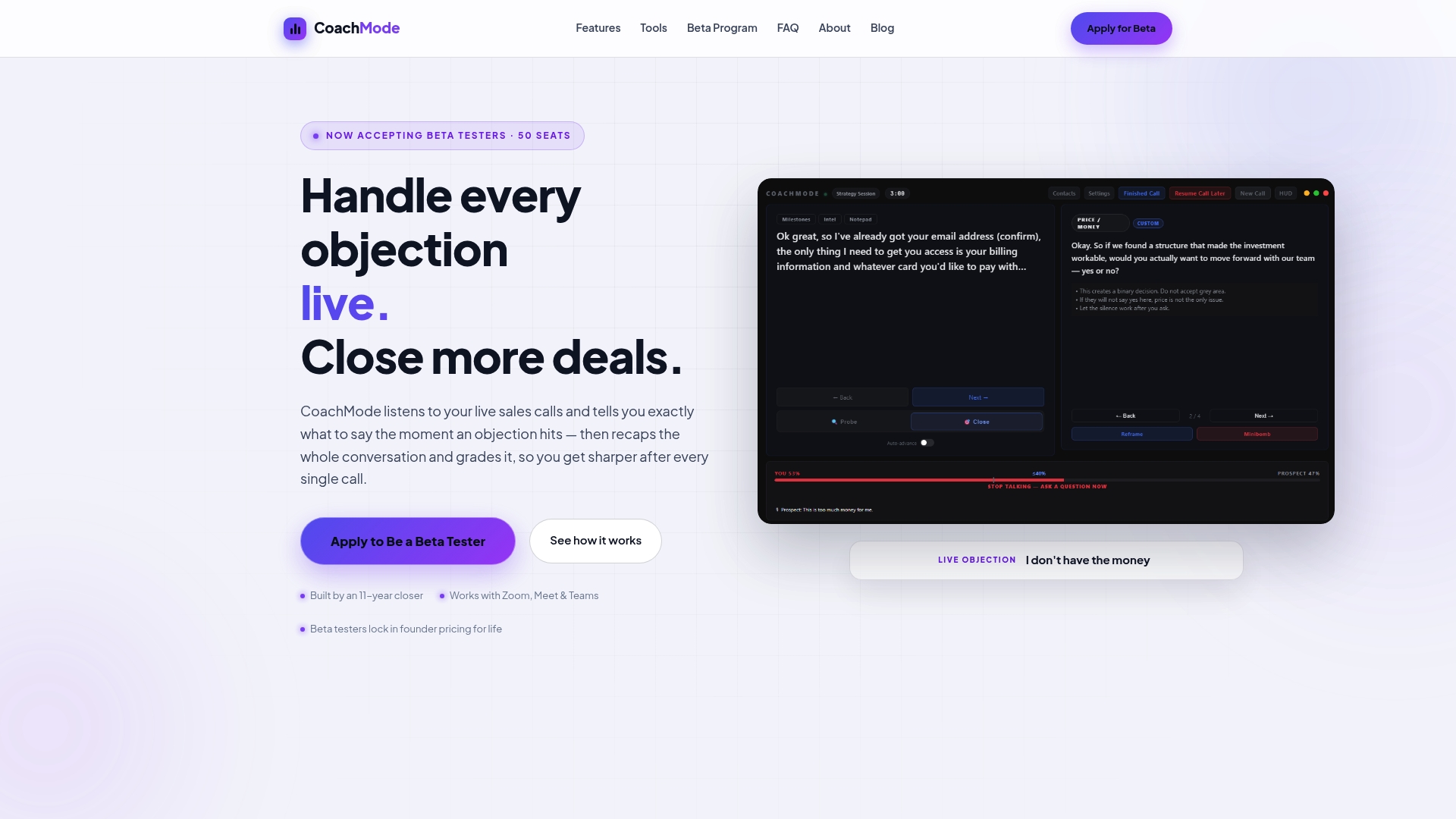
Three things it does for discovery specifically: it prompts the next high-value question based on what the prospect just said, it flags when talk ratio is skewing too far toward the rep, and it generates a post-call scorecard that tracks question count and qualification signals automatically, so managers stop guessing which reps are doing discovery well. Teams using CoachMode’s sales question sequence tool report more consistent qualification data across reps within weeks, since the prompts standardize what “good discovery” looks like instead of leaving it to individual memory.
If you’re ready to see how real-time prompts and post-call scoring work on your own calls, check out CoachMode’s AI sales coaching platform and book a walkthrough with your actual call recordings.
Frequently Asked Questions
What are the best sales discovery questions to start with?
Open with a question that confirms context without feeling scripted, like “What led you to book this call?” It’s low pressure and immediately reveals whether the prospect has a specific trigger or is just browsing.
How many discovery questions should a rep ask on a single call?
Aim for 11 to 15 total, split between three or four pre-call async items and nine to twelve live questions, based on Gong’s finding that this range correlates with the highest win rates.
What’s the difference between BANT, MEDDIC, and SPIN?
BANT organizes questions around Budget, Authority, Need, and Timeline. MEDDIC adds metrics, decision criteria, and champion identification for more complex deals. SPIN is a sequencing method, not a qualification checklist, moving from situation to problem to implication to need-payoff questions.
How do you politely disqualify a prospect during discovery?
Acknowledge what they’ve shared, state plainly that the timing or fit doesn’t line up yet, and offer a specific future touchpoint, like checking back in a quarter. This keeps the door open without wasting more time on either side.
Should discovery questions be sent before the call or asked live?
Send factual, low-stakes questions (team size, current tools, rough timeline) in a pre-call form. Save live time for pain, impact, and stakeholder questions that need a real conversation to surface fully.
Sources
- Gartner press release: By 2030, 75% of B2B buyers will prefer human interaction over AI
- Sales Discovery Questions: 40 That Qualify, and When to Ask Them | Perspective AI
- Discovery Call Questions: 30 Best for B2B Sales | Sendspark
- What is a discovery call? Questions & sample script | Salesforce
For rolling this out across a team, pair the question bank here with internal coaching sessions and shared call recordings so every rep calibrates against the same standard.