A sales coaching scorecard is a short rubric that scores observable behaviors on a call or in a rep’s skill set, using fixed criteria instead of gut feel. Used well, it becomes the backbone of a weekly coaching cadence built around changing one behavior at a time, which drives predictable gains in pipeline and quota attainment. The rest of this guide covers how to build one, how often to score, and where AI genuinely helps versus where it doesn’t.
TL;DR:
- Weekly scoring and self-assessment improve coaching consistency, leading to faster behavior change and increased quota attainment among sales reps.
- Limiting scorecard to five to eight specific behaviors per call type enhances reliability and avoids rater fatigue.
- AI assists in call transcription, evidence citation, and trend analysis, but human judgment remains essential for vague criteria and nuanced behaviors.
- Using behavior-specific, concrete indicators for each score level strengthens calibration, consistency, and actionable insights.
- Piloting real-time AI coaching tools can help reps manage objections during calls and reinforce behaviors identified in scorecards.
Table of Contents
- What Is a Sales Coaching Scorecard (and How Is It Different From a Dashboard)?
- Why Scorecards Turn Coaching Into Evidence Instead of Opinion
- How to Build a Sales Coaching Scorecard Step by Step
- How Often Should You Score Coaching Calls?
- What Can AI Actually Do for a Sales Coaching Scorecard?
- Sample Scorecard Rows for Discovery, Demo, and Rep Development
- Why Fewer Rows and Real Cadence Beat a Perfect Rubric
- Piloting Real-Time Coaching Alongside Your Scorecard
- Where to Go Next for Templates and Vendor Guidance
- Sources
What Is a Sales Coaching Scorecard (and How Is It Different From a Dashboard)?
A scorecard and a dashboard answer different questions. A call scorecard grades a single conversation against specific behaviors: did the rep ask an open discovery question, did they confirm the next step, did they handle the pricing objection cleanly. A skills or rep scorecard looks across many calls to track a person’s development on a handful of core competencies over a quarter. Both are behavior-based, not outcome-based.
Dashboards do the opposite job. Team coaching dashboards, like the goals panels and compare-team views built into Salesloft, aggregate outcomes across many reps and calls so a manager can spot who needs attention.
Common scorecard types include:
- Discovery call scorecard — scores question quality, pain identification, and qualification rigor.
- Demo scorecard — scores relevance to stated pain, objection handling, and call-to-action clarity.
- SDR outreach scorecard — scores cold call opening, tone, and booking technique.
- Rep development scorecard — rolls up call scores into quarterly skill trends.
Why Scorecards Turn Coaching Into Evidence Instead of Opinion
Most sales coaching runs on impressions. A manager remembers one bad call from three weeks ago and lets it color the whole review. A scorecard replaces that with a written record tied to specific moments, which is why managers who run at least one structured coaching conversation per week with reps win more deals than those who coach less often or less deliberately.
Sales Assembly and Gartner benchmarks show that structured weekly coaching paired with a focused framework accelerates behavior change and cuts ramp time for new reps.
The practical benefits stack up fast:
- Coverage and consistency: every rep gets scored against the same rows, not whatever the manager happened to notice.
- Leading indicators surface early: track next-step confirmation rate and win rate on coached deals versus uncoached ones.
- Faster calibration: managers agree on what “good” looks like before they argue about a specific rep.
- Targeted enablement spend: you invest training dollars in the skill gap the data actually shows, not the one that’s loudest in the room.
How to Build a Sales Coaching Scorecard Step by Step
Start narrow. A scorecard with too many rows gets rushed, and rushed scoring is inconsistent scoring.
- Pick one conversation type. Discovery, demo, and cold outreach each need their own scorecard. Trying to build one universal rubric for every call type produces vague, unusable rows.
- Limit yourself to 5 to 8 behaviors. Sleak AI’s research on scorecard design recommends up to 8 to 12 criteria for a full conversation-type rubric, but coaching scorecards specifically should stay closer to 5 to 8 rows to avoid rater fatigue.
- Write three-level indicators for each row. Use a 100/50/0 scale rather than a 1 to 10 range, which invites arguments over whether something is a 6 or a 7. Gong’s scorecard guidance backs this approach because a clear top, middle, and bottom anchor reduces rater variance.
- Attach concrete evidence to each level. For “confirms next step,” 100 might mean the rep locked a date and calendar invite live on the call; 50 means they got a verbal agreement with no specific time; 0 means the call ended with no next step at all.
- Decide weighting and who scores when. Weight the behaviors that most affect deal progression higher, and have the rep self-score before the manager reviews the recording.
- Pilot on a small batch, then calibrate. Score the same 5 to 10 calls independently as a manager team, compare results, and adjust the wording of any row where scores diverge widely.
Rollout checklist for the first 30 days:
- Run the pilot on real recorded calls, not staged ones.
- Train every scorer on the rubric language in a single session so nobody improvises their own definitions.
- Set a monthly calibration meeting to keep rater agreement tight as new managers join.
- Communicate to the team that the scorecard defines the standard, not a punishment list.
Pro Tip: Write the 0-level indicator first. It’s easier to define the clear failure case, then work backward to what “good” and “great” look like on the same behavior.
How Often Should You Score Coaching Calls?
Weekly is the baseline, and the data backs it. Shifting from monthly to weekly coaching produces a real jump in quota attainment for the middle segment of sales reps, the group that’s neither struggling nor already at the top of the board.
The weekly loop itself is simple: score a call, have the rep self-assess against the same rubric, coach exactly one behavior from that scorecard, agree on a small experiment for the next call, then re-score. Richardson’s coaching resources point out that having reps self-assess before the session shifts the dynamic toward ownership instead of defensiveness. Trying to fix three behaviors in one session is the fastest way to produce no measurable change at all.
For new hires, run a 30/60/90 ramp: score every call in days 1 through 30, move to twice weekly in days 31 through 60, and settle into the standard weekly cadence by day 90.
- Days 1 to 30: score every call, coach daily on fundamentals.
- Days 31 to 60: score twice weekly, focus on one behavior per week.
- Days 61 to 90: shift to weekly scoring at the standard team cadence.
Pro Tip: Budget 20 to 30 minutes per rep per week for scoring plus coaching. Anything less turns into a rushed skim of the transcript instead of real evaluation.
What Can AI Actually Do for a Sales Coaching Scorecard?
AI’s biggest contribution isn’t judgment. It’s coverage. A manager can realistically score a handful of calls per rep each month by hand; AI-assisted scoring can extend that to nearly every call, closing the gap between what actually happened on calls and what a manager saw.
What AI reliably handles:
- Transcription and speaker separation, so you’re not guessing who said what.
- Evidence citation, pulling the exact moment in the transcript where a behavior did or didn’t happen.
- Trend aggregation across weeks and reps, flagging which rubric row is slipping team-wide.
- Near-complete call coverage, instead of the small sample a manager can score manually.
What still needs a human: AI only scales scoring coverage when the rubric itself is precise. A vague row like “handles objections well” produces vague AI scores. AI can also surface noise, flagging technically correct behavior that still felt off to a real buyer, so a periodic human audit of a sample of AI-scored calls stays necessary.
Guardrails worth setting before you turn AI scoring on:
- Write the rubric in the same concrete, evidence-based language you’d use for human scorers.
- Build a small calibration dataset of manually scored calls to check AI scores against.
- Set a minimum sample size before trusting a trend line from AI-scored data.
- Schedule quarterly human audits to catch drift between AI scores and actual outcomes.
Sample Scorecard Rows for Discovery, Demo, and Rep Development
Here’s what a discovery call scorecard row looks like with real behavioral anchors instead of vague labels:
| Behavior | 100 | 50 | 0 |
|---|---|---|---|
| Opens with agenda | States call purpose and gets buyer agreement in first 2 minutes | States purpose but no buyer confirmation | Jumps straight into pitch |
| Asks open discovery questions | 3+ open questions before any pitching | 1 to 2 open questions, mostly closed follow-ups | No open questions asked |
| Confirms next step | Locks specific date and calendar invite live on call | Gets verbal agreement, no specific time | Call ends with no next step |
For rep development, aggregate 8 to 10 recent call scores per behavior row into a quarterly trend, then use that trend, not any single call, to set the coaching focus for the next month. A rep who scores 0 on “confirms next step” three calls in a row needs a different intervention than one who slipped once during a rough week.
Use cases beyond discovery follow the same pattern: demo scorecards weight relevance-to-pain and clear calls to action; SDR scorecards weight opening tone and booking technique over deep qualification, since that’s not the SDR’s job.
Why Fewer Rows and Real Cadence Beat a Perfect Rubric
Most managers overbuild their first scorecard. They try to capture every possible skill in one document, and the result is a 20-row monster nobody scores consistently. The teams that actually change rep behavior do the opposite: they pick five or six rows that matter most, protect the weekly coaching slot on their calendar like it’s a client meeting, and make rep self-assessment mandatory before every session.
The scorecard’s real job isn’t grading reps. It’s steering where you spend enablement time and budget. If three reps score 0 on the same objection-handling row, that’s not three individual coaching problems. That’s a training gap the whole team needs, and the rubric just told you where to look.
Calibration matters more than most managers assume going in. Two managers scoring the same call should land within a few points of each other, or the rubric’s language is too loose to trust. Treat the rubric itself as the team’s shared operating language, not a form to fill out.
— Ryan
Piloting Real-Time Coaching Alongside Your Scorecard
A scorecard tells you what happened after the call ends. It can’t help a rep who’s fumbling an objection in real time. That’s the gap real-time AI coaching closes, and it’s worth piloting alongside whatever rubric you’ve built.
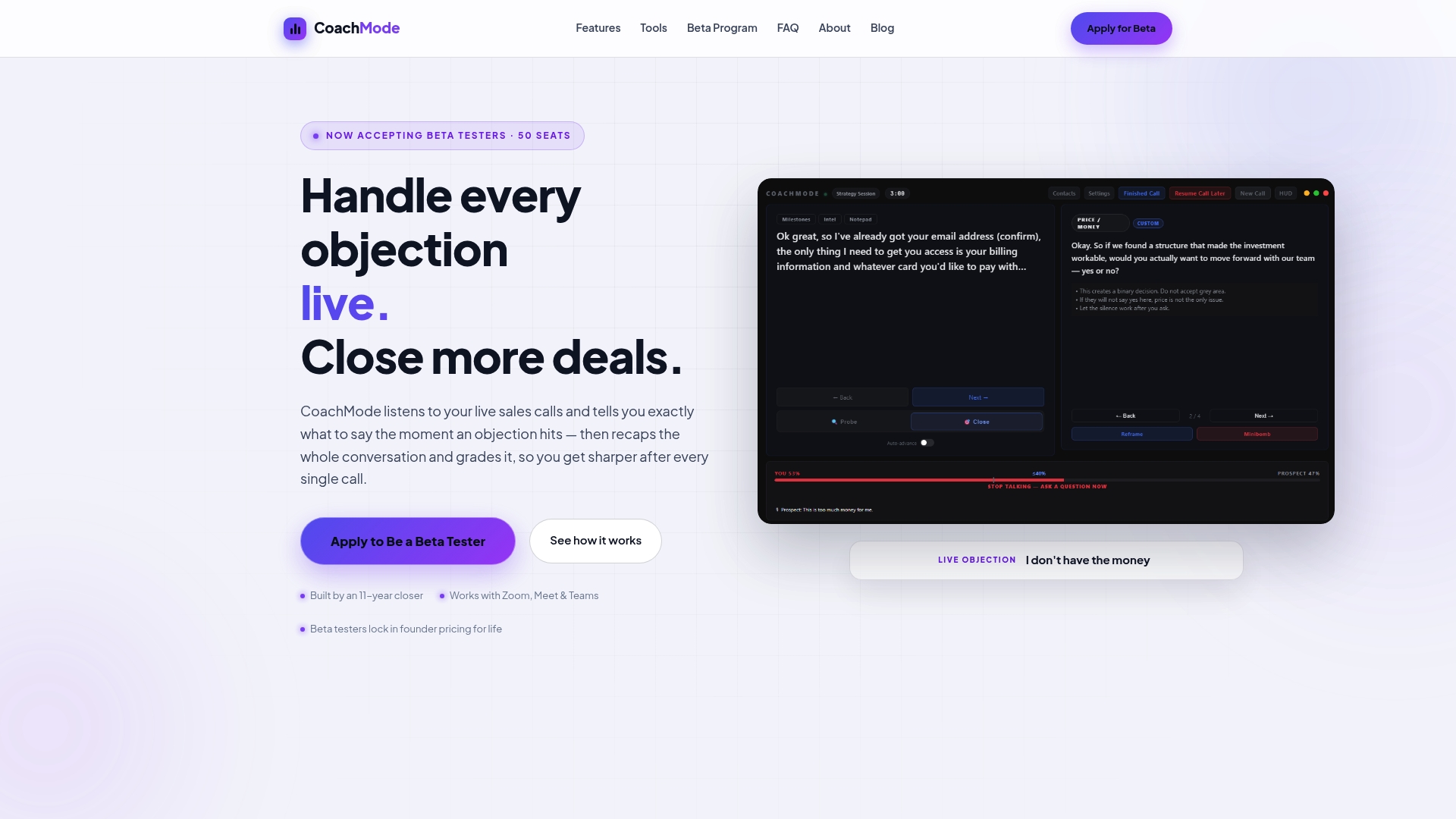
CoachMode listens live during Zoom, Google Meet, or Teams calls and surfaces the right response the moment a buyer raises an objection, so reps stay composed instead of freezing. After the call ends, CoachMode’s scoring system grades the conversation against your rubric automatically, turning every scored row into a concrete coaching moment instead of a memory the manager half-remembers a week later. Talk ratio feedback and playbook integration mean the same behaviors you defined in your rows show up directly in the post-call recap, feeding the exact weekly loop this guide walks through.
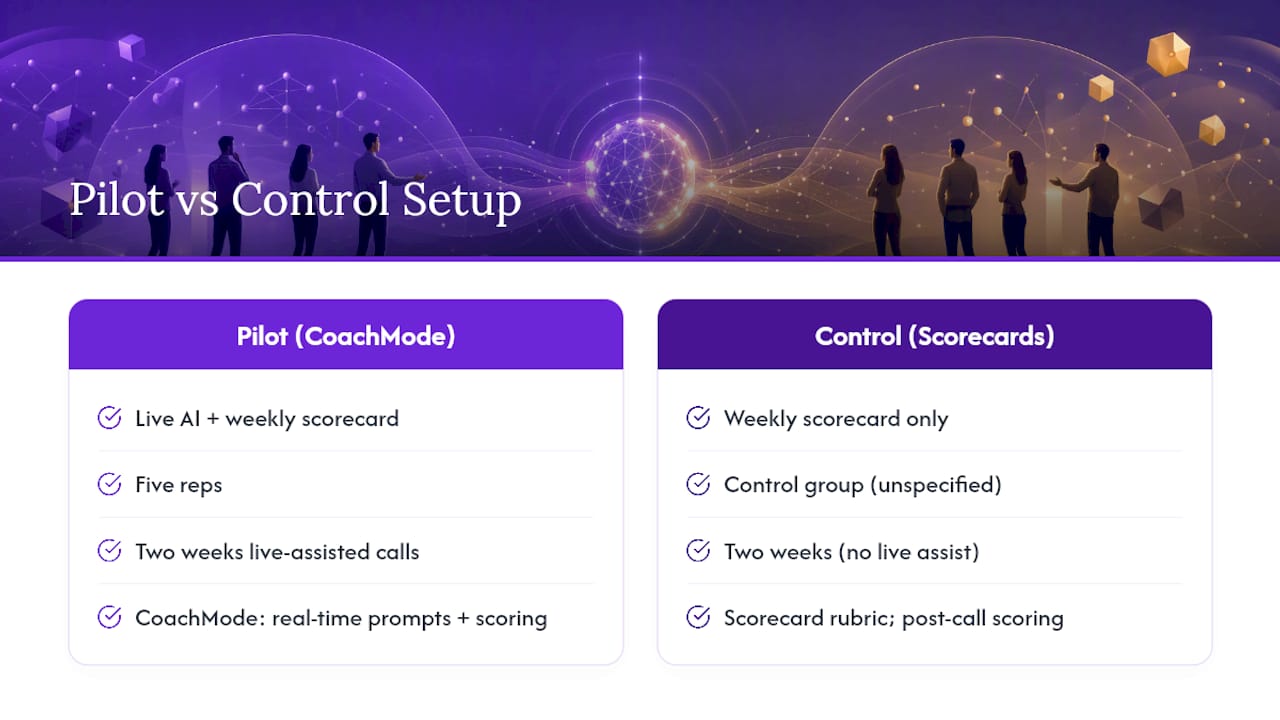
For a team piloting this, start with five reps, run two weeks of live-assisted calls, and compare their scored behaviors against a control group using scorecards alone. Check out CoachMode’s AI sales coaching platform to set up a pilot on your own call volume.
Where to Go Next for Templates and Vendor Guidance
For deeper rubric design, read Gong’s scorecard documentation on three-level scales and calibration. Sleak AI’s writeup covers AI scaling limits in more depth, and Salesloft’s dashboard guide shows how team-level aggregation should look once scoring is underway. CoachMode’s free sales tools page has starter templates worth adapting.
Sources
- How to Coach Sales Reps in 2026: A Manager’s Playbook
- Team Coaching Dashboard — Salesloft Help
- All about scorecards — Gong Help
- Scorecard-based coaching makes sales excellence definable and feedback reproducible — Sleak AI