AI complements human coaching rather than replacing it. The honest read of the current evidence: some randomized trials show AI matching humans on narrow, well-defined goal attainment, while others show humans winning decisively on wellbeing, self-efficacy, and complex development. The practical answer for most people and organizations is a hybrid model, AI for scale, reminders, and in-the-moment prompts, humans for judgment, identity work, and relational depth.
TL;DR:
- AI coaching is most effective for automation, accountability, and live support in fast-paced contexts, rather than for complex identity or emotional work.
- Human coaches excel in building trust, making judgment calls, and managing nuanced, emotionally laden challenges that AI cannot reliably handle.
- Most research shows AI matches humans on narrow goal achievement but generally falls short on broader wellbeing and self-efficacy outcomes.
- Successful AI-human hybrid coaching depends on clear governance, narrowly defined goals, and transparent data practices from the outset.
- Real-time AI tools for live sales support are particularly valuable for instant objection handling when coaches cannot be present physically.
Table of Contents
- AI vs Human Coaching: Defining the Terms Before Comparing Them
- What Human Coaches Do That AI Still Can’t Match
- Where AI Coaching Actually Delivers Value
- AI vs Human Coaching, Dimension by Dimension
- What the Research Actually Shows About AI and Human Coaching
- When to Use AI, When to Use a Human, and How to Blend Both
- How to Pilot AI and Human Coaching Together Without Wasting a Quarter
- Why the “AI Versus Human” Framing Misses the Point
- Getting the Best of Both: Real-Time AI Support for Live Sales Calls
- Sources
AI vs Human Coaching: Defining the Terms Before Comparing Them
“AI coaching” gets used as if it’s one thing. It isn’t. A Forbes analysis of the field frames it as a spectrum, and that framing matters because a chatbot that nudges you to log your workout and an AI that role-plays a difficult conversation with you are solving completely different problems, even though both get called “AI coaching.”
The spectrum roughly breaks down like this:
- Administrative tools: scheduling, note-taking, transcription, and session summaries that support a human coach’s workflow without touching the actual coaching interaction.
- Nudges and reminders: automated check-ins, habit trackers, and prompts that keep a client accountable between sessions.
- LLM-based chatbots: conversational AI that asks questions, offers frameworks, and simulates a coaching dialogue, sometimes structured, sometimes freeform.
- Real-time embedded assistants: tools that listen to a live interaction and surface guidance in the moment, common now in sales and increasingly in other performance contexts.
- Embodied avatars: emerging, more experimental systems designed to simulate presence and nonverbal cues, still early and unevenly validated.
Human coaching, by contrast, centers on a trained person building a working relationship with a client over time. Certification bodies like the International Coaching Federation set standards around competencies, ethics, and supervised practice hours, which is part of why credentialed human coaches carry a trust signal that most AI tools currently don’t have an equivalent for.
Where this gets confusing is the overlap. A lot of what’s marketed as “AI coaching” is really AI-assisted human coaching, a coach using a tool to prep faster or track progress between sessions. That’s a different product than a standalone AI chatbot doing the coaching itself, and conflating the two is where a lot of the “is AI better than a human coach” debate goes sideways. Precision here isn’t pedantic. It changes which comparison you’re actually making.
What Human Coaches Do That AI Still Can’t Match
Ask anyone who’s had a good coach what made it work, and they rarely mention frameworks. They mention being understood. Practitioner research from INSEAD points to lived experience, intuition, and ethical judgment as the parts of coaching that resist automation, not because AI can’t ask good questions, but because it can’t draw on having actually navigated a layoff, a failed launch, or a hard leadership call itself.
There’s also a physical layer to this that’s easy to underrate. A skilled human coach reads a pause, a shift in posture, a voice that tightens slightly before someone admits something they didn’t plan to say. Research on coaching presence describes this as co-regulation, the coach’s calm, paced attention helping to settle a client’s nervous system in the moment. That’s not a metaphor. It’s a mechanism, and it shows up in longer-term engagement and internalization, not just in how a session feels.
Where humans reliably pull ahead is on the messy stuff: rebuilding confidence after a public failure, working through an identity shift during a promotion or a career pivot, untangling a conflict with a business partner where the “right answer” depends on reading years of unspoken history. These are judgment calls, not goal-tracking exercises.
Pro Tip: If you’re choosing a human coach, ask about their supervision hours and niche experience, not just their certification badge. A credential proves training. A track record in your specific situation proves judgment.
Typical engagement models reflect that depth. Executive coaching often runs weekly or biweekly sessions over three to twelve months, with pricing that varies widely by market and coach experience, generally landing well above what a self-serve app costs per month. You’re not paying for the hour. You’re paying for someone who remembers what you said six weeks ago and connects it to what you’re avoiding saying today.
- Sustained working alliance built over multiple sessions, not a single interaction.
- Judgment calls in ambiguous, high-stakes, or emotionally loaded situations.
- Credibility drawn from having lived through comparable professional or personal challenges.
Where AI Coaching Actually Delivers Value
AI’s real advantage isn’t that it’s smarter. It’s that it’s always there. A chatbot doesn’t cancel because it’s tired, doesn’t charge more for a 6 a.m. session, and doesn’t need three weeks of lead time to fit you into a calendar. That availability changes who gets access to coaching at all, and Chamorro-Premuzic’s analysis for Forbes makes exactly this point: AI is democratizing entry-level coaching access for people who’d otherwise get none.
The practical capabilities are genuinely useful, not just cheap substitutes:
- Transcription and summaries that turn a rambling conversation into a clean, searchable record.
- Structured nudges that keep someone accountable to a goal between human sessions.
- Practice simulations, low-stakes reps for a hard conversation before you have the real one.
- Real-time prompts during live interactions, surfacing a next step or a response option in the moment, which is exactly where tools like real-time AI sales coaching tend to earn their keep.
A working-alliance study found no statistically significant difference between a simulated AI coach and human coaches in a single session, human alliance scores averaged 74.50, AI averaged 72.73, a gap the researchers called not statistically meaningful. That’s a real finding, and it’s worth taking seriously. It’s also a single session with a simulated AI, not months of sustained development work, so treat it as evidence of narrow parity, not proof of equivalence.
The limits are just as real as the strengths. AI can’t sense a shaking voice the way a trained ear can. It can’t weigh an unspoken office politics dynamic against what a client is literally saying. And every conversation you have with an AI coaching tool generates data that lives somewhere, raising legitimate questions about who can access it, how long it’s retained, and whether it’s ever used to train other systems without clear consent.
AI vs Human Coaching, Dimension by Dimension
Numbers aside, the comparison usually comes down to six practical dimensions. Here’s how they typically shake out.
Empathy and working alliance. Humans generally hold the edge, though the gap is narrower than most people assume. The single-session working-alliance study found comparable scores between AI and human coaches in that limited context, but practitioner analysis is clear that sustained empathy, the kind built across a difficult year, not one conversation, still leans heavily human.
Effectiveness on goal attainment and development. This is where the evidence splits most sharply. A Frontiers-published RCT found that AI can match human coaching on narrow, specific goal attainment measures in some cases. But a separate randomized controlled trial comparing human coaching, an AI chatbot, and a waiting-list control found something less flattering for AI: human coaching produced medium-to-large effects across multiple outcomes, while the AI-chatbot group often failed to differ significantly from the control group on wellbeing and self-efficacy. Translation: AI can look competitive if you only measure a narrow checkbox goal. Broaden the lens to how someone actually feels and functions, and human coaching usually pulls ahead.
Scalability and availability. No contest. AI coaching scales to thousands of users simultaneously at a fraction of the marginal cost, and it’s available at 2 a.m. on a Sunday. Human coaching scales one relationship at a time, which is a feature for depth and a bottleneck for reach.
Cost and access. AI tools typically run a small monthly subscription. Human coaching, particularly executive-level engagement, runs considerably higher per hour, which prices a lot of people out entirely. This is the access gap AI is genuinely closing.
Personalization and domain expertise. Human coaches personalize through relationship and sector-specific credibility, a former VP of Sales coaching a sales team carries context an algorithm doesn’t have. AI personalizes through pattern matching across large datasets, useful for consistency, weaker on the kind of context that comes from having actually done the job.
Privacy and ethical risk. This is the dimension people underrate. Every AI coaching interaction creates a data trail. Look for tools that state clear data retention limits, explicit opt-out options, and a straight answer on whether your conversations train future models. Human coaching carries its own confidentiality expectations, typically governed by professional codes of ethics, but the data footprint is smaller by nature.
- Empathy: human advantage, though narrower in single-session, narrow-scope contexts.
- Goal attainment: mixed, AI competitive on narrow tasks, humans ahead on broad development.
- Scalability: AI advantage, decisively.
- Cost: AI advantage on price, human advantage on depth per dollar for complex needs.
- Personalization: human advantage via lived context; AI advantage via consistency at scale.
- Ethics and privacy: requires active scrutiny of any AI tool’s data practices.
What the Research Actually Shows About AI and Human Coaching
The research pool on this topic is smaller and messier than you’d expect for a question this consequential, but a few well-designed studies give a real signal.
The working-alliance study mentioned earlier used a mixed-methods randomized design and found human coaches scored 74.50 on average, AI scored 72.73, with the difference falling short of statistical significance (t(50) = -0.71, p = 0.48). That’s a meaningful data point precisely because it’s counterintuitive, people formed a comparably strong working relationship with a simulated AI coach in a single session, at least on this measure, according to the PMC-published study.
Set that against the Frontiers-published RCT literature, which found that while AI sometimes matches human coaching on narrow, specific goal attainment, human coaching more often produces broader gains in wellbeing and self-efficacy, outcomes that matter more for sustained development than a single completed task.
The starkest contrast comes from the randomized trial comparing human coaching, an AI chatbot, and a waiting-list control. Human coaching showed medium-to-large effects across goal attainment, wellbeing, and self-efficacy. The AI-chatbot arm often didn’t separate from the do-nothing control group on most of those same measures.
The choice of outcome measure changes the story entirely. Goal-attainment scales, which track whether a specific, narrow objective got completed, tend to favor AI parity. Wellbeing and self-efficacy measures, which track how someone actually feels and functions, tend to favor human coaching by a wide margin.
That’s not a contradiction in the research. It’s a reminder that “does AI coaching work” depends entirely on what you’re measuring it against.
Every study in this space carries real caveats worth naming plainly:
- Wizard-of-Oz designs: some “AI coach” conditions in early research are simulated by a human behind the curtain, which limits what the results say about actual deployed AI.
- Small, short-duration samples: many trials run single sessions or a few weeks, not the months-long engagements typical of real coaching relationships.
- Fast-moving technology: a study on a chatbot from two years ago may not reflect what today’s more capable systems can do.
- Population specificity: results from university students or corporate volunteers don’t automatically generalize to executives, salespeople, or clinical populations.
Read any confident headline claiming AI “beats” or “loses to” human coaching with those caveats in mind. The design principle behind rigorous pilots, per Frontiers-linked guidance on trial design, is to pre-register outcomes and mix quantitative with qualitative measures precisely because a single metric tells an incomplete story.
When to Use AI, When to Use a Human, and How to Blend Both
Matching the tool to the task beats picking a side in the AI vs human coaching debate. Some situations genuinely don’t need a human in the room. Others absolutely do.
- AI alone is sufficient for onboarding and repetitive skill drills. New hire ramp-up, standardized objection-handling practice, and habit reminders are exactly the kind of high-volume, low-ambiguity tasks where AI’s consistency and availability outperform scheduling a human for every rep.
- AI alone works for between-session accountability. Nudges to log a goal, prompts to review notes before a meeting, and quick check-ins don’t need relational depth, they need reliability.
- Human coaching is necessary for identity-level work. A leader questioning whether they’re cut out for the next role, someone processing a career derailment, a founder deciding whether to shut down a company they built, these require judgment and lived context AI doesn’t have.
- Human coaching is necessary for trauma-informed or high-conflict situations. Anything involving genuine emotional risk, interpersonal conflict with real stakes, or a client who needs to feel truly seen belongs with a trained person, not a chatbot.
- Hybrid flows work best for performance-critical, high-frequency tasks like sales. A practical sequence looks like this: AI handles pre-call prep and drilling, a human coach runs periodic strategy sessions, AI delivers real-time prompts during the live call itself, and post-call analytics feed back into the next human coaching conversation. This is close to how tools built for live-call objection handling are actually used inside sales teams today, not as a replacement for a sales manager’s coaching, but as the layer that catches a rep in the moment a manager can’t be on every call to catch.
Pro Tip: If you’re an L&D lead building a hybrid program, don’t let AI usage data replace human coaching conversations, use it to make those conversations sharper. A coach walking into a session already knowing a rep’s talk-ratio problem from AI-generated data spends less time diagnosing and more time actually coaching.
Governance matters here more than people expect. Whoever owns the program needs a clear answer to who’s accountable when AI guidance and human judgment conflict, and that handoff protocol should exist before the pilot launches, not get improvised after something goes wrong.
How to Pilot AI and Human Coaching Together Without Wasting a Quarter
Most failed coaching pilots fail for the same boring reason: nobody defined success narrowly enough before starting. A pilot measuring “does this help people” against no baseline and no timeline will produce a mushy result no matter how good the tool is.
Start with a narrow outcome. Pick one measurable thing, close rate on a specific objection type, time-to-proficiency for a new skill, self-reported confidence before and after a defined stretch, and commit to tracking it for a fixed window, typically 60 to 90 days for a meaningful read. Get explicit consent from participants about what’s being recorded and why, and build in an opt-out that doesn’t penalize anyone who takes it.
Data governance can’t be an afterthought bolted on after launch. Before any AI coaching tool touches real conversations, an organization needs clear answers on four points:
- Consent: do participants know exactly what’s being captured and analyzed?
- Retention: how long is data kept, and who decided that window?
- Access: who inside the organization can see individual-level coaching data versus aggregated trends?
- Opt-out: can someone withdraw without losing access to the coaching itself?
Measurement is where most pilots quietly go wrong. Short-term goal completion is the easiest thing to track and the least reliable signal of real development, which is exactly why rigorous trial design calls for pre-registered outcomes and mixed measures rather than a single metric declared as the verdict.
| Pilot element | What to define upfront | Common mistake to avoid |
|---|---|---|
| Outcome metric | One narrow, measurable goal per pilot | Tracking too many metrics with no clear primary one |
| Timeline | 60 to 90 day minimum window | Judging results after two weeks |
| Consent | Written, specific to data use | Vague blanket consent forms |
| Handoff protocol | Clear rule for AI to human escalation | No defined owner when AI guidance and human judgment conflict |
Leadership perspective on this from sales enablement circles echoes the same point: coaching that only tracks activity metrics misses the judgment calls that actually separate a good rep from a great one, a distinction worth keeping in mind when building any coaching program around AI-generated data.
Why the “AI Versus Human” Framing Misses the Point
The debate over AI vs human coaching gets framed as a competition because that’s a better headline than the truth, which is that they’re solving different parts of the same problem. AI is exceptional at the parts of coaching that are really about consistency and availability: showing up every time, tracking every data point, never having an off day. Human coaches are exceptional at the parts that require actually being a person: reading a room, holding space for someone’s fear, making a judgment call that has no clean data-backed answer.
What gets underestimated in most coverage of this topic is how much the measurement choice drives the conclusion. Studies that track narrow goal completion make AI look competitive. Studies that track wellbeing, self-efficacy, and sustained behavior change consistently favor humans. That’s not AI failing, it’s a reminder that coaching was never really about checking a box in the first place.
Where Getcoachmode’s own category, real-time AI support during live sales conversations, actually earns its place is in exactly the gap human coaches can’t fill by design: a manager can’t be on every call, but a rep facing a tough objection at 4 p.m. on a Friday still needs the right response in that exact second. That’s not a replacement for a sales manager’s coaching relationship. It’s the layer that catches what happens between coaching sessions, when the stakes are live and the clock is running.
The honest limit worth naming: no AI tool, including ours, replicates the judgment a seasoned sales leader brings to a rep’s long-term development. What it does is make sure that development isn’t the only thing standing between a rep and a lost deal.
— Ryan
Getting the Best of Both: Real-Time AI Support for Live Sales Calls
Some tools fill the specific gap this article keeps circling back to: the moment between coaching sessions when a rep is on a live call and needs the right response right now, not feedback later. These tools listen to the conversation in real time and surface suggested responses when an objection arises, then score the call afterward so a manager’s coaching time goes toward the patterns that actually matter.
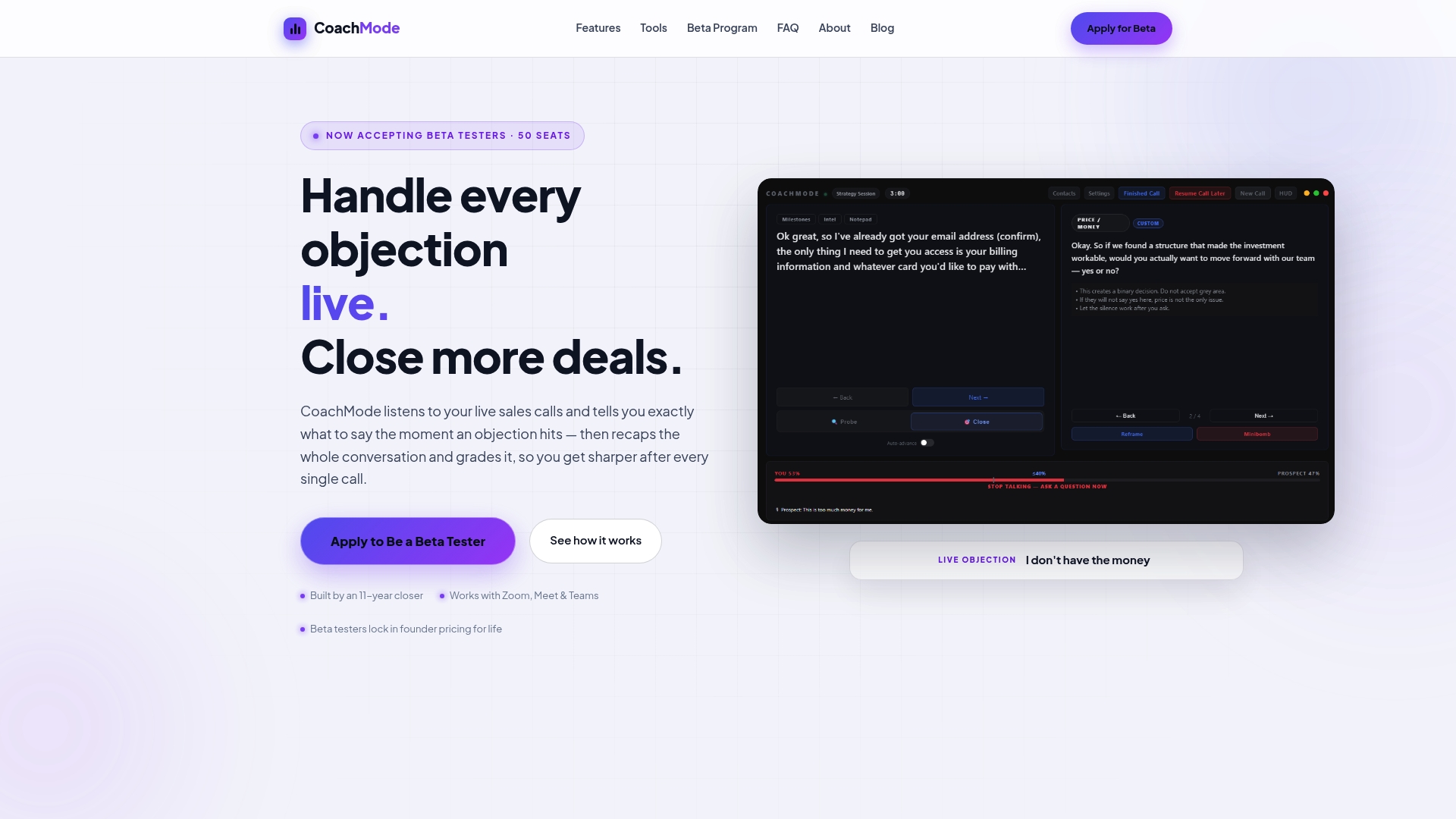
This fits best for high-ticket closers, sales managers running teams they can’t shadow on every call, and agencies scaling coaching impact across reps faster than a 1:1 calendar allows. It runs inside Zoom, Google Meet, and Teams, so there’s no new platform to learn, just support that shows up exactly when a deal is on the line. If your team handles objection handling on live calls regularly, that’s the clearest sign this belongs in your stack.
If you’re running a sales team and want to see what real-time coaching looks like on an actual call, start with the AI sales coach overview and get a look at how the scoring and prompts work before your next live call.
Sources
- Artificial intelligence vs. human coaches: examining the development of working alliance in a single session
- Comparing artificial intelligence and human coaching goal attainment efficacy
- Does AI Coaching Work? What The Evidence Shows