Train three moves. Pause two to three seconds before you respond, cap yourself at 90 seconds of straight talking, and track your ratio weekly. Discovery calls run best when sellers talk about 43% of the time and buyers carry the rest. Set a timer for your next call right now and pick one drill: the pause. That single habit, practiced deliberately, moves the ratio faster than any script rewrite.
TL;DR:
- Maintaining a seller talk time of around 43% on discovery calls, with buyers speaking 57%, is linked to higher win rates across industries.
- Monologues exceeding two to three minutes or seller talk surpassing 65% of the call typically lead to deal losses.
- Implementing a three-second pause after each buyer response and capping seller talk at 90 seconds improves conversation flow and prospect engagement.
- A structured 30/60/90 training program focused on visibility, peer review, and pressure testing can help teams sustain talk-time habits.
- Real-time AI coaching tools that monitor talk ratios and provide immediate prompts have shown to increase win rates and shorten coaching cycles.
Table of Contents
- Why Talk Time Matters More Than Most Reps Think
- How to Reduce Talk Time on Live Sales Calls
- Building a 30/60/90 Program to Cut Team Talk Time
- Measuring Talk Time Without Guessing
- Why Real-Time Coaching Speeds Up the Habit Change
- When the Buyer Won’t Stop Talking
- Scripts That Build in Brevity by Design
- Getting Buyers to Talk More Without Pushing
- Staying Warm While Talking Less
- What Happens When You Actually Track This for a Week
- Let Getcoachmode handle the In-Call Moment
- Sources
Why Talk Time Matters More Than Most Reps Think
The benchmark comes from conversation-intelligence analyses that track thousands of recorded calls: top performers speak roughly 43% of the time on discovery calls, buyers speak the other 57%, and that split shows up repeatedly across industries and deal sizes, according to Gong’s research on talk-to-listen ratios. Most guides frame the healthy range as 40 to 50% seller talk, with 43% as the sweet spot top reps hit most often.
The cost of ignoring this isn’t abstract. Excessive seller talk correlates directly with lower win rates, and the same research shows monologues stretching past roughly 90 seconds, or seller talk climbing above 65% of the call, tend to precede a loss. Talking less isn’t automatically better, though. A rep who barely speaks fails to guide the call, skips qualifying questions, and leaves buyers unsure what happens next. The goal is a working range, not a race to zero.
Before you touch a script, run a quick audit on three recent recordings:
- Time your longest uninterrupted monologue in each call.
- Count how many questions were open versus closed.
- Note how many times the buyer’s answer led to a follow-up question versus a pivot to your next talking point.
Most reps discover their longest monologue runs two to three minutes, double the recommended cap, and that single number usually explains more about a stalled deal than anything in the pitch itself.
How to Reduce Talk Time on Live Sales Calls
Cutting airtime isn’t about talking faster or memorizing a shorter pitch. It’s about installing specific, repeatable behaviors you can practice before your next call and measure after it.
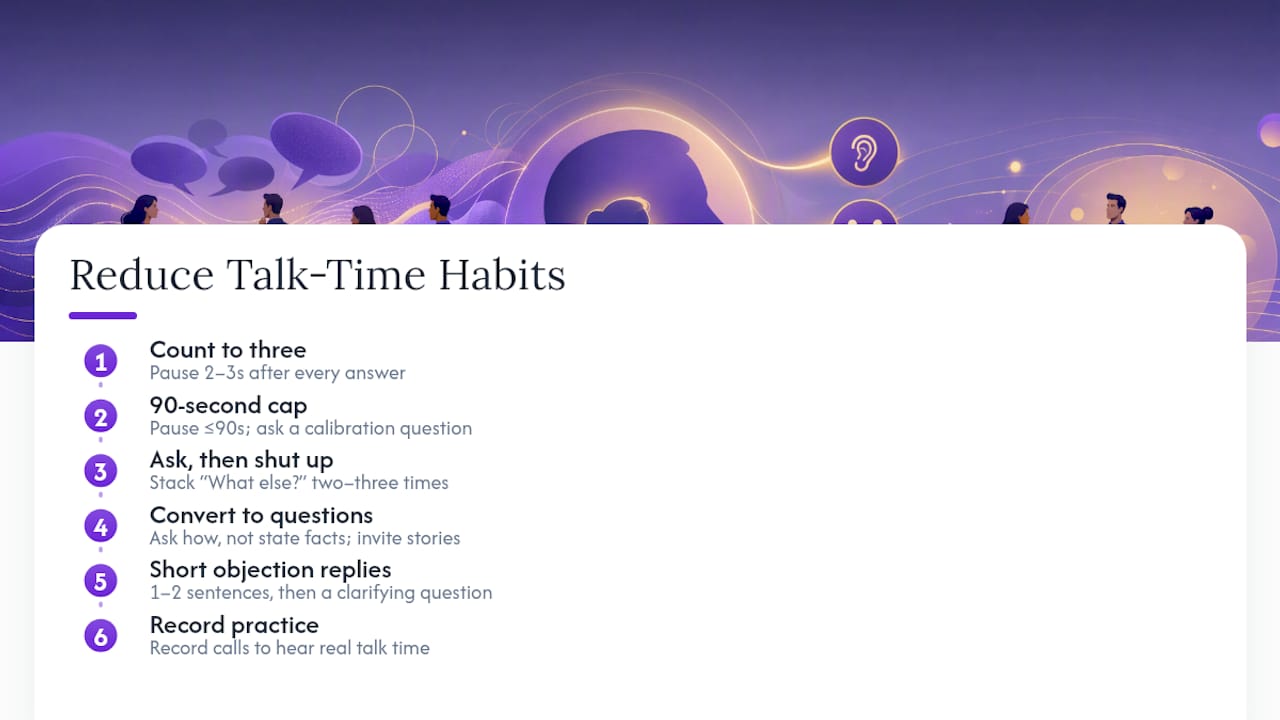
1. Count to three after every buyer answer.
Silence feels longer to the person who just stopped talking than to the one waiting to respond. That two- to three-second gap, sometimes called the five-count rule, prevents the reflexive interruption that kills elaboration, and it frequently prompts the buyer to keep going and reveal something you didn’t ask for directly, according to The Sales Hunter’s guidance on the pause. Reps who are uncomfortable with silence tend to rescue it by talking, which trains buyers to give short answers and stop. Desensitizing to that discomfort is a skill, not a personality trait, and it comes from repetition, not willpower.
2. Set a personal 90-second ceiling.
Never run longer than 90 seconds without pausing to ask a calibration question like “Does that match what you’re seeing?” or “How does that compare to what you’ve tried?” Long seller monologues are one of the clearest predictors of a stalled deal, and the 90-second checkpoint forces you to confirm the buyer is still with you instead of assuming it, a pattern conversation-intelligence data backs up directly.
3. Build the “ask, then shut up” habit with layered follow-ups.
Ask an open question, then resist filling the silence with your own commentary. When the buyer finishes, ask “What else?” before moving to your next point. That one phrase, stacked two or three times in a row, pulls out details buyers wouldn’t have volunteered on the first pass. Sales discovery questions built around this stacking pattern consistently surface more usable information than single-shot questions.
4. Convert statements into questions.
Instead of “Most companies in your space struggle with onboarding speed,” try “How’s onboarding speed working for your team right now?” The first version invites a nod. The second invites a story, and stories carry the objections and buying signals you actually need.
5. Keep objection responses short and redirect with a question.
When a buyer raises a concern, resist the urge to explain your way out of it in three paragraphs. Answer in one or two sentences, then ask a clarifying question: “Is that the main thing holding you back, or is there something else in play?” Short replies that flip back to the buyer keep the conversation moving instead of turning into a monologue defending your product.
Pro Tip: Record yourself practicing the 90-second cap on a call where you already know the material cold. Reps consistently underestimate their own talk time until they hear it played back, and the surprise is usually the fastest way to make the habit stick.
Practicing active listening with a built-in pause before your next call takes fifteen minutes and changes how the whole conversation flows.
Building a 30/60/90 Program to Cut Team Talk Time
Individual willpower doesn’t survive quota pressure. A structured 30/60/90 program does, because it makes the behavior visible and measurable instead of aspirational.
Days 1 through 30 focus on visibility. Pull three recent recordings per rep, calculate a baseline talk ratio, and identify each rep’s longest monologue. Install one behavior team-wide: the three-second pause. Don’t add more than one drill in month one. Coaching to a single visible behavior beats coaching to a vague instruction like “listen more,” according to Pulse RevOps’s coaching framework.
Days 31 through 60 layer in question stacks and peer review. Reps practice the “what else?” follow-up in role-play pairs, then apply it live. Managers start tracking a second metric: follow-up depth, meaning how many times a rep asks a second question on the same topic before moving on.
Days 61 through 90 stress-test the habits on hard calls, the ones with skeptical or talkative buyers where old patterns resurface fastest. This is where you check whether the pause and the 90-second cap survive pressure, not just easy calls. Compare win rates from this cohort against the prior quarter.
Weekly structure matters as much as the calendar. Run GROW-model one-on-ones, do live role-play with a stopwatch, review one call per rep per week, and post scorecards publicly so reps can see where they land against the team.
| Phase | Core focus | What you measure |
|---|---|---|
| Days 1 to 30 | Baseline and the pause | Talk ratio, longest monologue |
| Days 31 to 60 | Question stacks, peer review | Follow-up depth, open vs. closed mix |
| Days 61 to 90 | Pressure testing | Win-rate movement, ratio under hard calls |
Training that sticks tends to share one trait: it turns into a habit reps practice weekly, not a workshop they attend once, a point echoed in Middy Matthews’s work on sales training that lasts.
Measuring Talk Time Without Guessing
You don’t need software to start. Pull up a call recording, timestamp every speaker change, add up total seconds each person spoke, and divide your talk time by the call length. Do this for three calls and you already have a baseline more accurate than gut feel, a manual method detailed step by step by Numi.
Conversation-intelligence platforms automate this and add signals manual review misses:
- Talk ratio trended across weeks, not just single calls.
- Longest continuous monologue per call.
- Open-versus-closed question ratio.
- Where in the call the seller’s longest talking stretch happened.
The gap most teams miss is timing. Post-call dashboards tell you what already went wrong. They can’t stop a rep from running a three-minute monologue while it’s happening. Real-time prompts during the call itself close that gap, because they intervene at the moment the habit forms instead of a day later in a review meeting, which is part of why in-the-moment coaching tends to shorten the timeline for behavior change compared to review-only feedback.
Why Real-Time Coaching Speeds Up the Habit Change
Reading about the pause and actually holding it under live pressure are different skills. That gap is where most talk-time coaching stalls, because reps revert the moment a buyer pushes back or goes quiet in a way that feels uncomfortable.
Getcoachmode’s approach maps directly onto the drills above instead of replacing them:
- Live objection prompts surface a short response in the moment, so reps don’t fill silence with a rambling defense.
- Talk-ratio feedback shows where you land during the call, not two days later in a dashboard.
- Post-call scoring grades pause usage, monologue length, and question quality so the 30/60/90 program has real numbers to review weekly.
Reps using live sales call coaching report clearer control over objection moments and steadier pacing, because the tool listens alongside them and offers the right next move instead of leaving them to freeze or over-explain.
A sensible pilot: baseline ten calls per rep, run a 30-day pilot with weekly review against the metrics above, then decide whether to expand based on whether the ratio and win rate actually moved.
When the Buyer Won’t Stop Talking
Talkative buyers create a different problem: the rep goes quiet out of politeness, the call drifts, and nothing gets qualified. Reducing your own talk time doesn’t mean losing control of the conversation.
The fix is a soft interrupt that redirects without cutting the buyer off mid-thought. Wait for a natural breath, then use a bridge like “That’s helpful, and it connects to something I want to ask you about” before steering back to your agenda. This works because it acknowledges what they said instead of ignoring it, which is what makes an interruption feel rude in the first place.
Set the agenda out loud at the start of the call. “I’ve got three things I want to cover in the next 25 minutes, starting with your current process” gives you a structural excuse to redirect later. When a buyer wanders, you can say “I want to make sure we get to the budget piece before we run out of time,” which sounds like time management, not impatience.
Watch for the difference between a buyer elaborating on something relevant and a buyer venting about something unrelated to the deal. The first deserves your full silence and a follow-up question. The second deserves a brief acknowledgment and a redirect: “That sounds frustrating. Let’s come back to it if we have time. First I want to understand…”
Reps who struggle here usually share one trait: they treat every pause as their turn to talk again. Practicing silence as a deliberate skill instead of a gap to fill makes redirects land as natural pacing rather than interruption.
Scripts That Build in Brevity by Design
Most call frameworks fail at talk-time reduction because they’re built around what the rep says, not around forcing the buyer to respond. A script that promotes brevity looks different structurally: every section ends in a question, not a statement.
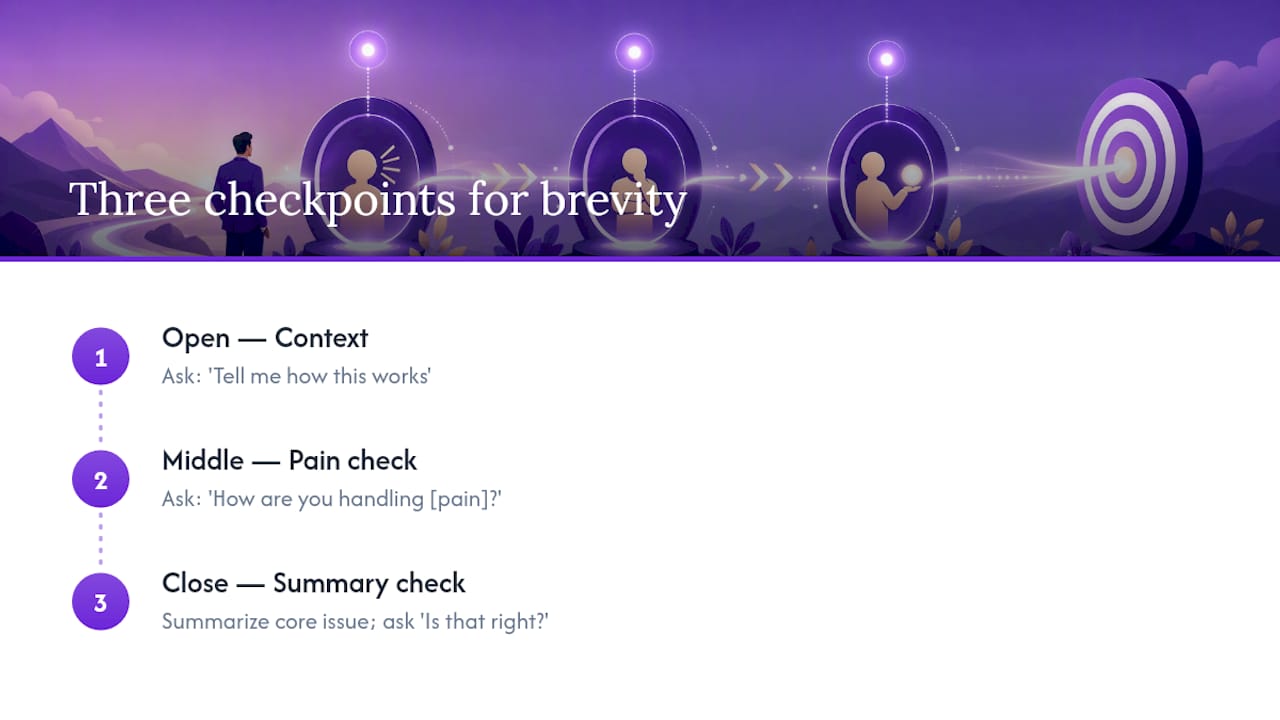
Take a standard discovery framework and restructure it around three checkpoints instead of a monologue. Open with context (“Tell me about how this process works today”) rather than an explanation of your product. Middle-of-call transitions should sound like “Given what you just told me, how are you handling [specific pain point] now?” rather than a pivot into feature explanation. Closing the discovery phase means summarizing in one sentence and checking it: “So the core issue is X, is that right?”
The SPIN framework (Situation, Problem, Implication, Need-payoff) works well here because every stage is phrased as a question by design, not a talking point. Reps who script their calls as a list of things to say almost always overshoot their talk time, because a statement invites another statement in response, while a question invites an answer.
Build your script with hard stops. After every third line of the script, insert a literal note: “STOP. Ask a question here.” That visual cue matters more than it sounds. Reps drafting scripts alone tend to write persuasive paragraphs, then read them out loud on the call exactly as written. A script with built-in stop points breaks that pattern before it starts, and it turns brevity into the default instead of something you have to remember under pressure.
Getting Buyers to Talk More Without Pushing
Buyers open up when they feel like they’re being understood, not interrogated. The psychology here is straightforward: people fill silence, and they elaborate when they sense genuine curiosity rather than a checklist being worked through.
Mirroring the buyer’s own language back to them, instead of paraphrasing into your terminology, signals that you’re actually listening rather than translating everything into your pitch. If a buyer says their team is “drowning in manual reporting,” repeat “drowning in manual reporting” back rather than reframing it as “inefficient data processes.” The specific phrase they chose usually carries more emotional weight than the neutral version, and echoing it invites them to keep going in their own words.
Labeling emotion works the same way a good therapist uses it: “It sounds like that’s been a real source of frustration for your team” often produces more detail than a direct follow-up question would, because it invites the buyer to confirm or correct you rather than answer a pointed question. That subtle shift from asking to reflecting lowers the pressure buyers feel to give a “correct” answer.
Silence itself is the most underused tactic here. Most reps read a pause as awkward. Buyers read it as an invitation, provided the rep isn’t visibly rushing to fill it. Combine that with genuinely curious follow-ups like “What made that a priority now versus six months ago?” and you get elaboration that no closed question could extract, without the buyer ever feeling pushed.
Staying Warm While Talking Less
Cutting talk time without losing rapport is the actual skill here, not the ratio itself. Reps who over-correct toward silence often come across as cold or checked out, which damages trust just as much as over-talking does.
Empathy and brevity aren’t opposites. A short, well-placed acknowledgment, “That makes sense, especially given your timeline,” takes four seconds and signals you’re tracking the conversation without adding a paragraph of commentary. The mistake reps make is confusing warmth with word count, when the two aren’t actually connected.
Tone carries more of the rapport-building weight than most reps assume. A rep who speaks less but sounds genuinely engaged, curious, and present will feel warmer to a buyer than a rep who fills every gap with reassurance and small talk. Buyers pick up on real attention faster than they pick up on volume.
The practical test: after a call, ask whether the buyer did most of the talking and whether they’d still describe the conversation as comfortable. If both are true, you’ve found the balance. If the buyer talked less and the call still felt cold, the problem isn’t your talk time, it’s your tone during the silences you did use. That distinction is worth diagnosing separately, because fixing the wrong one wastes a coaching cycle.
What Happens When You Actually Track This for a Week
Try this on your own calls before asking a team to do it: enforce the 90-second cap and the five-count pause on every call for one week, and time your longest monologue on the first and last day.
The pattern shows up almost immediately. The first day feels unnatural, the pauses feel long, and there’s a strong pull to fill silence the moment it appears. By day three or four, the discomfort fades, and something more useful happens: buyers start saying more without being asked a follow-up question, simply because the silence gave them room.
Watch two numbers by the end of the week. Longest monologue should drop noticeably from wherever it started, often from two or three minutes down closer to 60 to 90 seconds. Overall talk ratio should trend toward that 40 to 50% range instead of sitting well above it.
Success in week one isn’t a closed deal. It’s a measurable shift in your own numbers and a call that felt less like a pitch and more like a conversation you didn’t have to control every second of.
— Ryan
Let Getcoachmode handle the In-Call Moment
Drills work best when you have backup in the moment they’re hardest to hold, like mid-objection when the instinct to over-explain kicks in. Some AI sales coaching tools listen to your live call and surface short, specific responses right when an objection lands, instead of leaving you to freeze, ramble, or fall back on a long defense you’ll regret in the recording.
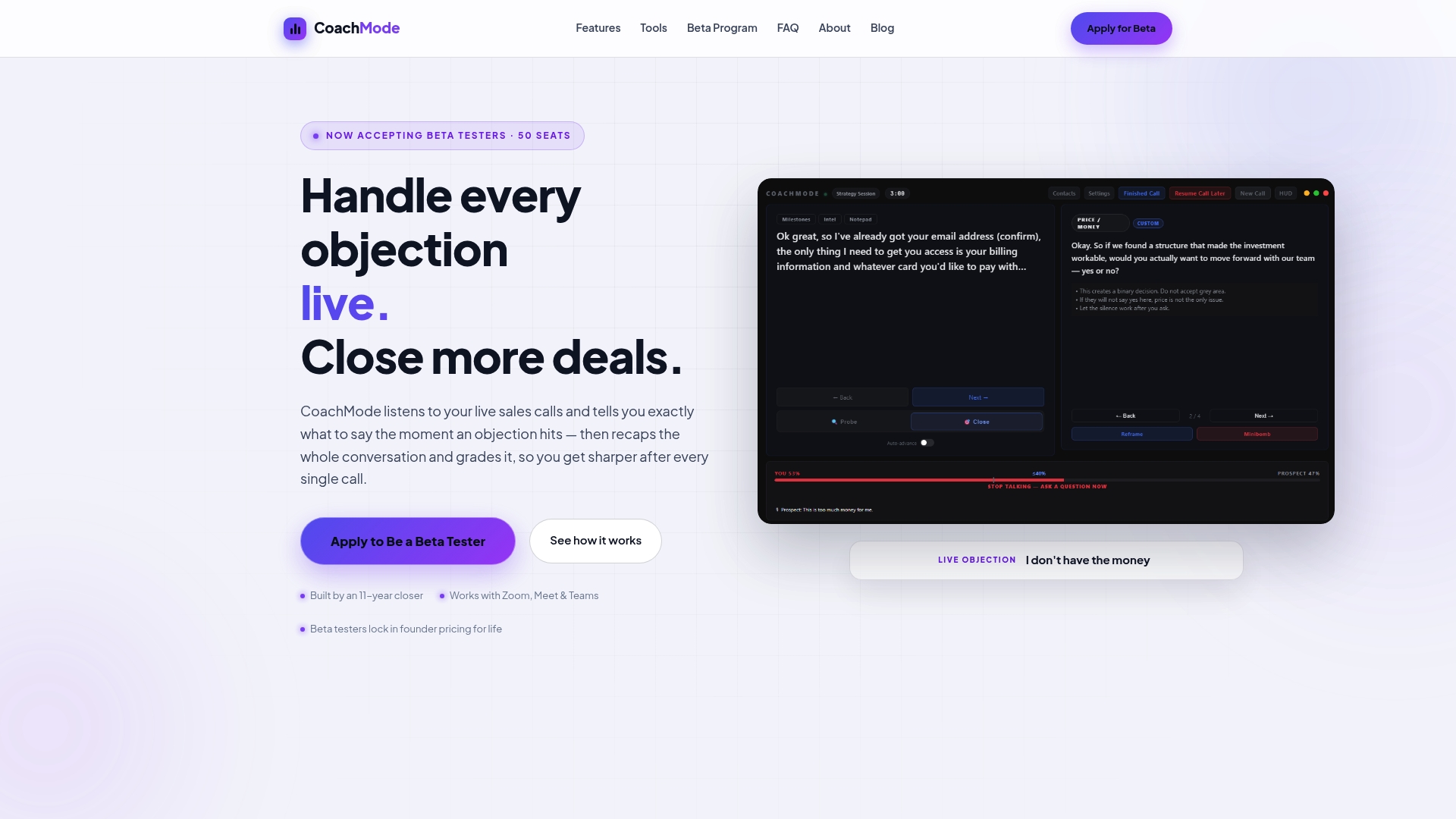
Some platforms track your talk ratio in real time and grade the call afterward, so coaching programs like the 30/60/90 program have actual numbers instead of guesswork. That combination, live prompts plus post-call scoring, is built for reps and managers running high-ticket discovery calls who need the habit to hold under pressure, not just in practice. Teams already report meaningful win-rate lift and hours saved per week once objection handling stops eating into prep and follow-up time.
If you run high-ticket sales calls and want the pause, the 90-second cap, and the ratio tracking backed by a tool that works while you’re on the call, start with AI sales coaching for live sales calls and set up a baseline call this week.
Sources
- Mastering the talk-to-listen ratio in sales calls — Gong blog
- How do you coach a rep to talk less and listen more on calls? — Pulse RevOps knowledge base
- How a simple pause can save a sales call — The Sales Hunter
- Ideal talk-to-listen ratio on sales calls — Vozah blog